Scientists Open Million-Year-Old Time Capsule, Find Ancient Bird Drama
A cave in New Zealand yields fossils from 1 million years ago, revealing a lost ecosystem and an ancient relative of the kākāpō that might have actually been able to fly.
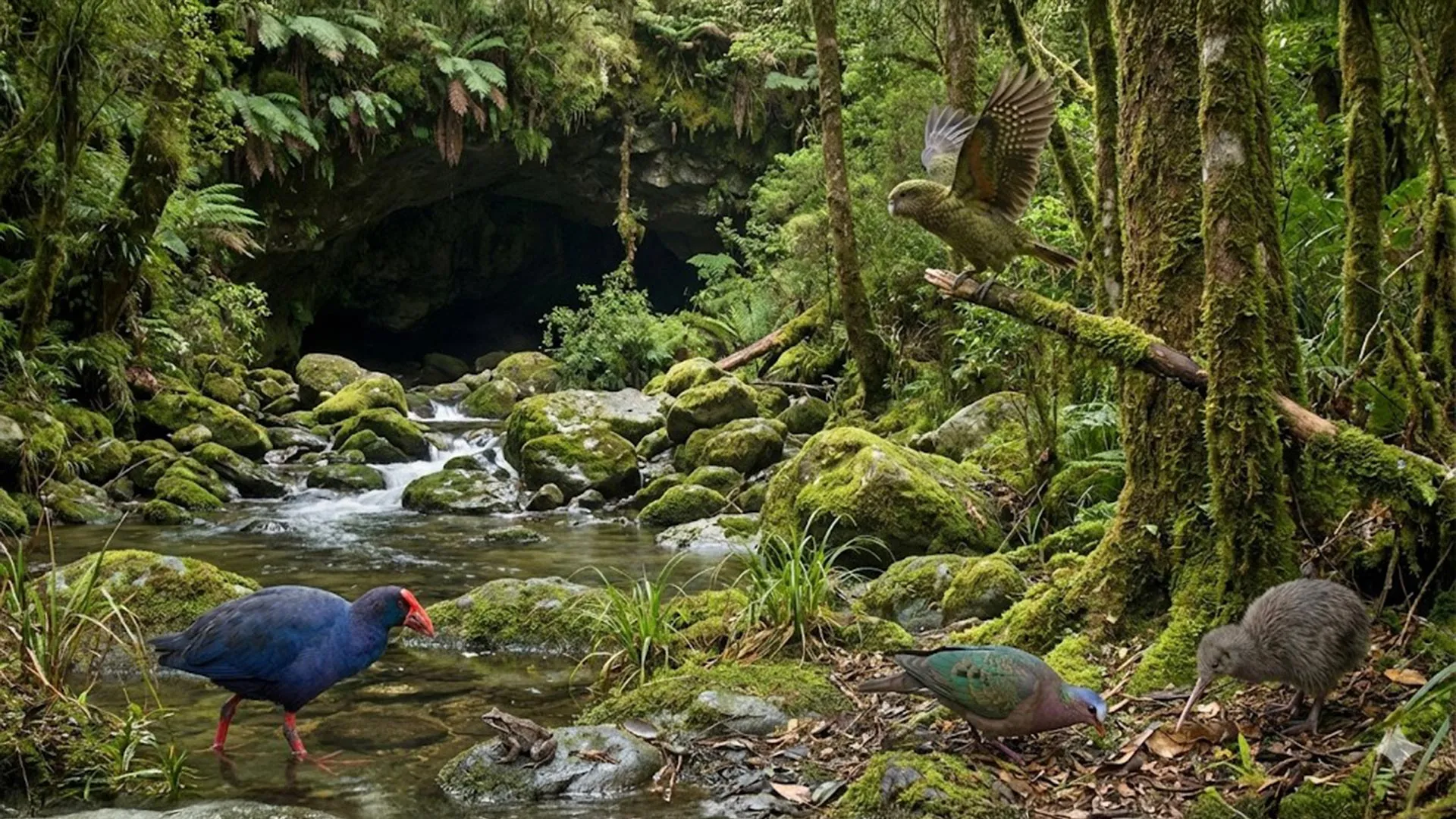
A cave near Waitomo, New Zealand, has yielded a fossil trove that gives scientists an unprecedented peek at a long-vanished ecosystem - basically, a million-year-old episode of "Survivor: Prehistoric New Zealand." Researchers from Australia and New Zealand uncovered remains of ancient birds and frogs dating back about 1 million years, including a previously unknown relative of the iconic kākāpō. This is the first time scientists have recovered a large collection of terrestrial vertebrate fossils from this period in New Zealand's history. The cave preserved fossils from 12 bird species and four frog species, offering a rare snapshot of a world that existed hundreds of thousands of years before humans showed up.
Published in Alcheringa: An Australasian Journal of Palaeontology, the study suggests New Zealand's wildlife was already undergoing dramatic changes long before human settlement. Powerful volcanic eruptions and rapid climate shifts repeatedly reshaped habitats, driving extinctions and opening opportunities for new species to evolve. Lead author Associate Professor Trevor Worthy of Flinders University says the fossils reveal a bird community unlike anything seen in New Zealand today. "This is a newly recognized avifauna for New Zealand, one that was replaced by the one humans encountered a million years later," says Worthy. In case you're not up on your biology jargon, "avifauna" just means the collection of bird species in a particular place and time.
The study involved paleontologists from Flinders University and Canterbury Museum, plus volcanologists Joel Baker (University of Auckland) and Simon Barker (Victoria University of Wellington). According to the researchers, approximately 33-50% of species disappeared during the million years before humans reached Aotearoa New Zealand. Why? Mostly volcanoes and climate change - nature's original wrecking crew. "These extinctions were driven by relatively rapid climate shifts and cataclysmic volcanic eruptions," says co-author Dr. Paul Scofield, Senior Curator of Natural History at Canterbury Museum.
The discovery fills one of the largest gaps in New Zealand's fossil record. "From our excavations at St Bathans in Central Otago over many years, we have a snapshot of life in Aotearoa between 20 and 16 million years ago. These new findings cast light on the 15 million year period from then to 1 million years ago, which is largely absent from New Zealand's fossil record," says Scofield. "This wasn't a missing chapter in New Zealand's ancient history, it was a missing volume."
One of the most exciting finds is a newly identified parrot species called Strigops insulaborealis, an ancient relative of the kākāpō - the world's only flightless parrot and one heavy, nocturnal bird. But this ancestor may have been different: analysis of the fossilized bones suggests it had weaker legs than modern kākāpō, so it may have spent less time climbing and possibly retained the ability to fly. (Additional research is needed to confirm whether it could actually take to the air.) The cave also contained fossils from an extinct ancestor of the takahē and an extinct pigeon species closely related to Australia's bronzewing pigeons.
The shifting habitats forced a reset of bird populations, says Scofield, likely driving evolutionary diversification. The fossils' age is unusually precise because they were trapped between two layers of volcanic ash: one from an eruption about 1.55 million years ago, the other from a massive eruption about 1 million years ago. That younger eruption likely covered much of the North Island in meters of ash. Some ash remained protected inside caves, making this site the oldest known cave on New Zealand's North Island.
Associate Professor Worthy says the fossils provide a crucial benchmark for understanding how New Zealand's wildlife evolved. For decades, scientists focused primarily on the ecological changes after humans arrived roughly 750 years ago. But this study proves that natural forces like super-volcanoes and dramatic climate shifts were already sculpting the unique identity of New Zealand's wildlife over a million years ago. So, next time you think humans are the only ones messing things up, remember: nature was doing it first.
The Good Times
News in your inbox.
One sardonic roundup, delivered on your schedule. Free. Unsubscribe whenever your tolerance for wit runs out.
Already subscribed but we never reach your inbox? Check your spam folder and hit 'Not spam' (or 'Remove from spam') to bust us out of junk-mail purgatory. You'll be helping everyone else too.
Don't open any of our emails for a month and you'll be automatically removed from the mailing list.
Rewrite Article
Select parts to regenerate with a fresh AI pass. Translations will be updated automatically.
Generate AI Image
Creates a sardonic version of the article image using OpenAI.