Scientists Finally Look Inside 30-Year-Old Rock, Find Ancient Sea Monster Bones That Were There the Whole Time
Ancient sea monster bones, hidden in a rock for 30 years, finally get their moment in the spotlight - because nothing says 'new species' like a horny skull bone.
In a stunning display of 'we should have checked that earlier,' researchers from Okayama University of Science, Tokyo City University, the Natural History Museum, and Kishiwada City (Osaka Prefecture) have unearthed four fossil bones that had been hiding in plain sight for roughly three decades. The bones were found inside rock containing mosasaur remains collected in Kishiwada City, Osaka Prefecture.
The star of the show is a premaxilla - the bone at the very front of the upper jaw - marking the first time such a bone has been confirmed in a mosasaur fossil discovered in Japan. Because of course, the first one would be hiding in a drawer. Other odd anatomical features don't match any previously described mosasaurs, suggesting this creature could be a species new to science.
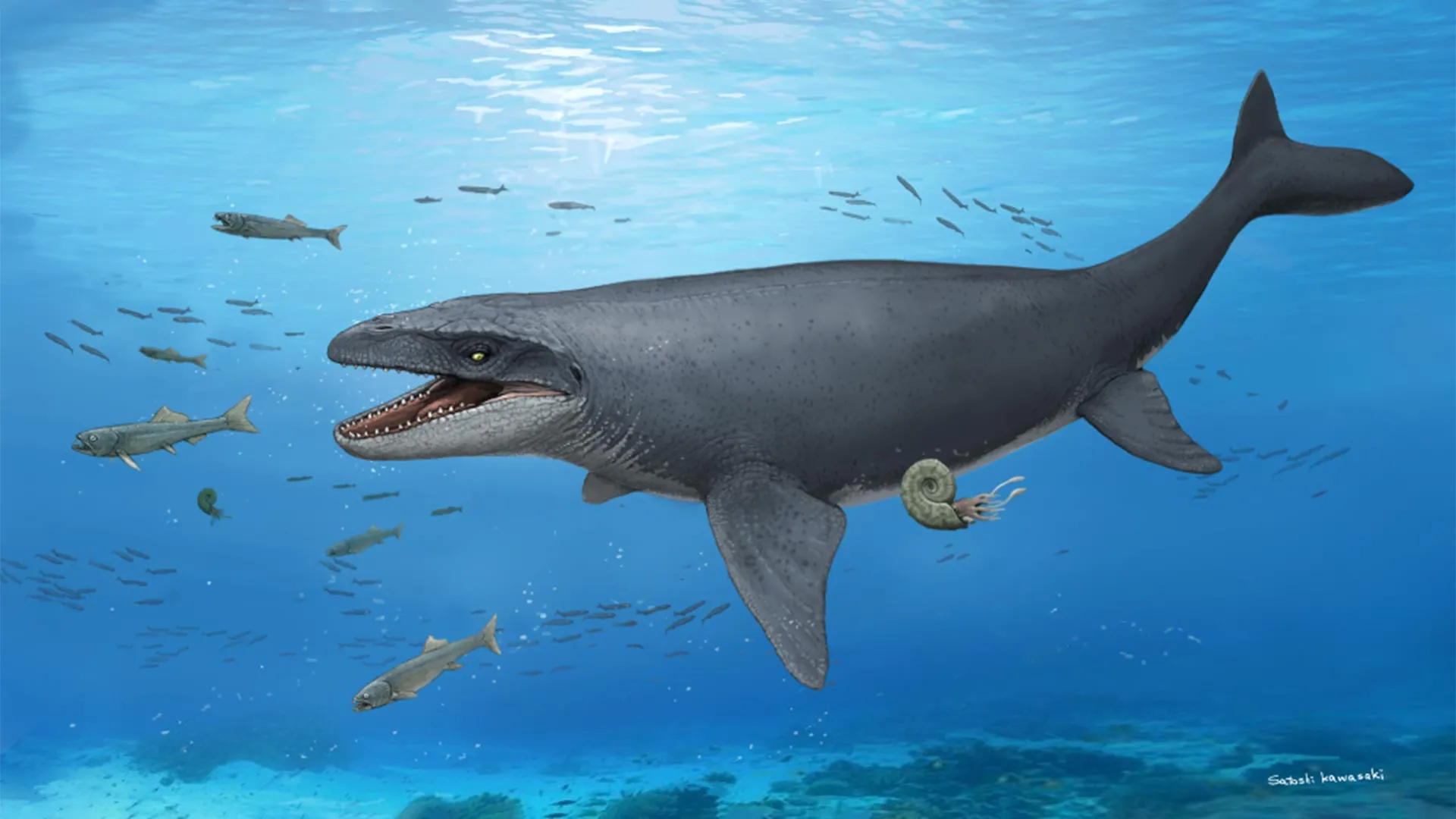
Mosasaurs, for the uninitiated, were large marine reptiles that cruised the world's oceans during the Late Cretaceous, roughly 98 to 66 million years ago. Think of them as the ocean's answer to Godzilla, but with better dental hygiene.
The fossils were originally discovered between 1990 and 1992 in Sobura, Kaizuka City, Osaka Prefecture, and later preserved at the Natural History Museum, Kishiwada City. When researchers recently decided to poke around in unprepared rock pieces, they found four fossil bones still embedded in the surrounding material. It's like finding money in an old coat pocket, except the money is a 66-million-year-old reptile skull part.
The premaxilla is a big deal because it's the first confirmed example of this skull bone in a Japanese mosasaur. Back in the '90s, scientists had fewer mosasaur specimens to compare, so they couldn't tell what they had. Now, with decades of accumulated anatomical knowledge, they've finally figured it out. Better late than never, right?
Researchers also examined the basisphenoid, a bone near the braincase, and found some distinctive features: short, horn-like projections sticking out and no ventral median groove. These traits don't match any known mosasaurs, which is scientific speak for 'we might have a new species on our hands.'
The findings highlight the value of revisiting unprepared museum specimens. Fossils stored for decades can still yield important discoveries - proving that procrastination sometimes pays off. The discovery could also help paint a clearer picture of marine ecosystems in the northwestern Pacific during the Cretaceous. But whether this is truly a new species will require more research.
The results were presented at the 177th Annual Meeting of the Palaeontological Society of Japan, held at Osaka Metropolitan University on June 27, 2026. Materials provided by Okayama University of Science. Note: Content may be edited for style and length.
The Good Times
News in your inbox.
One sardonic roundup, delivered on your schedule. Free. Unsubscribe whenever your tolerance for wit runs out.
Already subscribed but we never reach your inbox? Check your spam folder and hit 'Not spam' (or 'Remove from spam') to bust us out of junk-mail purgatory. You'll be helping everyone else too.
Don't open any of our emails for a month and you'll be automatically removed from the mailing list.
Rewrite Article
Select parts to regenerate with a fresh AI pass. Translations will be updated automatically.
Generate AI Image
Creates a sardonic version of the article image using OpenAI.