
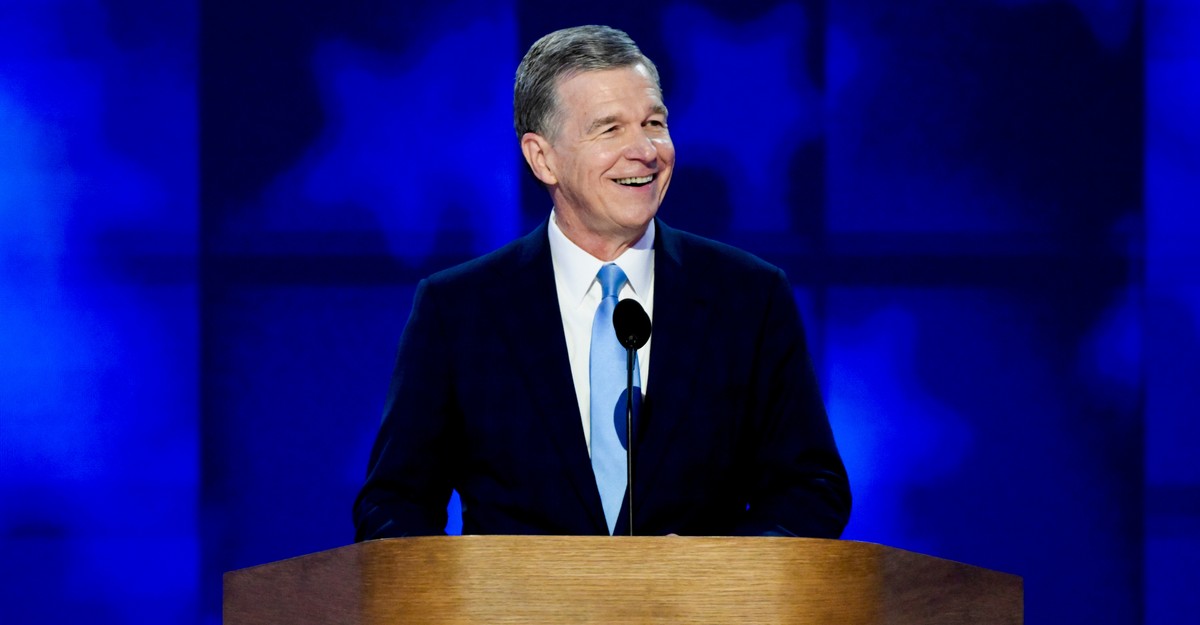
In the grand tradition of political thrillers, North Carolina's Senate race was supposed to be a barnburner. Thom Tillis, the Republican incumbent, decided to hang up his spurs. Donald Trump, never one to miss a casting call, recruited Michael Whatley, the former RNC chair, to fill the void. Democrats, desperate for a competitive race in a state Trump has won three times and where no Democrat has taken a Senate seat since 2008, pinned their hopes on Roy Cooper, the former two-term governor. It was the political equivalent of a Hail Mary pass.
Fast forward to today, and the race has all the excitement of a C-SPAN marathon. Whatley, a political rookie, can't seem to get traction, and Cooper has morphed from underdog to odds-on favorite. Cooper's camp isn't cracking open the champagne just yet. "This is going to be a two-to-three-point race at the end of the day," his longtime strategist, Morgan Jackson, told me. "We know that it's a 50 - 50 state and you win or lose on the margins." But most forecasters are leaning toward a Cooper victory, which in political terms is about as close to a sure thing as you can get without actually being one.
In an era when the Democratic Party is having an identity crisis louder than a teenager's angst-ridden playlist, Cooper's purple-state success has become the political equivalent of a comfort blanket. National press coverage has hailed his campaign as "boring" (complimentary) and "normal." That lack of drama is a relief for a party that's seen more than its share of chaos, from Abdul el-Sayed's controversial stands in Michigan to Graham Platner's personal scandals in Maine. And unlike Texas's James Talarico, Cooper hasn't given Republicans any easy "weird" labels to stick on him.
It's tempting for Democrats to want to bottle whatever Cooper's having, but I'm skeptical that his success offers any simple, transportable lessons. That's not to say the "boring" and "normal" labels are wrong. When I asked Jackson point-blank if Cooper was boring, he didn't exactly deny it. "He's a workhorse; he's not a show horse," he said. "He's a steady hand. So voters don't see him out there as a lightning rod."
Cooper's first big asset is his long-standing relationship with North Carolina voters. He's been in statewide office since the waning days of the Clinton administration, a stretch that only ended in January 2025 after two terms as governor. That means any Republican candidate will have a hard time defining Cooper on their own terms - he's already a known quantity, like that one relative who always brings the same casserole to Thanksgiving.
This longevity is also a product of Cooper's cautiousness. Almost from the moment he became attorney general in 2001, he was expected to run for senator or governor. But he didn't actually do so until 2016, when he eked out a win over incumbent Republican Governor Pat McCrory by a little more than 10,000 votes. He waited to jump into the Senate race until shortly after Tillis's retirement announcement, which likely scared off more formidable Republicans than Whatley. He also picked an extremely favorable cycle for Democrats nationally. Talk about playing the long game.
Cooper's caution and affability shouldn't be mistaken for softness. Chris Cooper, a political scientist at Western Carolina University (no relation, apparently), jokes that Roy Cooper is like Mister Rogers, if Mister Rogers carried a switchblade. Andrew Dunn, a North Carolina writer and Republican operative, is less complimentary. "Roy Cooper has carefully cultivated a public persona as your friendly, easygoing grandpa who wears sweaters and talks quietly," he told me. "That is far from his private persona. He is incredibly opportunistic and calculating." In other words, he's a politician. Shocking.
As governor, Cooper used a range of tricks to push his agenda. He waged a war of attrition against the Republican-controlled state legislature over Medicaid expansion under the Affordable Care Act. GOP leaders started out dead set against it, but Cooper finally got the expansion passed in 2023, his penultimate year in office. He also wielded his veto more frequently than any past governor. (Fun fact: North Carolina was the last state in the union to give its governor veto power, doing so in 1997 via legislation championed by a young state senator named Roy Cooper - yes, that Roy Cooper.)
After Republicans overrode some of Cooper's vetoes, he led a push to break their supermajority and backed a successful primary challenge to a Democratic lawmaker who'd sometimes voted with the GOP. When Cooper was replaced in 2025 by his fellow Democrat Josh Stein, Raleigh Republicans professed relief at being able to deal with someone they viewed as more agreeable (or, as a cynic might say, whom they thought they could more easily outflank).
Contending with a unified Republican general assembly constrained Cooper on policy, but it may have also benefited him politically. Because Democrats have spent the past 15 years desperately trying to stave off conservative legislation, the party has had little room for internecine warfare. As a result, Cooper has sidestepped the kinds of battles that might have gotten him pigeonholed as a liberal or a moderate. (The only Republican governor in that stretch, meanwhile, lasted only one term, sunk in part by battles with GOP lawmakers - a cautionary tale if ever there was one.)
Some conservatives also feel that Cooper gets a free pass from the press. This summer, Whatley's campaign barred journalists from mainstream and left-leaning outlets from events, while Cooper's campaign turned away staffers from two conservative outlets, but local coverage focused more heavily on Whatley. Funny how that works.
Dunn told me he still believes that Whatley could win. He takes some hope from a 1984 race, when popular former two-term Democratic Governor Jim Hunt ran against Senator Jesse Helms. "Helms spent millions upon millions of dollars trying to convince North Carolinians that they didn't really like Governor Hunt's record as governor," Dunn said. "It didn't work." Early polls showed Hunt well ahead, but in the last phase of the campaign, Helms emphasized national issues and won. To do something like this, Dunn contends, Whatley could argue that Cooper will be another vote for the Democratic agenda, no matter how nice people think he is.
But Helms also benefited from President Ronald Reagan's landslide victory in 1984; Whatley is a close ally of Trump, who is both not on the ballot and sinking in popularity. Jackson told me he believes that voters' opinions of Cooper are already set anyway. "People see him as a genuine guy," he said. "The reality is, Roy Cooper is as authentic as they come." One argument for his authenticity might be how hard he is for Democrats to replicate elsewhere. After all, you can't just manufacture a folksy, switchblade-carrying Mister Rogers in a lab.