
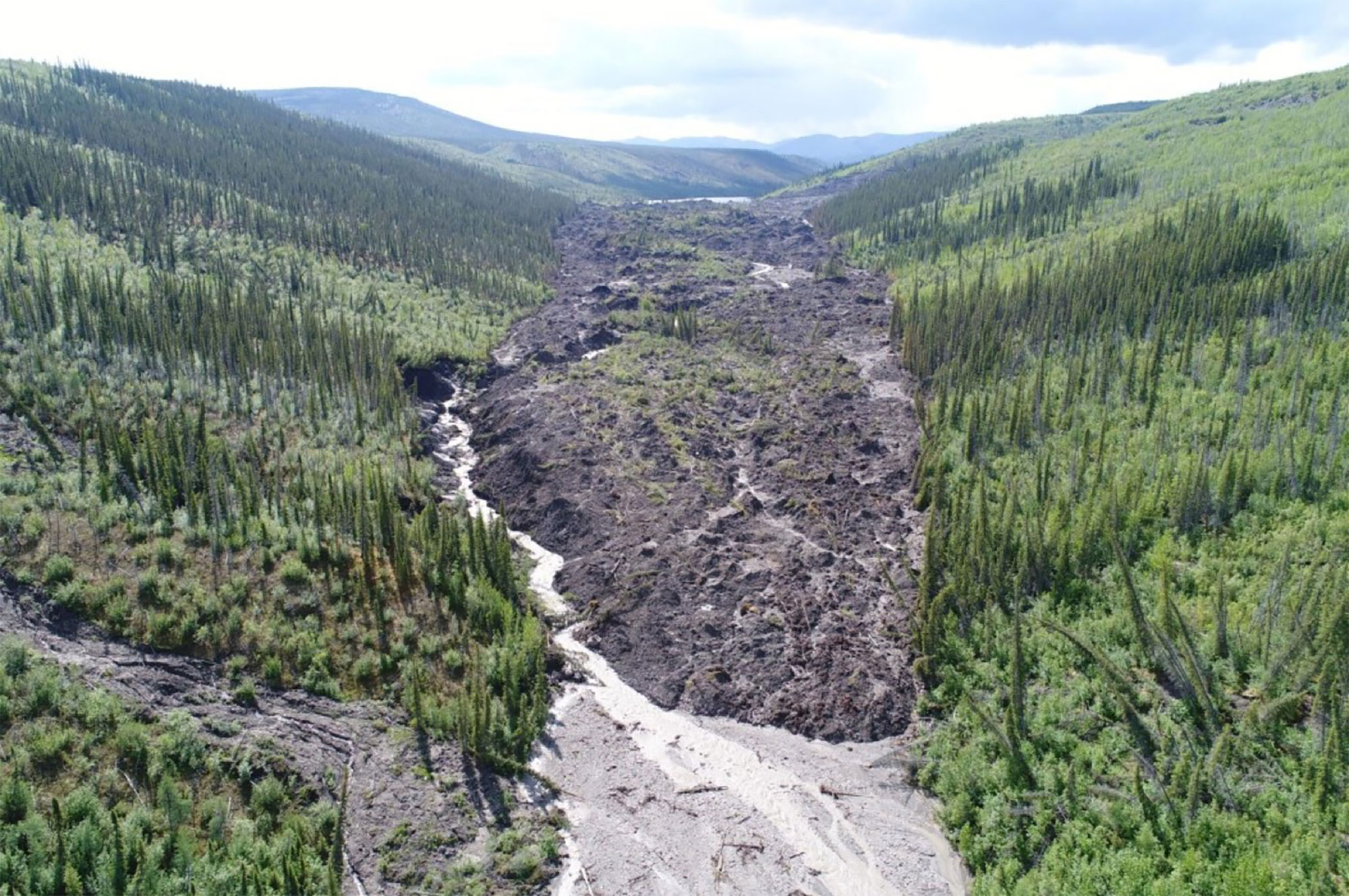
Nearly a decade ago, a helicopter pilot in Canada’s Northwest Territories spotted something that would make a geologist spit out their coffee: a landslide so massive it had dammed a river and birthed a new lake. But the real kicker wasn’t the impromptu water feature - it was that the slide was a phenomenon entirely new to science. Researchers have since dubbed it a “permafrost detachment slide,” which sounds like a move in a very niche video game but is, unfortunately, all too real.
In a recent paper, scientists describe two of these events in the region: one stretching for three-quarters of a mile, the other for 2 miles. Combined, they moved 30 million cubic yards of earth - enough to make a mountain feel inadequate. Unlike your garden-variety landslide, which sends rainwater, mud, and rock cascading down a hillside, permafrost detachments occur when frozen soils degrade and the land fails catastrophically. Even weirder: the two slides actually began three decades ago during a wildfire, which slowly transformed the permafrost until the land collapsed in a matter of hours or days along the Johnson River in 2017 and the Redstone River in 2018. It’s like a geological slow cooker that suddenly explodes.
When researchers visited the slides, they found them embedded with chunks of frozen material up to 650 feet long. “It’s a very dramatic manifestation of the changing climate,” said geoscientist Joseph Young, lead author of the paper, who conducted the research while at the University of Alberta. “They’ve only started happening in the last 10, 15 years, and it’s a very drastic and abrupt change in the landscape.” Dramatic indeed - like Mother Nature decided to redecorate with a wrecking ball.
Permafrost is a major planetary wild card. Simply put, it’s ground that remains frozen for two years or longer, containing ice, dead plants, dirt, rock, or sand. Across the Northern Hemisphere, permafrost zones cover an area two and a half times the size of the continental United States. With the Arctic warming four times faster than the rest of the planet, permafrost is now thawing so quickly that it’s gouging massive potholes in the landscape - a phenomenon known as thermokarst - and releasing clouds of greenhouse gas in the process. Think of it as the Earth getting stretch marks, but with more carbon emissions.
A similar thing is happening with permafrost detachment slides, only a single event is much, much bigger in scale. “I think it’s fascinating that we’re discovering a new type of thermokarst,” said David Olefeldt, a soil scientist at the University of Alberta, who studies permafrost but wasn’t involved in the new paper. “This is a type of land collapse due to permafrost thaw which hasn’t really been observed before.” Fascinating, yes - in the way a new species of shark is fascinating, but you’d rather not meet it in a dark alley.
The disturbance began in 1995, when a wildfire swept through the region. The flames burned off the vegetation that normally shaded the permafrost, keeping it cool during the sunny northern days of summer. The ground, then, lost a sort of thermal shield. “After about 20 years or so, that thermal signature from the burned forest can reach the base of permafrost,” Young said. “It’s slight, but it’s there.” Slight, like a tiny crack in a dam - until it isn’t.
The collapse of the permafrost, then, actually came from the bottom up through the mixture of soil, ice, and organic material that comprised it. As the base warmed - even slightly - tension cracks propagated. This created pools of relatively warm water at the surface, which further infiltrated the permafrost. As the mélange degraded, it slipped downhill at a rate of a handful of feet a year, increasing to perhaps 80 feet annually, before it all suddenly gave way as a detachment slide. “This kind of movement can create its own release of energy because of friction and cracking on the bottom,” said Vladimir E. Romanovsky, a permafrost geophysicist and professor emeritus at the University of Alaska Fairbanks, who wasn’t involved in the new research. Glaciers - vast sheets of ice creeping downhill - do this, too, suddenly surging and accelerating. So, essentially, the ground is learning to surf.
Because the researchers found those huge blocks of frozen material, they can tell that the permafrost eventually failed from below. That is, if they instead found a bunch of mud in the slide area, that might suggest that the ground degraded from above as the permafrost slowly thawed into mush. Instead, they got frozen chunks the size of school buses - a clear sign that the failure was a bottom-up job.
The tumult didn’t stop at the moment of collapse. So much material was displaced that it left walls of permafrost on either side of the slide, which were then exposed to the sun. “Just because you have this large detachment failure, that doesn’t mean it’s over,” Young said. “Actually, it means you’ve opened up more potential for failure.” In other words, the landslide is not a one-hit wonder; it’s a franchise.
The consequences could extend far beyond the Northwest Territories. As permafrost thaws, microbes begin feasting on the organic material within, expelling greenhouse gas as they digest it. This might be kicking off a feedback loop, in which warmer temperatures release more carbon, which leads to more warming and more carbon, and on and on. “That’s a major global concern,” said Miriam Jones, a research geologist who studies permafrost at the United States Geological Survey but wasn’t involved in this research. “It’s a feedback that many of us have been studying.” A feedback loop - the climate’s version of a pyramid scheme, except everyone loses.
At the same time, plants are quickly marching north at miles per decade, a phenomenon known as Arctic greening. In some areas, a rising number of shrubs trap snow, preventing the chill of winter from penetrating the underlying permafrost, thus hastening its decline. More plants also means more fuel for the wildfires that initiate permafrost detachment slides. As if that weren’t bad enough, northern wildfires tend to burn through peat, the carbon-rich material that accumulates in the ground over centuries. These “zombie fires” are so persistent that they can smolder underground even as snow falls above, popping up again during the spring thaw, releasing still more carbon into the atmosphere. Zombie fires - because regular fires weren’t apocalyptic enough.
Now the question is: How much more of that planet-warming gas might be spewing from permafrost detachment slides, as bacteria proliferate in the aftermath? “The short answer is: We don’t know how much, because we haven’t characterized and classified it,” Young said. “But it could be quite severe, just because the size of these features.” Severe - like a surprise party, but with more methane.
Indeed, previous research has found that much smaller instances of abrupt permafrost thaw could be producing significant carbon emissions. “I expect that we can see more of these types of surprises,” Olefeldt said, “as we cross thresholds in other regions that have these vulnerabilities to collapse.” Surprises - the kind that make you want to hide under the covers and never come out. But hey, at least we’re discovering new things. Silver lining?