
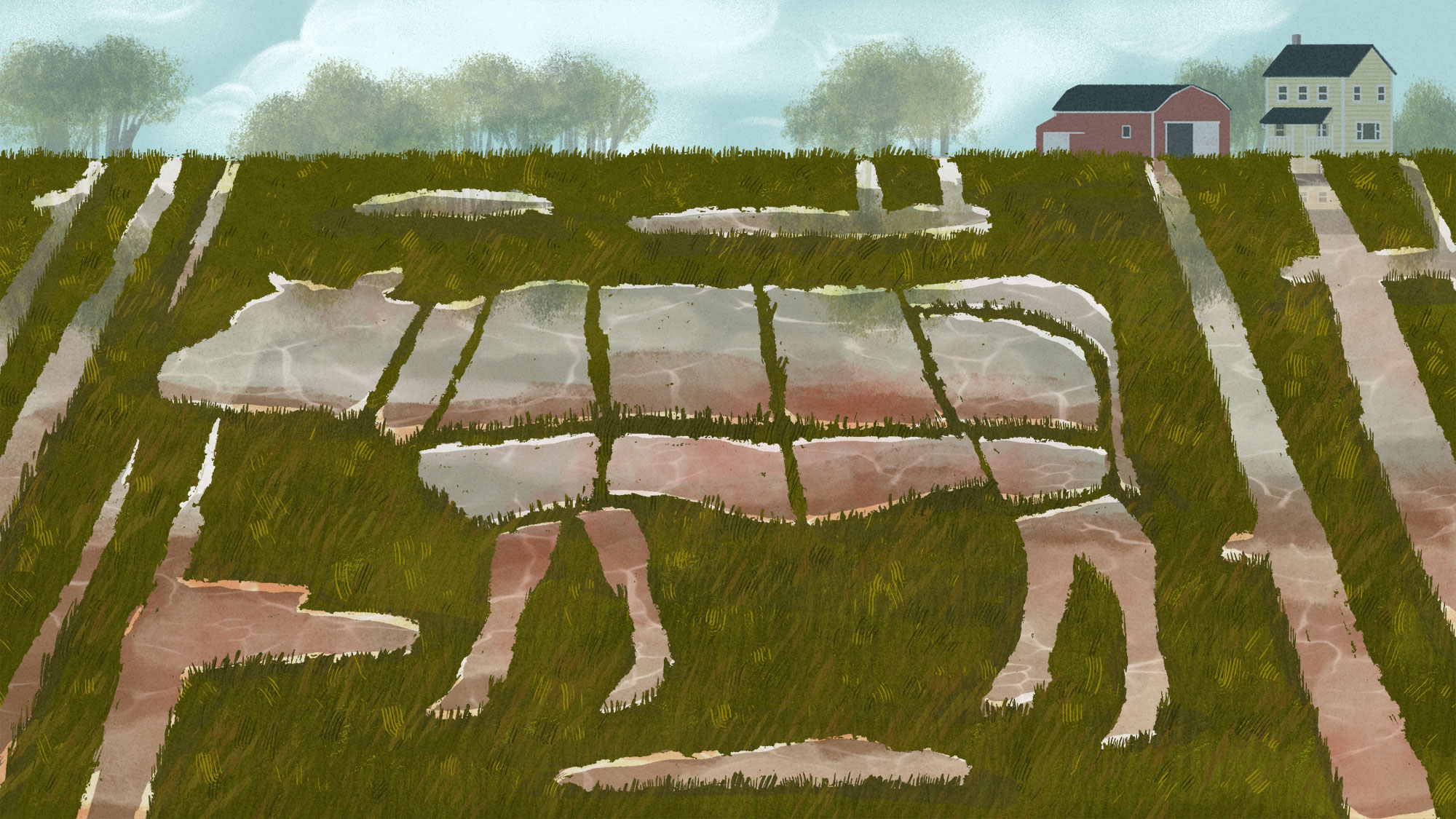
When Trish Leigey's taps started running brown and foul in late 2019, she had an uneasy suspicion about what was tainting the once-clear mountain water. Tests later confirmed her hunch: bovine DNA had infiltrated drinking water supplies in rural Loganton, Pennsylvania - contamination her lawyers linked to Nicholas Meat and its practice of spreading liquefied animal waste on nearby fields.
That may not have surprised many of Leigey's neighbors. Most were well aware of the desiccated animal parts occasionally strewn across local roads. Not many gave a second thought to trucks spraying a cocktail of blood, urine, water, and other slaughterhouse refuse over local farmland. But few wanted to accuse the company of wrongdoing, given that it employs over 425 people - about as many people in all of Loganton - and by some estimates processes 10 percent of the state's beef.
Leigey, a single mother who works three jobs, decided she had to speak up. "I just want a simple life," she said. "I don't feel like I should have to be emotionally, mentally, financially, and physically exhausted because some millionaire wants to dump blood on fields because it's a cheap way to dispose of it. It's not right."
A jury agreed and in December held the company liable for causing a nuisance and trespassing on neighboring properties by fouling their air and water. Leigey and three others who joined her in suing Nicholas Meat were awarded $145,000 - a surprising victory in a state where lenient right-to-farm laws make such cases difficult to win.
Still, the verdict is not expected to change how operations like Nicholas Meat do business. There's no compelling reason for them to. Nicholas Meat is much smaller than giants like Tyson Foods, but it's a big player in central Pennsylvania. What started in 1987 as a family business handling a couple dozen cattle each day bloomed over the decades into one of the county's largest private employers. It slaughters about 1,000 cattle each day, according to the lawsuit, and has been the biggest business in a town so small it doesn't have a traffic light.
Across the state, waste from slaughterhouses, farms, and the like is routinely spread on fields as fertilizer. Spreading these "food processing residuals" is legal, lightly regulated, and cheaper than transporting and treating the waste elsewhere. At least 900 farms and food-processing operations across the state participate in it. The lawsuit estimated that Nicholas Meat produces at least 200,000 gallons a day, with the capacity to store 1 million gallons on-site and another 4.3 million elsewhere. Aside from mixing and aerating the slop, there is no treatment before disposal.
"There's nowhere that there's a law or a regulation involved with the type of farming that we do," Eugene Nicholas said during the trial. Pennsylvania does not require a permit to spread food processing residuals. The practice is governed by guidelines published in 1994 that do little more than require farmers to outline details like how much could be used for various crops, and warn people not to dump it near waterways or drinking water sources.
Regulators investigate complaints of unbearable odors or polluted runoff, but DEP records dating to 2013 show people near the slaughterhouse would often wait days for a response. "There is really no oversight by anyone except residents," said Angela Harding, a Clinton County commissioner.
The lawsuit states that Nicholas Meat began spraying its waste on fields after it reopened in 2010 after a fire. It estimated that it sprays 10 million to 13 million gallons of waste over "hundreds" of acres annually. Reports revealed the company was "way over applying blood" to farmland and the practice was "continuous for 8-10 hours a day." Evidence showed the company sprayed on barren, wet, and even snowy fields, creating the risk of runoff.
Local geography and geology add to that danger. Springs and sinkholes are common in central Pennsylvania, and the cracks and channels in the rocky soil make it easier for contaminants to flow into aquifers and wells, said Brandon Fleming, a groundwater specialist with the U.S. Geological Survey Pennsylvania Water Science Center. A 2017 USGS assessment of Clinton County groundwater found that more than half of 54 private wells, including Leigey's, contained fecal bacteria, including E. coli, which appeared in about 25 percent of them.
Bovine DNA from blood or tissue, along with human fecal markers, also were detected in water samples from three homes near disposal sites in Sugar Valley. Such pollutants can cause gastrointestinal illnesses resembling food poisoning. Meat processing waste can expose people to viruses, bacteria, parasites, and chemicals associated with health risks ranging from gastrointestinal illness to methemoglobinemia and cancer.
For those living near one of these sites, those impacts are part of daily life. Leigey said her youngest daughter, Alaina, who is now 15, suffered debilitating headaches from the stench. Many neighbors stopped hanging their clothes out to dry years ago. For Leanna Rockey, a retired nurse who sued alongside Leigey, it has meant investing in a water cooler and regularly hauling clothes to the laundromat.
"We still don't drink our water," Rockey said. "I never dreamt in a million years my little piece of heaven would be turned into a dumping ground."
The two-week trial lasted longer than most cases heard in Clinton County. Jurors deliberated for several hours before returning a verdict that Nicholas' attorneys appealed on May 5. The $145,000 award will help cover what Leigey and her neighbors spent on bottled water, laundromat visits, and new wells. But the jury did not award punitive damages, and nothing about the verdict requires the slaughterhouse to change how it operates.
"There's no disincentive for him to do this," said Chris Nidel, Leigey's lawyer. Based on the volume of waste produced, he estimated the company saves $4,500 an hour spreading it locally rather than hauling it to a wastewater facility. "They can make that money up in less than a week."
But unless state regulators pursue an investigation or adopt new rules, accountability remains elusive. Cases like Leigey's can be difficult to prove if defendants can create enough doubt by pointing to other possible sources of contamination. These cases are usually "a catch-me-if-you-can situation," said Dani Replogle, an attorney with Food & Water Watch.
The same pressures play out nationwide in a $161 billion beef industry built on processing vast numbers of animals at low cost. "The more animals you have in one location, the worse the environmental problems are going to be," Replogle said. "That is just not happening. There's a really powerful lobby standing in the way of that."
State Representative Paul Friel said the rules need to change. He has introduced legislation to tighten oversight and hold polluters more accountable because some "bad actors" are turning "farm fields into unregulated landfills." "There has to be a distinction between normal farming practice and industrial waste disposal," he said.