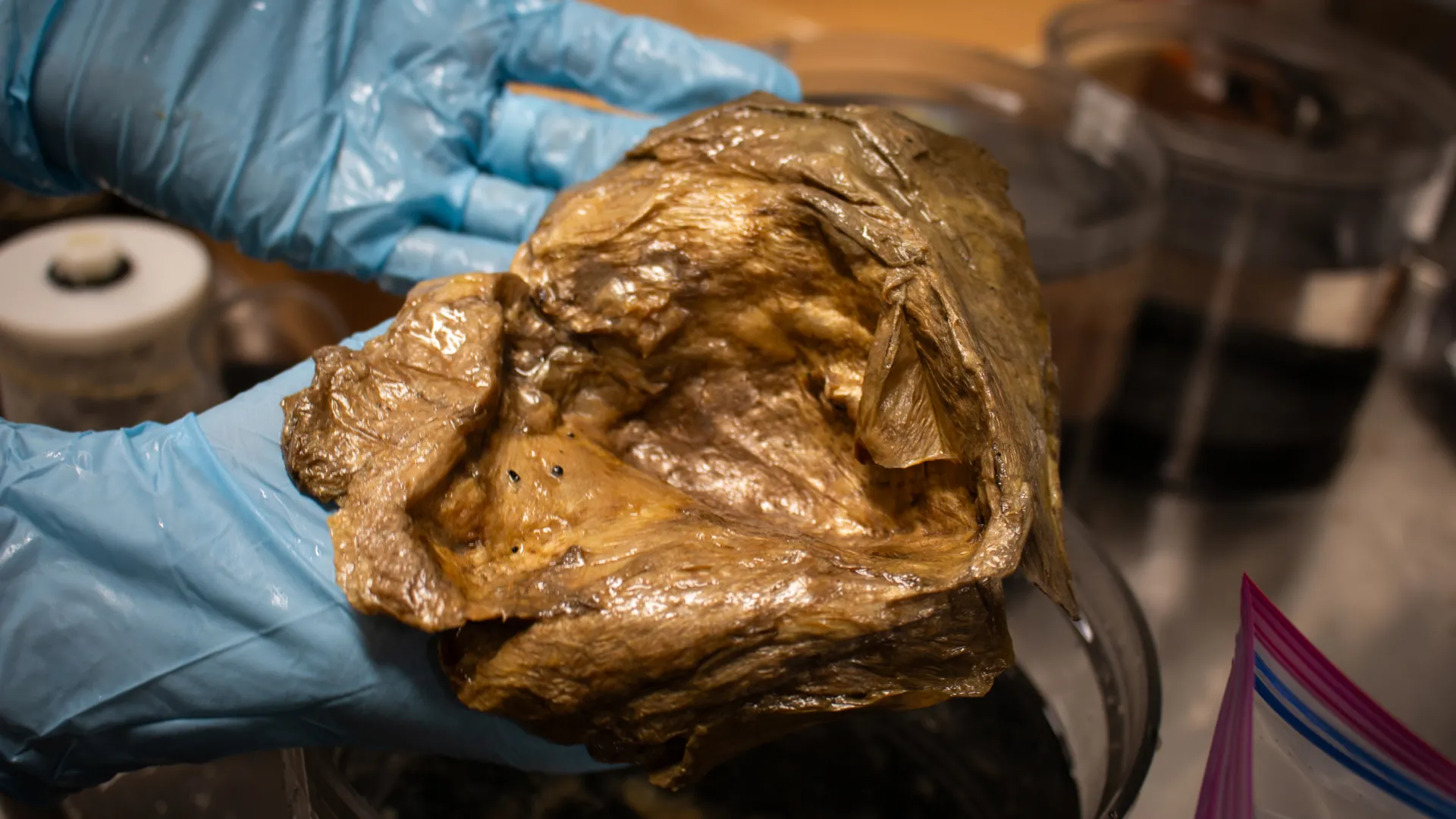
NOAA Finally Identifies Mysterious 'Golden Orb' Found Two Miles Under the Sea, Ending Two Years of Wondering What the Heck That Thing Was
After two years of head-scratching, scientists identify a mysterious golden blob from the deep sea as the discarded foot of a giant anemone, because the ocean is weird and we are just visiting.
A strange golden blob discovered during a 2023 NOAA expedition has finally been identified, putting an end to two years of scientists scratching their heads and the internet having a field day with speculation.
The object, found at a depth of 3,250 meters (over two miles) in the Gulf of Alaska, is not an alien egg, a lost piece of treasure, or the world's most disappointing gold nugget. It is, in fact, the remains of dead tissue from a giant deep-sea anemone called Relicanthus daphneae - specifically, part of the base that anchors the animal to rocks. So, essentially, a deep-sea anemone's discarded foot. Exciting.
During NOAA Ocean Exploration missions aboard the NOAA Ship Okeanos Explorer, encountering weird stuff is par for the course. Usually, scientists can identify these finds quickly by pooling their collective brainpower. But the "golden orb" was a stubborn little mystery that refused to play ball.
In 2023, the remotely operated vehicle Deep Discoverer (launched from Okeanos Explorer) was poking around more than two miles down when it spotted a rounded, golden object with a small opening sitting on a rock. The team was baffled. Was it an egg case? A sponge? Something entirely new? Did something crawl in or out of that hole? The internet, as it does, ran wild.
To get answers, the team carefully sucked the object up with a sampler and shipped it off to the Smithsonian National Museum of Natural History (NMNH) for a proper look-see.
A Complex Investigation Using DNA and Microscopy
Solving the mystery took years of painstaking analysis. "We work on hundreds of different samples and I suspected that our routine processes would clarify the mystery," said Allen Collins, Ph.D., a zoologist and director of NOAA Fisheries' National Systematics Laboratory, located within the Smithsonian. "But this turned into a special case that required focused efforts and expertise of several different individuals. This was a complex mystery that required morphological, genetic, deep-sea and bioinformatics expertise to solve."
Researchers from NOAA Fisheries and the Smithsonian used an integrative taxonomic approach, combining physical examination with genetic testing. Early analysis showed the object lacked typical animal features - instead, it was made of fibrous layers packed with cnidocytes (stinging cells), suggesting it belonged to a cnidarian, the group that includes corals and anemones. Further study by National Systematics Lab scientist Abigail Reft identified the cells as spirocysts, unique to the Hexacorallia subgroup of cnidarians. Scientists also compared the specimen to a similar object collected in 2021 during an expedition aboard Schmidt Ocean Institute's Research Vessel Falkor, finding matching cellular structures.
Initial DNA barcoding attempts were inconclusive - probably because the sample was contaminated with genetic material from other microscopic critters. So the team went big: whole-genome sequencing. That deeper analysis confirmed animal DNA and revealed a strong genetic match to Relicanthus daphneae. Sequencing of mitochondrial genomes from both specimens showed they were nearly identical to a known reference genome for this species.
Case closed: the "golden orb" was not an egg, sponge, or unknown organism. It was just a leftover bit from a deep-sea anemone - specifically, the base that once attached the animal to the seafloor.
The Deep Ocean Still Holds Many Mysteries
"So often in deep ocean exploration, we find these captivating mysteries, like the 'golden orb'. With advanced techniques like DNA sequencing, we are able to solve more and more of them," said CAPT William Mowitt, acting director of NOAA Ocean Exploration. "This is why we keep exploring - to unlock the secrets of the deep and better understand how the ocean and its resources can drive economic growth, strengthen our national security, and sustain our planet."
Even with this mystery solved, scientists remind us that the deep sea remains one of the least understood environments on Earth, filled with discoveries still waiting to be made. And probably more weird golden blobs.
The Good Times
News in your inbox.
One sardonic roundup, delivered on your schedule. Free. Unsubscribe whenever your tolerance for wit runs out.
Already subscribed but we never reach your inbox? Check your spam folder and hit 'Not spam' (or 'Remove from spam') to bust us out of junk-mail purgatory. You'll be helping everyone else too.
Don't open any of our emails for a month and you'll be automatically removed from the mailing list.
Rewrite Article
Select parts to regenerate with a fresh AI pass. Translations will be updated automatically.
Generate AI Image
Creates a sardonic version of the article image using OpenAI.