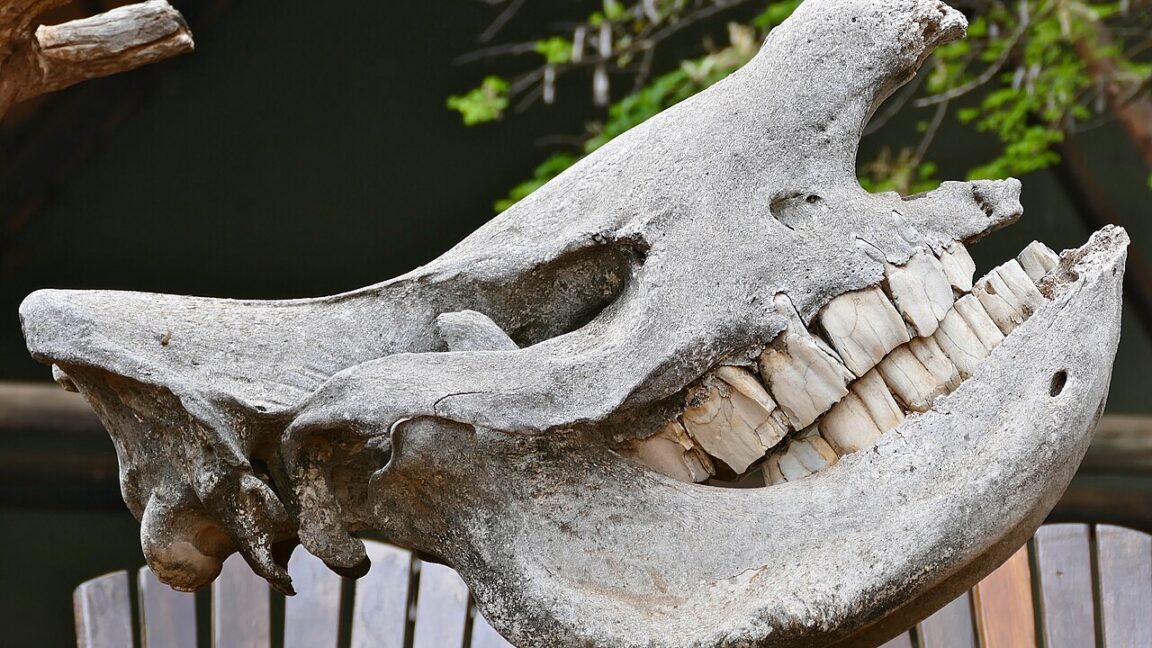
Archaeologists have long suspected that Neanderthals were the original multitaskers, but a new study suggests they also moonlighted as dental tool users. Researchers have confirmed that our ancient cousins used rhinoceros teeth as hammers for making stone tools, adding yet another item to the surprisingly diverse Neanderthal toolkit.
At archaeological sites like Panxian Dadong in southern China, 74 percent of rhino remains are teeth, and at Payre in France, that figure jumps to 91 percent - a suspicious concentration that led scientists to hypothesize the teeth were being collected for a purpose beyond mere snacking. The teeth showed markings consistent with hammering: groupings of shallow pits, overlapping cracks, and scratches from contact with sharp stone edges.
To test this, University of Aberdeen archaeologist Alicia Sanz-Royo and her team needed actual rhino teeth - no easy feat given that rhinos are threatened and their parts heavily regulated. "Obtaining rhinoceros teeth for the experiments proved to be an extremely difficult but indispensable exercise for this study," they wrote. The National Museum of Natural History in Paris had 236 teeth for viewing but, understandably, declined to let researchers smash them with rocks.
Eventually, the team acquired 18 white rhino teeth from three French zoos. Expert knapper David Pleurdeau then subjected them to a rigorous regimen: using some as hammers to shape flint, others as anvils for cutting leather, and a few as raw material to be knapped themselves. The team also simulated millennia of burial by spinning teeth in dirt-filled rotors and squashing them with a mechanical press.
Comparing the experimental marks to those on teeth from Neanderthal sites revealed "striking" similarities - same overlapping fractures, shallow indentations, and scratches. Tellingly, rhino teeth from paleontological sites with no human presence showed none of these marks. The conclusion: Neanderthals were using rhino teeth as soft hammers for knapping and retouching stone tools.
Tooth enamel is the hardest part of the mammal skeleton - 97 percent hydroxyapatite - and rhino enamel is especially thick and tough. This made rhino teeth ideal for absorbing the shock of rock-on-rock action without cracking. The researchers even determined the most ergonomic way to hold a rhino tooth while working, officially inaugurating the field of paleo-ergonomics.
While we tend to think of Neanderthal toolkits as stone-centric, they actually included wood, plant fibers, birch tar, antler, bone, shells, and eagle talons. Now we can add rhino teeth to the list - a reminder that for Neanderthals, using the remains of long-extinct megafauna as hammers was just another Tuesday.
The Good Times
News in your inbox.
One sardonic roundup, delivered on your schedule. Free. Unsubscribe whenever your tolerance for wit runs out.
Already subscribed but we never reach your inbox? Check your spam folder and hit 'Not spam' (or 'Remove from spam') to bust us out of junk-mail purgatory. You'll be helping everyone else too.
Don't open any of our emails for a month and you'll be automatically removed from the mailing list.
Rewrite Article
Select parts to regenerate with a fresh AI pass. Translations will be updated automatically.
Generate AI Image
Creates a sardonic version of the article image using OpenAI.