
Tomorrow morning, if all goes to plan - and let's face it, NASA has had better streaks - the Nancy Grace Roman Space Telescope will blast off from Florida, adding a little rocket-booster light to the Sunshine State's already excessive sunshine. This is NASA's latest and greatest orbital observatory, and it's carrying a lot of expectations. If the Roman succeeds, it could give humanity a brand-new way to see planets around other stars and a better understanding of the universe's largest structures. If it fails, NASA's science program - already dodging budget cuts like a matador - will have to seriously rethink its future. Artemis was a big win for human spaceflight; now the science side is desperate for a victory lap.
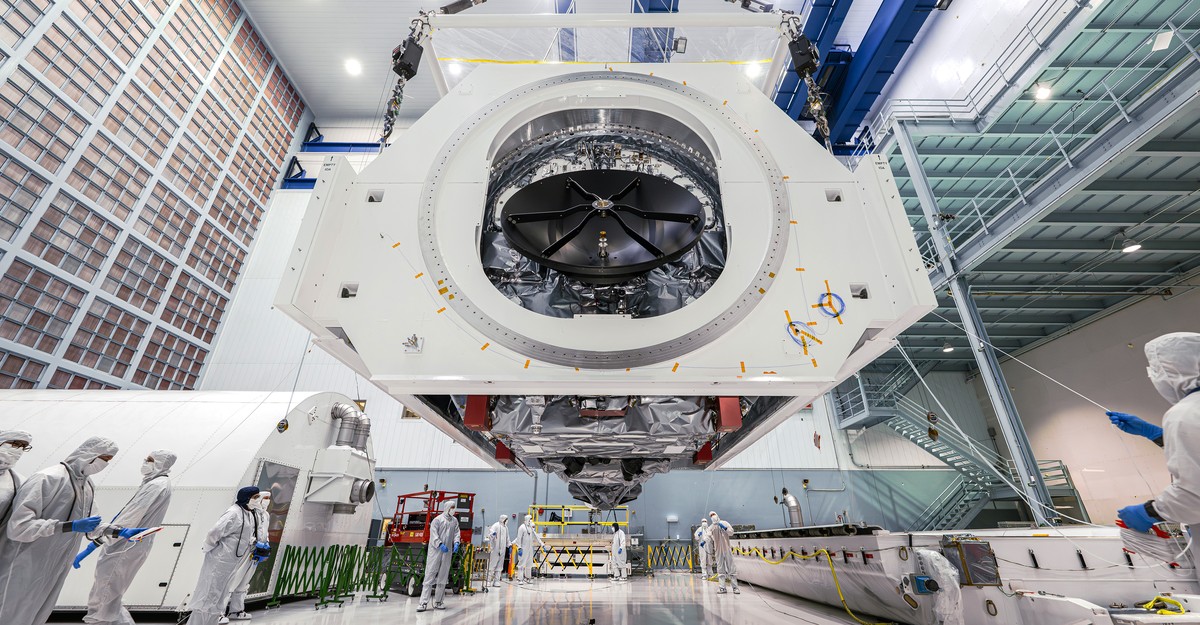
NASA's engineers have spent over a decade preparing the Roman for this moment. Before the telescope arrived in Florida, it spent more than a year in NASA's largest clean room at the Goddard Space Flight Center in Greenbelt, Maryland. To get near it, you had to be mummified alive. When I visited in December, NASA staffers led me to a sterile, fluorescent-lit locker room, tossed me a white jumpsuit and two sets of booties, and insisted I wear a beard net and hair net. They then triple-wrapped the gap between my sleeves and gloves with blue tape. The astronomers didn't want my skin flakes drifting onto the telescope's ultrasmooth primary mirror. "You're going to be the dirtiest thing in here," one told me as we walked through a chamber where more than 30 nozzles blasted us with air. I jotted that down on special mint-green paper that sheds fewer particulates than a regular notebook, then stepped into a cavernous eight-story white space filled with the hum of six school-bus-size fans. At its center, the Roman stood over 40 feet high, surrounded by a dozen jumpsuited workers - some chatting, some on motorized lifts applying duct tape. More than a thousand people worked on this project, and those lucky enough to get close to the hardware seem to derive physical pleasure from it.
The Roman has a shady backstory for a scientific instrument. Its primary mirror was a surprise gift from the National Reconnaissance Office (NRO), one of America's most secretive agencies, which apparently had a Hubble-class spare lying around. A cash-strapped agency can't be picky about provenance, so NASA took this mirror designed for surveillance and pointed it at the stars instead of the ground.
The NRO's spare mirror also solved some internal politics for NASA's science program. The Roman is built to monitor the universe at the largest scales, mapping the cosmic superstructure of galaxy clusters and how it has expanded over time. These observations might refine our understanding of gravity and even uncover new physics. But the idea for such a mission dates back to the early 2000s, after the discovery of dark energy. When NASA was finally ready to build it in the early 2010s, astronomers had shifted focus to discovering thousands of planets around nearby stars. The new mirror allowed them to do that in a whole new way.
Finding a little world with its own atmosphere in the glare of a nearby star is tricky. Even the largest planets are a billion times fainter than their suns. Dominic Benford, Roman's program scientist at NASA Headquarters, likened it to spotting a firefly buzzing around a powerful searchlight from thousands of miles away. To make this possible, astronomers lodged an exquisite new kind of coronagraph into the Roman's metallic guts. Coronagraphs originally helped see plasma flares from our sun by blocking out its brilliant disk, creating an artificial eclipse. The Roman's coronagraph does the same for distant stars, so astronomers can see their planets.
When the telescope targets a star in our Milky Way, it will catch light and run it through the coronagraph's system of barriers and mirrors. Two of these mirrors may be even more beautiful than the primary: each is smaller than a makeup compact, with more than 1,600 actuators that can deform tiny portions of glass in increments less than the diameter of a helium atom. Astronomers will use hundreds of these warping movements to deflect a star's glare, creating an image within a ring of nearly pure darkness. Deformable mirrors have been used on the ground to combat Earth's atmosphere, but no one has sent one this complex to space.
The Roman team believes that in space's pristine conditions, it will deliver the first direct images of distant planets in visible light. Until now, most extrasolar planets have been detected indirectly - via a star's wobble or the dimming as a planet passes in front. We've only gotten direct snapshots of a few young, hot, glowing planets, mainly in infrared. The Roman's coronagraph should spot worlds that aren't glowing at all, like Earth, illuminated solely by the soft visible light of their host stars.
I asked Vanessa Bailey, the coronagraph's instrument technologist, which stars she's excited to inspect. Since the coronagraph isn't part of the main mission, only three of the first 18 months are set aside for its observations. Bailey said they'll look at previously detected planets tens of light-years away, like the Epsilon Eridani system, where a Jupiter-size world orbits an orange dwarf star. They'll stare at it for hours, letting photons pile up. "It's just going to be a little fuzzy smudge, just barely there," Bailey said. "But we might be able to tell if it's cloudy or clear, and whether it's more like Jupiter or Neptune."
All of this could go wrong. Bailey told me the coronagraph has never been tested outside the lab, and in space, it may not work. If the mirrors misalign or the instrument malfunctions, any planets would be lost in the astral glare. NASA's quest for another living world would be set back, perhaps by a decade or more. But if it succeeds, it serves as a proof of concept for NASA's next big thing, the Habitable Worlds Observatory (HWO), in development for over a decade.
The Roman's coronagraph will only find large planets - Saturn-size or bigger - in cold, distant orbits. NASA wants a more precise one on the HWO, which will focus on over 100 nearby stars similar to our sun. Its coronagraph will cast a tighter ring of darkness to see planets in warmer, closer orbits that might be more hospitable to life, and it will even look for signs of life in their atmospheres. But the HWO won't launch until at least the late 2030s. For now, the Roman has to prove itself. It must survive launch and fly a million miles from Earth so its mirrors can catch a nearby star's light and surround it in darkness deep enough for a faint alien world to appear.