NASA Joins Japan's Mission to Finally Figure Out Where Mars' Weird Little Moons Came From
NASA is helping Japan's JAXA send a spacecraft to Mars' moons, because after decades of looking at Phobos and Deimos we still can't agree on what they actually are.
NASA has announced it's lending a hand to JAXA's Martian Moons eXploration (MMX) mission, because apparently we've spent decades staring at Mars and still can't definitively explain the two potato-shaped rocks orbiting it.
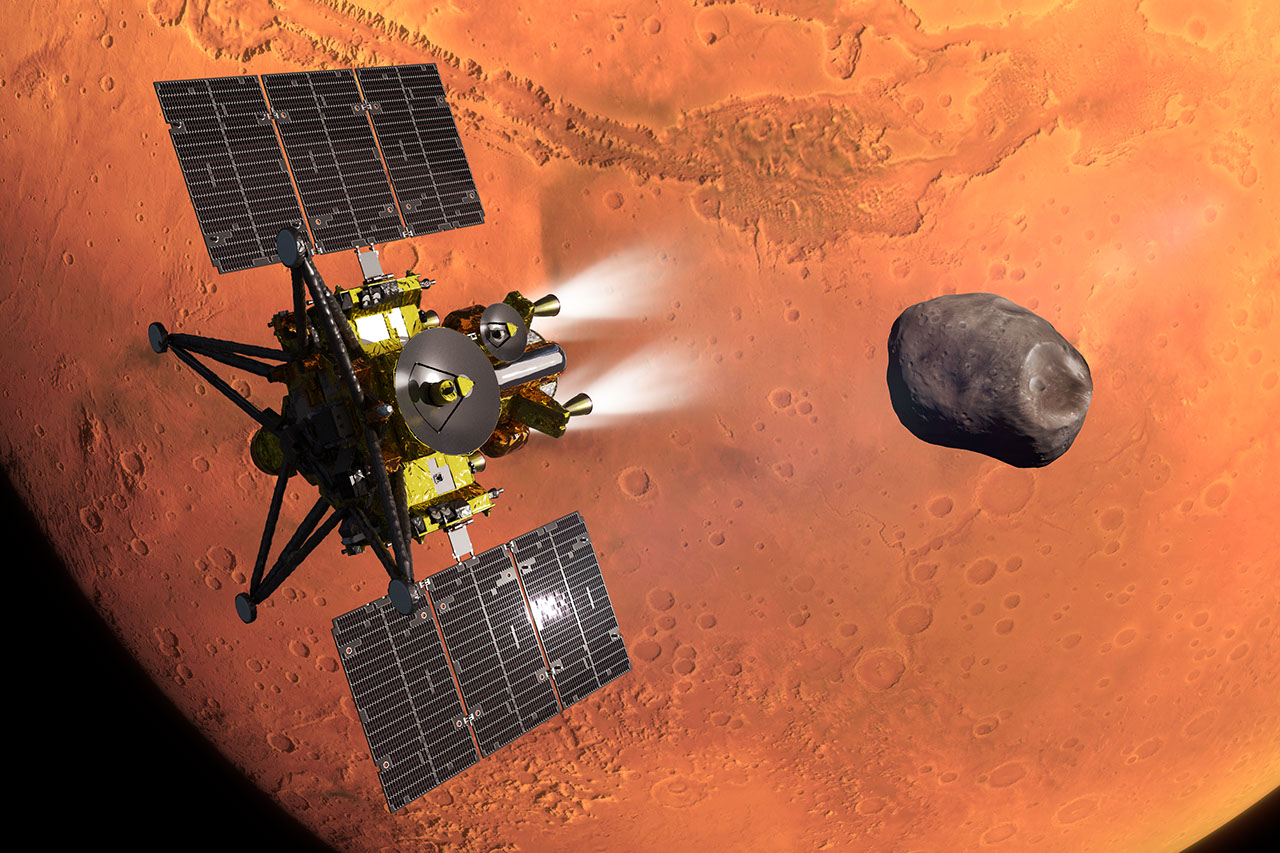
The mission aims to characterize and determine the origin of Mars' moons Phobos and Deimos, and - in a move that will delight anyone who enjoys waiting - deliver a sample of Phobos to Earth. The MMX spacecraft is targeting launch from JAXA's Tanegashima Space Center in Japan at 3:41 p.m. EDT on Monday, Oct. 19 (4:41 a.m. JST on Tuesday, Oct. 20).
"The samples from MMX will bring forth paradigm-shifting science on the Mars system for generations to come, especially as NASA prepares to send the first humans to Mars," said Nicky Fox, associate administrator of the Science Mission Directorate at NASA Headquarters in Washington. "The NASA-JAXA sample curation partnership is extremely valuable, and I am proud that NASA Science is supporting MMX sample curation and will be sharing portions of these samples for study as we continue to expand humanity's understanding of the universe for the benefit of all."
NASA's contributions include the Mars-moon Exploration with Gamma rays and Neutrons (MEGANE) spectrograph instrument, the Pneumatic Sampler (P-Sampler) technology demonstration, communications and navigation support from the agency's Deep Space Network, and funding for United States scientists on the MMX science team. Nothing says international collaboration quite like showing up with instruments, funding, and a deeply sophisticated walkie-talkie.
Scientists have long debated the origin of Mars' two moons, a debate that has now lasted long enough to outlast several theories about the moons themselves.
"Phobos and Deimos may be the remains of a massive impact on Mars that sent material into orbit around the planet, or they could be ancient asteroids that were captured by Mars' gravity billions of years ago," said Tom Statler, MMX program executive and program scientist at NASA Headquarters. "Having the answer will help illuminate that early era when Earth and the other inner planets may have been acquiring much of their water and organic compounds."
So, two options: either Mars got punched so hard its debris started orbiting it, or it grabbed a couple of passing asteroids. Either way, someone has to go check.
The MEGANE (pronounced meh-GAH-nay, Japanese for eyeglasses) spectrograph will help scientists "see" what Phobos is made of by measuring neutrons and gamma rays emitted from the moon's surface and determining its chemical elemental composition, which will provide important clues about its origin. Yes, they're literally naming the instrument "glasses" because it helps them look at the moon. Science is allowed to be cute sometimes.
Mounted on one of the spacecraft's landing legs, the P-Sampler is designed to collect a ground sample from Phobos. The system gathers surface material using bursts of high-pressure nitrogen gas, complementing JAXA's C-Sampler, which will extract cores from a few inches deeper. NASA will obtain and curate about 15% of the total returned sample at the agency's Johnson Space Center Astromaterials Lab in Houston, making it available for research for decades - presumably so future generations can also argue about it.
Another key part of NASA's contribution is its scientific partnership with JAXA. NASA-supported researchers are working alongside international colleagues to help reveal the story of Phobos and will use mission data and returned samples to uncover new clues about the moon's origin and the evolution of the Mars system.
The MMX spacecraft will arrive at Mars in August 2027 to begin its survey of the Red Planet's two moons. After surveying Phobos in detail, the spacecraft will collect a sample of the moon's surface no earlier than December 2028 and deliver it to Earth in 2031. That's a full decade from launch to delivery, which is a long time to wait for a bag of space gravel, but it's very important space gravel.
The MEGANE instrument was developed by the Johns Hopkins Applied Physics Laboratory. Honeybee Robotics, a Blue Origin company, developed the spacecraft's pneumatic sampler mechanism. NASA's contributions to the MMX mission were developed under the agency's Discovery Program, which is managed by NASA's Marshall Space Flight Center in Huntsville, Alabama, for the agency's Science Mission Directorate in Washington.
For more information about the MMX mission, visit:
Karen Fox / Alana Johnson
Headquarters, Washington
240-285-5155 / 202-672-4780
karen.c.fox@nasa.gov / alana.r.johnson@nasa.gov
The Good Times
News in your inbox.
One sardonic roundup, delivered on your schedule. Free. Unsubscribe whenever your tolerance for wit runs out.
Already subscribed but we never reach your inbox? Check your spam folder and hit 'Not spam' (or 'Remove from spam') to bust us out of junk-mail purgatory. You'll be helping everyone else too.
Don't open any of our emails for a month and you'll be automatically removed from the mailing list.
Rewrite Article
Select parts to regenerate with a fresh AI pass. Translations will be updated automatically.
Generate AI Image
Creates a sardonic version of the article image using OpenAI.