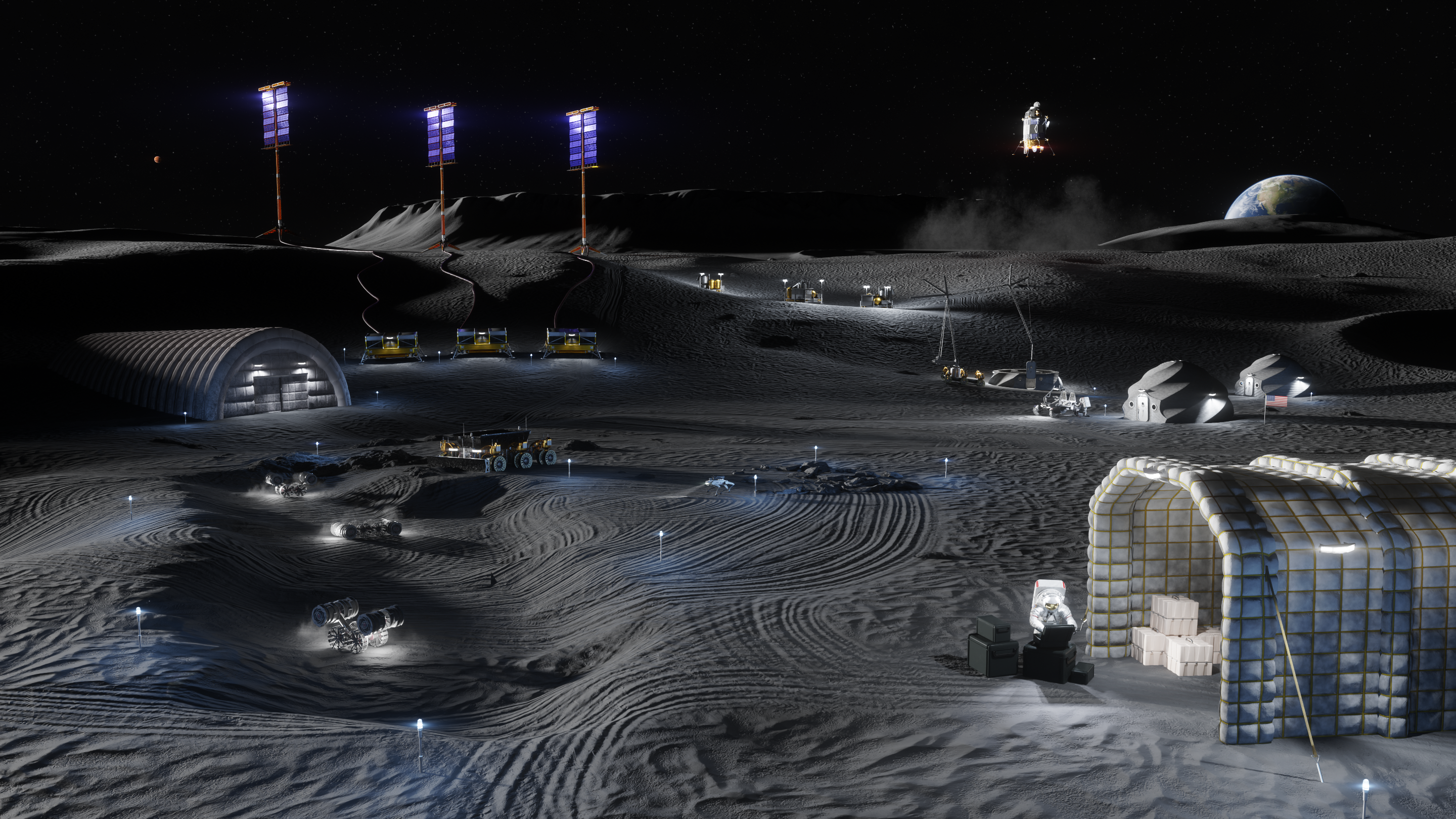
NASA is once again outsourcing its future to college students, because who better to imagine a Moon base than people who haven't even paid off their ramen debt? The agency is calling on U.S.-based collegiate teams to submit bold, original concepts for the 2027 edition of its Revolutionary Aerospace Systems Concepts - Academic Linkage (RASC-AL) competition, which focuses on aerospace innovation that could help envision a future on the Moon shaped by new technology.
This year's challenge specifically invites student teams to explore new operations paradigms and advance the technologies needed to sustain operations in the lunar South Pole region - because the Moon's equator is apparently just too crowded. The competition themes range from developing concepts to support prospecting in the permanently shadowed regions of lunar craters (where the sun never shines, but the ice probably does) to advancing critical and expandable infrastructure for future astronauts (so they don't have to live in a glorified tin can).
"This competition showcases the technical excellence and creativity of the next generation of explorers and innovators," said Chris Jones, chief technologist at NASA's Langley Research Center in Hampton, Virginia, in a statement that probably made every student who's ever pulled an all-nighter on a project feel oddly validated. "The concepts students develop through RASC-AL demonstrate exceptional talent and contribute to the body of work that advances NASA's missions."
Since 2002, RASC-AL has been fostering aerospace concepts, technology, and prototyping by making connections among universities, NASA, and industry - basically a matchmaking service for rocket science. Gabe Merrill, acting cross-program integration lead for the Advanced Research and Technology Division, added, "By asking student innovators to design concepts for what our future on the Moon might look like, this competition accelerates the technology we need to explore the Moon and provides a development opportunity for future aerospace innovators and leaders." Translation: We get free ideas, they get a résumé line.
Teams interested in participating must submit a non-binding notice of intent by Tuesday, Oct. 13, and will be invited to a Q&A session with NASA experts on Oct. 27. The real work begins later: Challenge proposals and accompanying video submissions are due Feb. 24, 2027. Proposals should demonstrate innovative solutions supported by original engineering and analysis in response to one of the four 2027 RASC-AL themes.
The competition will select up to 14 teams to advance to the final phase, which involves further developing their concepts, writing a technical paper, and creating a technical poster - because nothing says 'lunar future' like a poster board presentation. Each finalist team will receive a $7,500 award to facilitate full participation, which should cover at least a few hundred cups of coffee. Finalists will present their concepts to a panel of NASA and industry experts at the 2027 RASC-AL Forum in Cocoa Beach, Florida, June 7 - 10, 2027. The top two overall teams will receive an additional monetary award and an invitation to attend and present their concept at an aerospace conference later in 2027.
Interested student teams can find detailed guidelines and eligibility requirements on the official RASC-AL competition website. The 2027 NASA RASC-AL Competition is administered by the National Institute of Aerospace on behalf of NASA's Advanced Research and Technology Division within the Research and Technology Mission Directorate. NASA's Center of Excellence for Collaborative Innovation, part of the Prizes, Challenges, and Crowdsourcing Program, manages the challenge contract - because even NASA knows that sometimes you just need to crowdsource your way to the Moon.
The Good Times
News in your inbox.
One sardonic roundup, delivered on your schedule. Free. Unsubscribe whenever your tolerance for wit runs out.
Already subscribed but we never reach your inbox? Check your spam folder and hit 'Not spam' (or 'Remove from spam') to bust us out of junk-mail purgatory. You'll be helping everyone else too.
Don't open any of our emails for a month and you'll be automatically removed from the mailing list.
Rewrite Article
Select parts to regenerate with a fresh AI pass. Translations will be updated automatically.
Generate AI Image
Creates a sardonic version of the article image using OpenAI.