
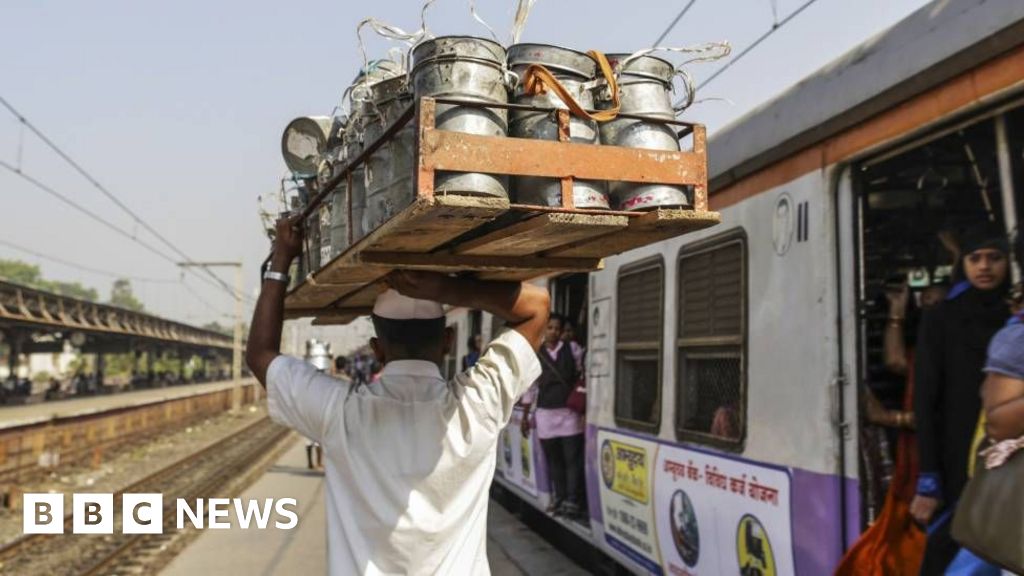
Every morning, before Mumbai fully wakes up, men in white caps and shirts arrive at suburban railway stations on bicycles stacked high with lunchboxes. They load these boxes onto trains, cross the city, then fan out on foot and bikes to deliver hot, home-cooked meals to office workers. After a short break, they reverse the process - collecting empty boxes and returning them to their kitchens by mid-afternoon.
These are the dabbawalas, and for over a century they've kept Mumbai fed with a delivery system so precise it became world famous. The lunchboxes - dabbas - typically carry rice, lentils, vegetable curries, rotis, and sometimes meat, freshly cooked in homes across the suburbs. For generations of Mumbai office workers, home-cooked meals have been deeply tied to family routine, culture, and dietary preferences, making the daily lunchbox an essential part of working life.
Each box is marked with an alphanumeric code telling a dabbawala where it came from, where it's going, which floor of which building, and how to get it back. No apps or GPS - just a system passed down through generations who know Mumbai's trains and streets instinctively. The trade brought the city global attention: Harvard Business School studied it as a masterclass in low-cost logistics, and in 2003, even the future King Charles spent time with dabbawalas on a trip to Mumbai.
Now, the men who built that reputation are struggling to survive. The dabbawala system is believed to have begun in the late 19th century, when Bombay was rapidly expanding and office workers needed fresh home-cooked food during the day. The idea is traced back to a Parsi banker who hired a man to pick up his lunch from home each morning, deliver it to his office, and return the empty box later. In 1890, Mahadeo Bachche organized the system in its modern form with about 100 workers. Early dabbawalas used bicycles and colored threads for sorting, later replaced by the alphanumeric code system, with deliveries relying on bikes, motorbikes, and the suburban train network.
At its peak, nearly 4,500 dabbawalas delivered around 50,000 lunch boxes daily. But the pandemic disrupted that. Offices shut, people worked from home, and dabbawalas who once served 20 or 25 customers a day were left with a handful - some with none. With little savings, many left. Offices have since reopened, but remote and hybrid work models have sharply reduced daily demand. "After the lockdown, work-from-home started," says Kiran Gavande, secretary of the Mumbai Tiffin Box Suppliers Association. "Some people now go to the office only two or three times a week. This had a big impact."
The number of registered dabbawalas has fallen from about 4,500 in 2018 to roughly 1,500 today. At the same time, Mumbai's relationship with food has changed. Online delivery apps like Swiggy and Zomato, plus a growing number of cloud kitchens offering cheap restaurant meals, have given people new choices. Where the dabbawala once had little competition - delivering home-cooked meals for just 2,000 rupees ($21; £16) a month - they now compete with everything from biryani to burgers at the tap of a screen.
Balu Bhagu Shinde spent 20 years as a dabbawala before leaving. The 41-year-old once earned about 20,000 rupees a month delivering to 15 - 20 customers - enough to support a family of five in one of India's most expensive cities. By end of 2020, only two customers remained. He waited for offices to reopen, but customers never returned in substantial numbers. Now a tuktuk driver earning around 15,000 rupees a month, he says: "There are no customers, no money - what should we do? We are struggling to survive."
For those who stayed, survival often means working two jobs. Mauli Bachche, 40, has been a dabbawala for two decades. His day starts at 07:00; by 10:30 he's collected lunchboxes and loaded them onto trains. By early afternoon, deliveries are done; at 14:00, the return cycle begins. Then comes his second job, collecting daily savings deposits from shopkeepers for a finance company, finally returning home around 22:00 after up to 15 hours of work and more than 100km (62 miles) across the city. "Before Covid, I used to deliver 25 dabbas. Only 15 customers remain," he says. "Income from dabbawala work is very low. Everyone is doing more than one job."
For older men like Baban Kadam, a 35-year veteran, the worry is for the future: "In our time, we managed to survive. But with today's cost of living, the younger generation will not come into this work." Ramdas Baban Karvande, president of the suppliers association, says the network no longer delivers across all parts of the city as it once did. The association is considering shift-based work so dabbawalas can take part-time jobs alongside morning deliveries. "We are continuing for now," he says. "But we cannot say what will happen in the future."
For now, each morning Mumbai's trains still carry men weaving through crowded platforms with stacks of steel lunchboxes - preserving a tradition that was once synonymous with the city's pace, but now risks being left behind by it.