
Kathie Purdy doesn’t mind the phone calls. There have been a lot of them - her iPhone buzzing continuously for nearly two weeks since Graham Platner dropped out of the Maine Senate race. At one point, the device got so hot she had to remove its case to let it breathe. That was fine, she said. As chair of the York County Democratic Committee, her job was to guide Mainers through this confusing moment.
What Purdy did not appreciate was the insinuation - from other Democrats, the media, online trolls - that the process to replace Platner was somehow undemocratic. “This is what I’m talking about,” she told me on Sunday, showing a text from a voter asking whom “leadership had picked.” We were side by side on the stage of the Sanford Performing Arts Center, looking out at the democratic process in action. Purdy rolled her eyes. “Actually, right now we are conducting the caucus-type meeting in Sanford where the participants vote for a group of delegates,” she replied via voice-to-text. “That’s the folks who’ll be voting for your Senate candidate.”
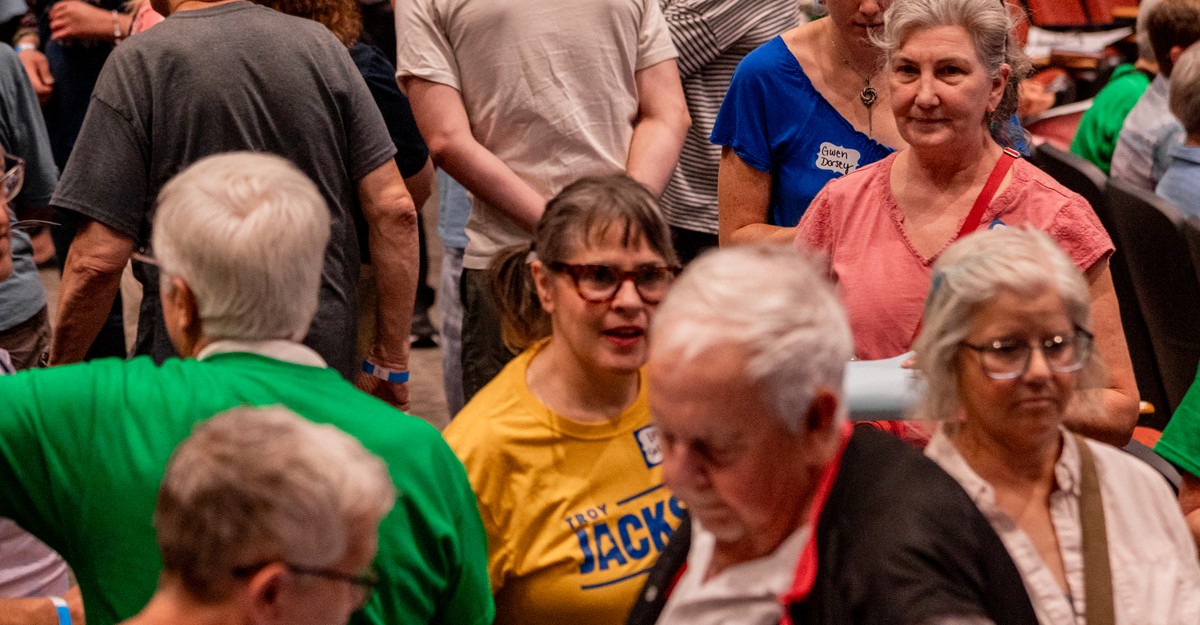
Choosing those delegates was not tidy. The room was crowded all morning, despite the state party urging people to vote from home. Mainers who wanted to be delegates, those who came to meet them, and campaign volunteers proffering lists of allied delegates wove between red-upholstered chairs, shaking hands, arguing, and complaining about the very process they were participating in. Some struggled with the Wi-Fi. Occasionally, Purdy took the stage to announce: “We found a pair of car keys. Please come to the stage if they’re yours!”
Looking around, I imagined Susan Collins rubbing her hands with delight somewhere a few hours north. Maine Democrats have failed to unseat her for nearly three decades, and there’s plenty of reason to believe they’ll come up short again in three months. Zoomed out, the situation is objectively ridiculous. Democrats nominated Platner despite a bouquet of red flags, including a Nazi tattoo and allegations of volatile behavior from past girlfriends. Now that a rape accusation has toppled his candidacy, the party is desperately trying to pick up the pieces of a race that might be their best shot to take back the Senate.
Yet the predictable conclusion - that the Democrats are once again in disarray - could not be fully drawn. Because ultimately, after all the hemming and hawing and arguing and complaining, the Democrats of York County sat down and voted. Totals were reached surprisingly quickly. Only a few hours after most attendees arrived, Purdy read out the names of the 84 delegates and 17 alternates who would go to the party’s nominating convention in Bangor. Plenty were frustrated with the results, which were very good for Troy Jackson, a progressive former state legislator. Others had issues with the process. But “that’s democracy,” Purdy said. So far, in Maine, it’s going pretty well.
In the days after Platner dropped out, there was much consternation about how Democrats would replace him. No time for another primary, but if state leaders simply chose a new nominee, voters might be indignant. Many of Platner’s supporters were exhausted with the so-called establishment. The compromise: a convention on July 25, where 601 delegates would choose Platner’s replacement. Before that, each county would elect its portion of delegates. People were not pleased. Only registered Democrats could select the replacement nominee, whereas independents participated in the June primary. “As an independent you’re saying my vote doesn’t count now,” one Facebook commenter wrote. Another self-proclaimed former Democrat weighed in: “If you believe primary voters should choose nominees, not party insiders, consider whether your party registration still reflects your values.”
Meanwhile, the county committee chairs - volunteers paid precisely zero dollars - were under a lot of stress. No one from the Maine Democrats returned my calls or emails. Purdy begged for kindness on Facebook: “I would really appreciate some respect. Please stop the snark.” Joseph Zamboni, chair of the Cumberland County Democratic Committee, seemed on the verge of tears when I spoke with him. In one of his many lengthy social-media updates, he cited Nobel Prize - winning scholar Herbert Simon on why people rarely make perfectly informed decisions.
So I did not know what I would find on Sunday. But when I arrived at the auditorium in Sanford at 9 a.m. sharp, I was greeted with a dozen volunteers and a box of donut holes. In the parking lot, supporters held a rally for Jackson, while inside, dozens of people circulated. “Usually we have to go begging for delegates,” one county committee chair told me. “Right now we’re fighting ’em off.” In York County, more than 400 people applied for 101 positions.
For two hours before voting, people made their case for candidates. Most supported either Jackson, a logger and former state-Senate president, or Nirav Shah, the former leader of the Maine CDC, who has since dropped out. Jackson’s supporters liked his alignment with Platner’s positions. “We’ve lost a lot of momentum, and he has the best chance of keeping them engaged,” Reed Gordon, a 29-year-old delegate candidate, said. The case for Shah: slightly more moderate, an easier sell to independents. “We need to stand up against Trump, but we have to be measured,” Paula Busby, 62, from Lebanon, told me.
Because delegates were chosen rather than direct candidates, campaigns had pre-made lists of allied delegates. Delegate selection was basically a proxy election: vote for Jackson’s slate to get Jackson. This upset Mainers who hoped delegates would be impartial. “This isn’t the way I’d have done it,” Julian Rogers, former vice chair of the Maine Democrats and a delegate candidate, said. “Rather than sort of coronating one person, I think we need to hear from these other people and have a little more balance.”
Leah Macomber, a game developer from Saco, was also on the ballot but knew nothing about slates until Sunday. “I was so pissed off,” she said. “I’m a Mainer, and I don’t like being told what to do, or especially who to vote for.” So she made a T-shirt reading Vote Independent Thinker and handed out lollipops labeled Susan sucks to stand out. Neither she nor Rogers were selected as delegates.
Still, even they were impressed at how quickly the process was put in place and how clear the communication was. It was preferable, some said, to the 2024 process to replace Joe Biden, which was ultimately an anointing of Kamala Harris. And obviously better than powering through with a toxic nominee. “I was so disappointed when Platner dropped out,” Diana Garry, a retired nurse from Shapleigh, told me. “I was so discouraged. But now I’m thinking it’s a blessing.”
By 11:15 a.m., people were in their seats with phones and iPads open, ready to vote. “It’ll all be electronic, so it’ll be fast,” Purdy said from the stage. I wondered whether she was tempting fate. Democrats don’t have the best track record with technology in important elections. When Purdy began reading voting instructions - “To edit your submission, hit ‘Continue,’ then ‘Edit,’ then ‘Continue’ again” - a feeling of dread came over me. It was not assuaged by the line for technical support that quickly formed down the center aisle.
But my concerns proved unfounded. The vote went smoothly. An hour in, all people in line had been helped. Some left; they’d see results online. Soon, Purdy gave a 10-minute warning. “Can I get a ‘yay’?” she asked. “Yay!” people replied, more enthusiastically than expected.
She sat back down next to me. “I’m proud of what we’ve done,” she said, looking relieved. “We had a very short time to do something herculean.” Thanks to Sunday’s elections, next weekend’s convention will be straightforward. The question now is whether Purdy and all the rest of Maine’s Democrats can pull off something similarly herculean in November.