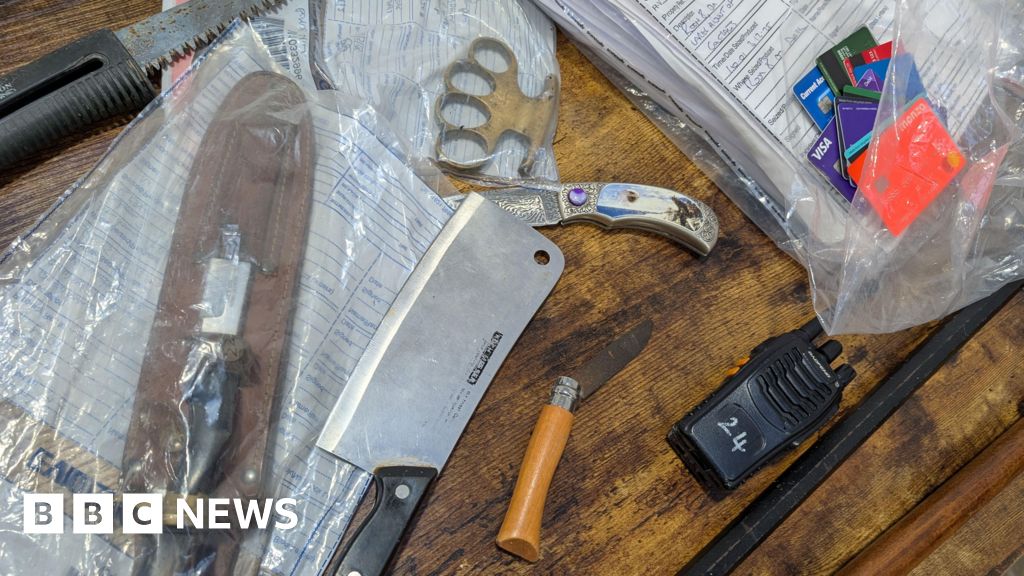
A samurai sword, a meat cleaver, and babies' passports. No, that's not the opening of a particularly grim pawn shop inventory - it's the haul from raids by England's Illegal Money Lending Team (IMLT), which has given the BBC rare access to their work tracking down loan sharks. These unlicensed lenders charge crippling interest rates and intimidate borrowers, and the IMLT relies on public tip-offs to identify them. But as you might imagine, people are a bit reluctant to report someone who might show up with a sword.
David Benbow, who leads the IMLT from Birmingham, has seen firsthand why victims stay silent. He's even noticed a rise in lenders posing as friends or acquaintances, because nothing says 'friendship' like threatening to hurt you if you're late on a payment. Benbow flips through a folder of evidence containing gold jewellery and passports, including for babies - which, as he notes, can be used to stop people from travelling, accessing employment, or 'anything where you need some form of physical ID'. Nothing says 'control measure' like confiscating a toddler's passport.
Take Sarah (not her real name, for obvious reasons). The 28-year-old from Yorkshire first contacted a loan shark via social media after being turned down for a credit card. The deal: borrow £50, repay £100. Miss a payment, and things get worse. She sent photos of her utility bills as part of what she thought was a legitimate registration process, unaware her lender wasn't regulated by the Financial Conduct Authority (FCA). Soon she was getting messages like 'I want it now or you are gonna be hurt'. Sarah became homeless, tried to end her life multiple times, and has only recently finished paying £20,000 on a debt that started at less than half that amount. She says some friends took their own lives after accumulating thousands in loan shark debt, their families knowing nothing - because being called a 'grass' is apparently scarier than being threatened with a meat cleaver.
Paul (also not his real name) from West Yorkshire had a similar awakening when a 'friend' of his son showed up at the door demanding money after his son borrowed £30 for a round of drinks. The debt ballooned to over £5,000, and Paul emptied bank accounts and used credit cards to pay. He turned to West Yorkshire Police, but 'got nowhere' - the force said they couldn't progress the report due to lack of evidence. Paul has now paid more than £20,000 to loan sharks 'with nothing to show for it'. He's installed CCTV cameras throughout his home and avoids being alone, living in fear that they might return. When asked if he'd pay again to protect his family, he said, 'I'd say we probably would, because you look after your own.'
The IMLT's statistics paint a grim picture: in the past year, they received 597 reports to their Stop Loan Sharks service, made 33 arrests, and secured six convictions. Six. That's not a typo. Meanwhile, research by Fair4All Finance estimates 1.9 million people used an illegal money lender in Great Britain in a 12-month period. The IMLT says building a successful case can take 'many months', and many suspects receive cautions or cease-and-desist notices rather than court action. They rely heavily on borrowers reporting loan sharks - but not everyone who calls for advice is willing to share details. Shocking, that.
Loan sharks have increasingly moved online since the Covid pandemic, meaning raids often uncover no cash, and victims are now found up to 60 miles apart rather than in the same neighbourhood. The BBC contacted several loan sharks advertising on social media and within a couple of taps were offered between £1,000 and £3,000. Some posed as legitimate loan firms, but when asked about late payments, one wrote: 'We will take action against you.' They demanded copies of driving licences, utility bills, and screengrabs of online banking. Because nothing says 'trustworthy lender' like asking for your entire financial life story before handing over cash.
If you need help with a small loan, both Citizens Advice and the FCA suggest contacting your local credit union. Or, you know, just avoid anyone who asks for your baby's passport as collateral.
The Good Times
News in your inbox.
One sardonic roundup, delivered on your schedule. Free. Unsubscribe whenever your tolerance for wit runs out.
Already subscribed but we never reach your inbox? Check your spam folder and hit 'Not spam' (or 'Remove from spam') to bust us out of junk-mail purgatory. You'll be helping everyone else too.
Don't open any of our emails for a month and you'll be automatically removed from the mailing list.
Rewrite Article
Select parts to regenerate with a fresh AI pass. Translations will be updated automatically.
Generate AI Image
Creates a sardonic version of the article image using OpenAI.