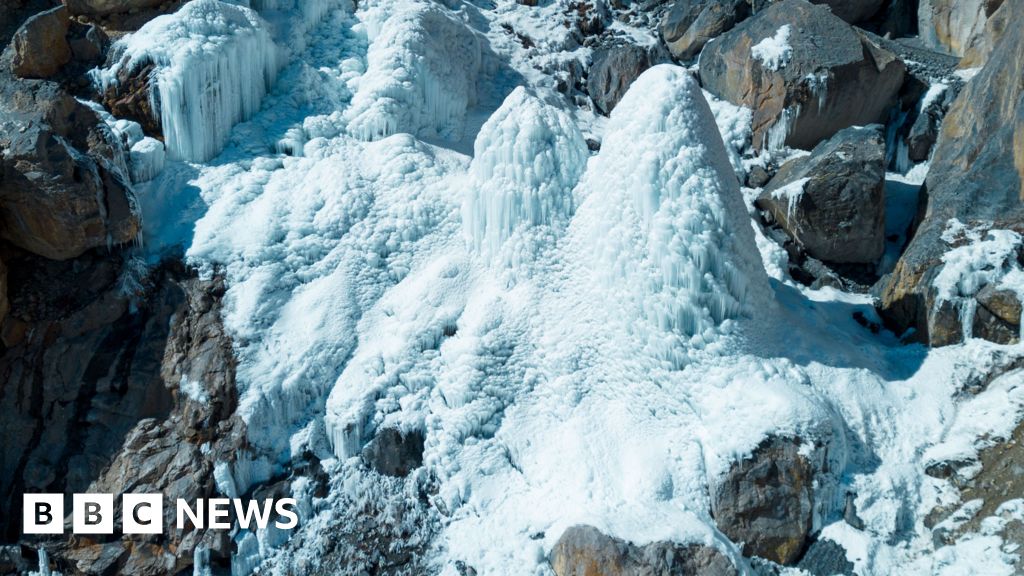
At nearly 4,000 meters in the Himalayas, the village of Sakti offers farming conditions that can best be described as 'brutal' - a word used by 65-year-old farmer Gelak Gutme, who has spent most of his life growing wheat, peas and potatoes there. Ladakh, he notes, is a desert with an extreme climate, and global warming has made it worse by melting the low-altitude glaciers that once watered crops.
"Last year I lost everything - my entire field got dried due to lack of water," Gutme says. Local water management committee member Lobzang Fardod explains that those small glaciers acted as frozen water towers, holding water all winter and releasing it for spring farming. Now they've vanished into dry rock.
In the early 2010s, some villages tried building ice stupas - towers of ice created by piping water from higher mountains and spraying it into the freezing air. It worked, but maintaining it was a nightmare: when temperatures dropped below minus 20°C (or minus 30°C), pipes would freeze and crack. Teams of farmers had to camp near the water source all winter, rushing out at night with boiling water to unblock pipes.
Enter the Automated Ice Reservoir (AIR), developed with private company Acres of Ice. The system pipes water downhill under pressure, shooting it through a vertical nozzle like a "massive fountain." A computer-controlled box, powered by solar panels and a battery, connects to a weather station that monitors air and water temperatures. If it detects a dangerous drop, it shuts the valve and drains the pipe, preventing cracks. Instead of spraying continuously, AIR fires bursts of mist, waiting for each layer to freeze before adding more - converting almost all diverted water into ice.
"The system waits precisely long enough for that layer of water droplets to freeze solid based on current wind and humidity, then fires the spray again," explains Dr. Suryanarayanan Balasubramanian, founder of Acres of Ice. Villagers have a manual override, but otherwise it runs automatically on a local wireless network.
During the winter of 2025, Acres of Ice and the local government ran 10 AIR projects across Ladakh. Executive engineer Murtaza Ali reports that villagers say groundwater is recharging and spring sources are reviving. Gutme, whose village has one AIR system, hopes to build at least two more artificial glaciers. "I am a farmer, land is all that I have to survive on. I don't know the technology, all that I know today is that I have water to grow my crops," he says. He adds that water scarcity was driving youth to cities - "that would have been a disaster."
The Good Times
News in your inbox.
One sardonic roundup, delivered on your schedule. Free. Unsubscribe whenever your tolerance for wit runs out.
Already subscribed but we never reach your inbox? Check your spam folder and hit 'Not spam' (or 'Remove from spam') to bust us out of junk-mail purgatory. You'll be helping everyone else too.
Don't open any of our emails for a month and you'll be automatically removed from the mailing list.
Rewrite Article
Select parts to regenerate with a fresh AI pass. Translations will be updated automatically.
Generate AI Image
Creates a sardonic version of the article image using OpenAI.