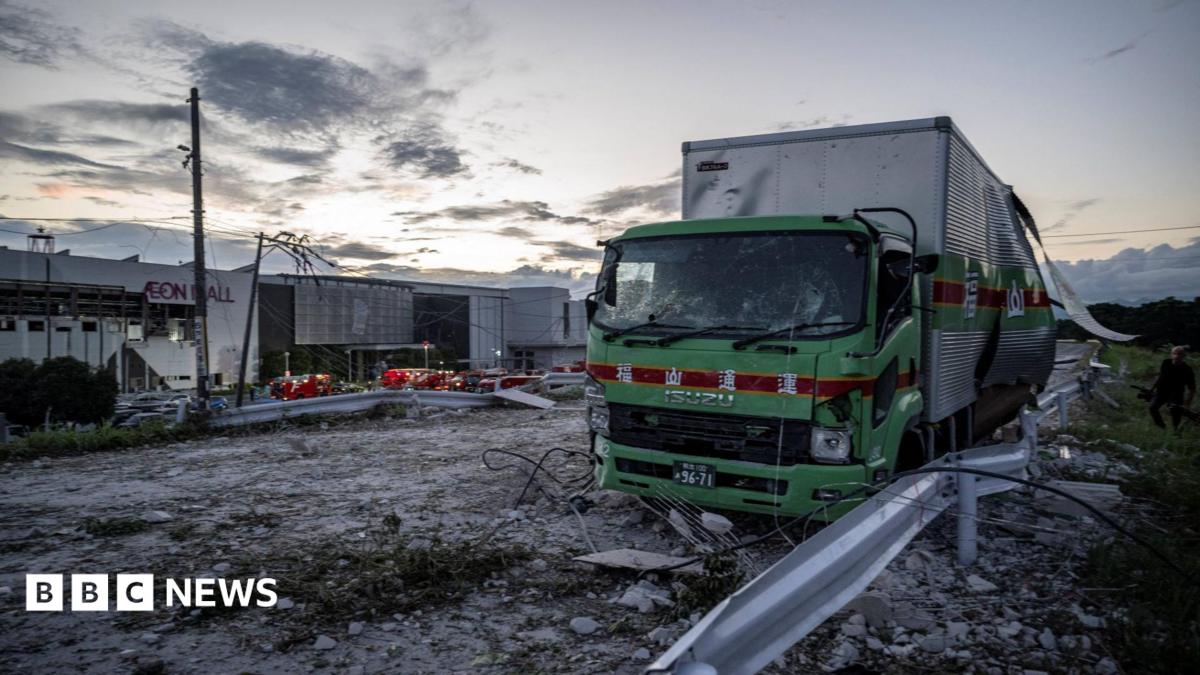
Japan's south-western Kyushu region has experienced over 100 aftershocks since Tuesday's powerful earthquake, which left at least 13 people dead and many others in a state officially described as 'cardiopulmonary arrest' - a phrase that in Japan essentially means 'we're pretty sure they're dead, but we're being cautious.'
Rescue crews, sweating in 35°C (95°F) heat, are digging through rubble at a paper factory and a shopping mall in Kumamoto prefecture, looking for trapped survivors. The mall, an Aeon Mall in Kashima, had the decency to explode just an hour after the quake, adding a touch of chaos to an already bad day. Three people were killed in that explosion, and 2,700 employees are now wondering where they'll work next.
Japanese Prime Minister Sanae Takaichi called it 'truly a race against time,' which is politician-speak for 'we're trying our best, please don't yell at us.' Over 4,600 personnel are deployed, and 300 air conditioning units are being flown in because nature decided that earthquakes weren't enough - now it's also blisteringly hot.
The Japan Meteorological Agency (JMA) warns residents to expect strong aftershocks for the next week or so, especially the next two to three days, with potential seismic intensity of 7. Because when you've already had 100 aftershocks, what's a few more?
The quake struck at 16:27 local time (07:27 GMT), measuring 7.1 on the JMA scale and 6.8 according to the US Geological Survey - because seismologists can't agree on anything, including how strong a disaster actually was. The shallow epicenter, 10 km deep, was about 20 km south of Kumamoto city.
Footage shows cracked roads, burning buildings, and the 19th-century Yatsushiro Shrine looking significantly less 19th-century. Train services are suspended, thousands are without power, and evacuation centers are packed.
Hiroko Ogata, 75, told the BBC she was at her restaurant when the quake hit. 'I have lived here for 75 years, but I have never experienced such a big quake. I thought I would die.' That's one way to spice up your day.
American tourist Chantel Mohar was on a bus with her family when everyone's phones screamed earthquake alerts. 'There was just a lot of rocking and confusion,' she said. So basically, a typical Tuesday in Japan, but with more aftershocks.
The Good Times
News in your inbox.
One sardonic roundup, delivered on your schedule. Free. Unsubscribe whenever your tolerance for wit runs out.
Already subscribed but we never reach your inbox? Check your spam folder and hit 'Not spam' (or 'Remove from spam') to bust us out of junk-mail purgatory. You'll be helping everyone else too.
Don't open any of our emails for a month and you'll be automatically removed from the mailing list.
Rewrite Article
Select parts to regenerate with a fresh AI pass. Translations will be updated automatically.
Generate AI Image
Creates a sardonic version of the article image using OpenAI.