
Jeff Hough did not pull any punches. What his fellow Republican county commissioners were about to do, he said to the packed courthouse, would violate America's founding ideals. He quoted the Declaration of Independence to make his case.
The three-person commission was about to vote on an ordinance that would ban utility-scale solar and wind development in Bannock County, Idaho.
"We cannot deny the entire county the opportunity to exercise their property rights," Hough said. "That goes against the principles this country was founded on."
A few minutes after Hough's emphatic speech, the ordinance passed by a 2 - 1 vote. Hough was the lone dissenter. Democracy: sometimes it works, sometimes it just makes you watch helplessly as your colleagues vote to ban wind turbines because a guy at a conference got spooked.
Since that consequential vote in March 2024, Hough has become the chair of the county commission and has dedicated himself to overturning that ordinance. He will soon have a chance to make that happen. This fall, Hough and the other two commissioners are set to vote on an ordinance with new language that would allow the development of solar and wind, along with nuclear energy, in the county.
The Bannock County vote is a test case of whether - and how - a community can revisit its assumptions about the costs and benefits of clean energy and decide to welcome development it once swore off. In other words, can a county admit it was wrong? History suggests: rarely, but occasionally when money is involved.
In 2025, nearly 1 in 4 U.S. counties had some kind of ban, moratorium, or impediment to clean energy development, up from 15 percent of counties in 2023. More than 60 percent of counties with bans are rural, according to a Daily Yonder and Canary Media analysis of data from USA Today and the Sabin Center for Climate Change Law at Columbia University. Nothing says "small government" quite like telling landowners what they can't do with their own property.
Bucking this national trend and reversing the ban would put Bannock County back in play at a moment when Idaho needs all the energy it can get. Idaho Power, the state's largest utility, expects electricity demand to grow by 1 gigawatt by 2030, a roughly 26 percent leap from current levels.
"The need to build stuff now is critical to Idaho's economic future," said Aaron Menenberg, the Idaho policy manager for Renewable Northwest, a nonprofit working to decarbonize the region's grid. "We can't afford to say no to anything."
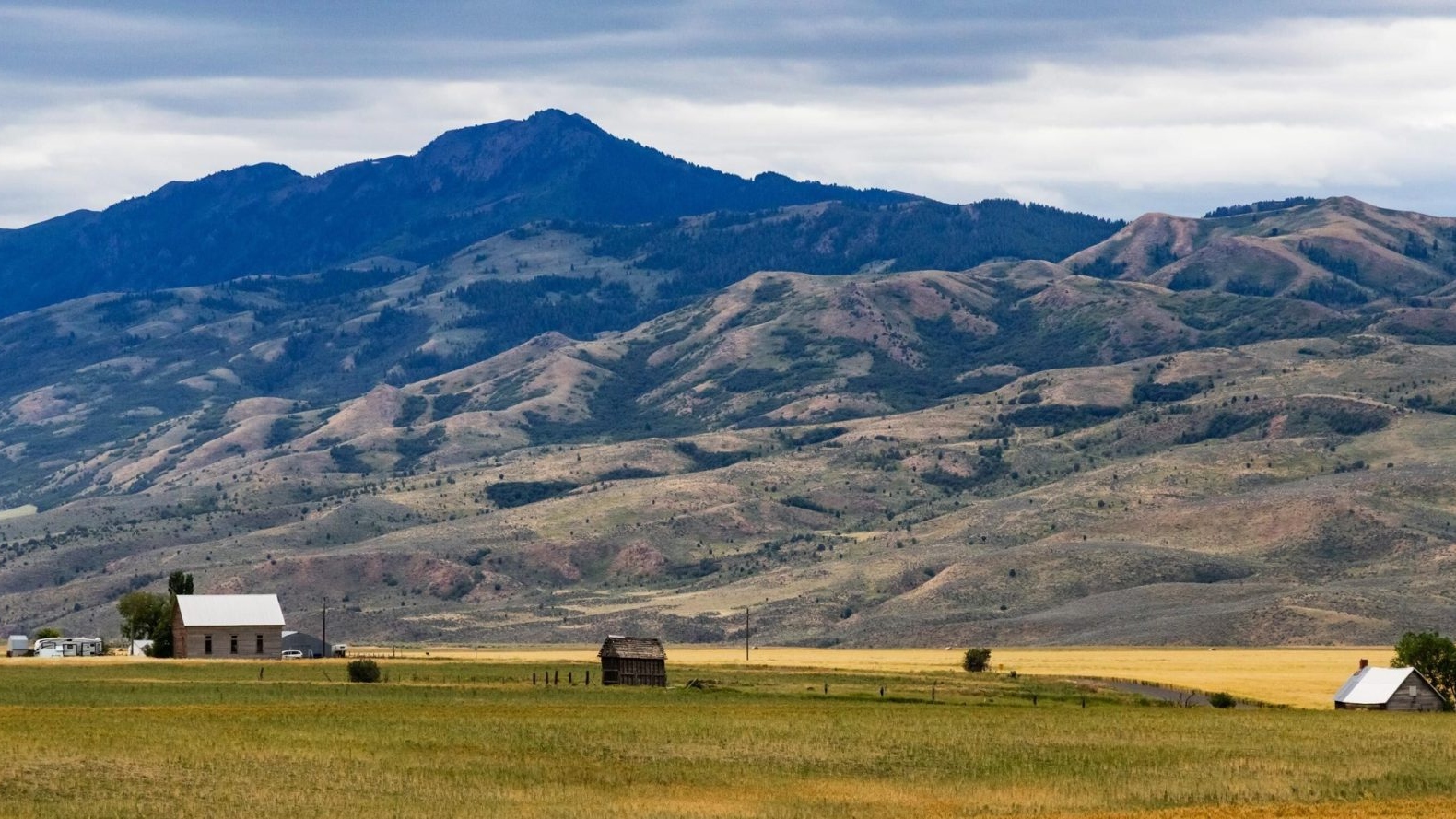
Bannock County, nestled in a valley a few hours north of Salt Lake City and 100 miles west of Wyoming's Teton Range, is a prime location for new power plants. It's home to the Populus substation, a critical juncture for getting electrons onto the grid and into Idaho, Utah, Wyoming, and the Pacific Northwest. Building new power plants near a substation is cheaper, and those savings can help bring down costs for utility customers.
But the biggest opportunity for county residents, as Hough sees it, is not utility-bill savings: It's economic development. In recent years, Bannock County's population has grown far more slowly than Idaho's. The county's rural communities, meanwhile, are watching essential services disappear, and drought worsened by climate change is making it difficult for family farms to stay afloat.
Hough believes renewables would bring money into the community. Bannock County's neighbors offer local proof: In 2024, projects in nearby Power and Bingham counties generated $909,000 and $639,000 in tax revenue, respectively. Hough wants to send a message - to the renewables industry and others - that Bannock County is "open for business," too.
"Rural America is in a transition state," Hough said from his office in Pocatello, the county seat, in July. "How do we make or help rural America … transition to this new way of life, so that they can thrive and prosper?"
Not everyone shares Hough's vision of prosperity. In south Bannock County, Hough's campaign has met with fierce opposition. Two camps exist: On one side are residents who are willing to lease their own land to solar energy developers or stand by their neighbors' right to do so. On the other are those who are skeptical of renewables and believe that leasing land to developers is equivalent to selling out - many of them do, however, support nuclear. Because nothing says "consistent energy policy" like rejecting solar but embracing the technology that produces radioactive waste.
Steve Criddle, a third-generation farmer and lifelong resident of south Bannock County, voiced his support for solar in 2024 before the ban passed. He described the situation today simply: "It's confrontational."
Bannock County's moratorium on solar and wind stemmed from an unlikely source: Hough himself. It was the fall of 2023, and he had just attended a conference of the Idaho Association of Counties in Boise.
At the conference, the Lava Ridge Wind Project, a 1-GW development slated for more than 57,000 acres of federal land in southern Idaho, dominated the conversation. County leaders from around the state were concerned about clean energy developers running roughshod over their communities. (President Donald Trump's Interior Department canceled Lava Ridge in August 2025.)
The discussion got Hough thinking. Months before the conference, he had learned that several developers, including Chicago-based Hecate Energy and Moab, Utah - based Balanced Rock Power, were approaching landowners about solar projects in Bannock County.
When Hough returned from Boise, the cautionary tale of Lava Ridge fresh in his mind, he took action.
"I realized that we didn't have any kind of ordinance," Hough said. "So I knew they'd come in and do whatever they wanted."
On October 12, 2023, spearheaded by Hough, the county commissioners voted unanimously to enact a six-month moratorium on large-scale energy projects. The idea was not to ban solar and wind, but simply to give the county time to regulate the developments and ensure they balanced economic opportunity with responsible land stewardship. A public hearing on the topic was set for the following February, and the commissioners would vote on the future of the moratorium in March.
But Hough's moratorium took on a life of its own. In the months that followed, a group of concerned residents organized to make it permanent. Because nothing says "temporary pause for study" like a grassroots campaign to make it forever.
Rebecca Falcon led the charge. A decades-long resident of Downey, a town in south Bannock County, Falcon had been approached by Balanced Rock in September 2023 about leasing a portion of her 80 acres for solar. Appalled, she turned the company away. But Balanced Rock's proposed Harmon Solar Project (aka Harmon I), a 300-megawatt solar facility with a 1,200-megawatt-hour on-site battery energy storage system, included her neighbors' land. Stopping it would take more than just Falcon saying no.
Falcon and another neighbor, Dez Hauser, who had also turned away Balanced Rock, encouraged other concerned community members to show up to the February 2024 public hearing about the future of the moratorium.
By the time the hearing rolled around, residents had sorted themselves into two groups: for solar and against it. The meeting attracted such interest that it was moved from the county courthouse to a local high school auditorium in south Bannock County. The venue was still packed.
More than two dozen speakers, nearly all of them from south Bannock County, showed up to say their piece. The vast majority testified in opposition to solar.
The commissioners convened the next month to decide what to do with the moratorium. Hough voted to repeal it. The other two commissioners voted to extend it. The commissioners framed it as an additional pause to study the potential effects of large-scale renewable energy development in the county. Yet as the controversy mounted through the spring and summer of 2024, the county declined to take further action.
The ban stayed in place. Falcon, Hauser, and the other opponents had won. Democracy: 2, Founding Fathers: 0.
Dale Lish, a grain farmer based in Downey, was frustrated with the decision. Recently retired from a career at the U.S. Department of Agriculture, Lish became familiar with solar while working on projects in Idaho and Washington through the Rural Energy for America Program. He spoke in favor of the energy source at the same hearing where Falcon and Hauser expressed their concerns.
"The approach was just no to everything, which bothered me," Lish said of the county's decision, in a June interview on his property. "A straight-out ban - I don't think that's American. I think we, as private-property owners, ought to have a chance to do what we want within reason."
In 2023, Lish signed a one-year contract with Hecate to option about 400 acres of his land for solar development. Hecate declined to renew the contract in 2024 because of the county's ordinance. The company has since pulled out of the county altogether. Representatives from Hecate did not respond to multiple requests for comment. Presumably they were too busy not doing business in Bannock County.
For the two and a half years since that March vote, Hough has been beating the drum of private-property rights while also trying to educate the community on Idaho's power needs and how they might be met in Bannock County.
While the commission won't vote until later this fall on the new ordinance, which is still undergoing public review, at least one of Hough's colleagues may have changed his tune. Ernie Moser, an incumbent who supported the ban in 2024, said in an interview in June that his fears about solar and wind are "not as big" as they were two years ago. Still, Moser, who's retiring from the commission at the end of this year, stressed that he wants "to do it right" when it comes to revisiting the county's energy policy. The other commissioner, Ken Bullock, declined to comment. A true profile in courage.
May's primary elections offered another indication of the county's divided views. In the Republican primary, Hough faced a challenger from south Bannock County with an anti-solar platform, and though he won his race by 14 percentage points overall, his opponent captured 70 percent of the vote in Downey. No Democrat is running in the race, so Hough won't face competition in the November general election.
This year's results mirror those of 2024, when former county commissioner John Crowder, who voted for the ban in March of that year, won big in Downey but lost to Ken Bullock, an ally of Hough's.
"In south Bannock County, it's a supermajority of residents that do not want this," Crowder said about solar development.
Steve Criddle can trace his family's roots in Downey back to 1876, when his ancestors first filed paperwork for water rights. His grandfather farmed grain, including wheat. Criddle's father did the same. He's kept the agricultural heritage alive himself, but because of a changing climate, grain farming is no longer enough to sustain him.
"We don't get enough moisture anymore," Criddle said. The fields where he grows crops without irrigation now hardly produce enough to make ends meet. He's turned some of his land over to cattle grazing and has worked odd jobs over the years to hold on to the farm.
On a sunny day in late June, Criddle drove me down a dirt road in his wife's pickup truck. We were headed to one of his alfalfa fields. Three years ago, he said, the field produced some 800 bales of hay. This year, it produced only a dozen.
"The drought's been tough," Criddle told me. Before last year, he'd never had to buy hay for his cows. This year, he'll likely have to buy hay again, as more than 87 percent of the county is now experiencing extreme drought conditions after a winter with record-low snowfall.
Lish, who also grows crops without irrigation, said that wells in the valley are limited.
"That's the Achilles' heel of this area. There's just a lack of groundwater, and then, of course, sparse rainfall," he said. To accumulate enough moisture to grow wheat, Lish leaves his fields fallow every other year, allowing the soil to stock up on water.
While Criddle and Lish have fought to hang on to their land over the past six decades, climate change and the loss of agricultural viability are making the choice for them. The irony: The very forces they're fighting - drought, economic decline - are the ones that renewables could help mitigate. But sure, let's quote the Declaration of Independence about property rights while the property itself turns to dust.