Humanity's Coastal Real Estate Investment Sinks Faster Than It Can Blame the Ocean
A new study finds the ground beneath hundreds of millions of coastal residents is sinking faster than seas are rising, largely thanks to our own brilliant engineering.
A new study in Nature delivers the uplifting news that many of the world's largest river deltas are sinking into the Earth faster than global sea levels are rising, putting hundreds of millions of people at risk. The primary drivers of this cheerful trend are intensive groundwater extraction, a decline in river sediment, and rapid urban development.
This research, led by former Virginia Tech graduate student Leonard Ohenhen, now at the University of California, Irvine, and overseen by Virginia Tech geoscientists Manoochehr Shirzaei and Susanna Werth, offers the first detailed, high-resolution analysis of elevation loss across 40 river deltas. The results show that almost every delta studied contains areas where the land is dropping faster than nearby sea levels are rising. In 18 of the 40 deltas, this subsidence already exceeds local sea-level rise, increasing near-term flood risk for more than 236 million people.
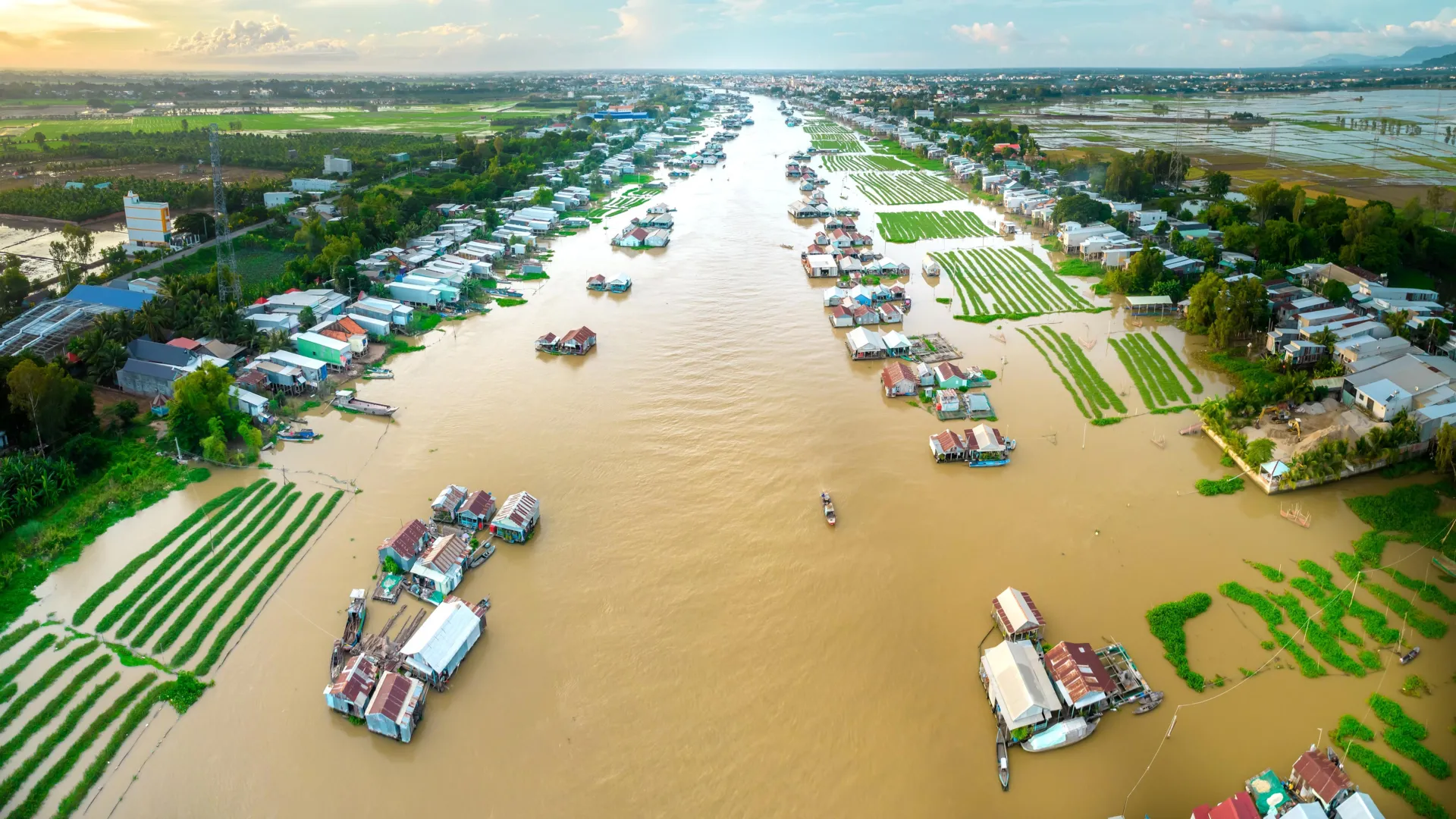
Using advanced satellite radar systems to map changes at a scale of 75 square meters per pixel, researchers tracked sinking across five continents. Several major deltas are experiencing especially rapid elevation loss, including those of the Mekong, Nile, Chao Phraya, Ganges-Brahmaputra, Mississippi, and Yellow rivers. "In many places, groundwater extraction, sediment starvation, and rapid urbanization are causing land to sink much faster than previously recognized," Ohenhen noted, with some areas sinking at more than double the current global pace of sea-level rise.
"Our results show that subsidence isn't a distant future problem -- it is happening now, at scales that exceed climate-driven sea-level rise in many deltas," said Shirzaei. The study identifies groundwater depletion as the strongest overall factor, though the main cause varies by region. Werth added, "When groundwater is over-pumped or sediments fail to reach the coast, the land surface drops. These processes are directly linked to human decisions, which means the solutions also lie within our control." The research was supported by the National Science Foundation, the Department of Defense, and NASA.
The Good Times
News in your inbox.
One sardonic roundup, delivered on your schedule. Free. Unsubscribe whenever your tolerance for wit runs out.
Already subscribed but we never reach your inbox? Check your spam folder and hit 'Not spam' (or 'Remove from spam') to bust us out of junk-mail purgatory. You'll be helping everyone else too.
Don't open any of our emails for a month and you'll be automatically removed from the mailing list.
Rewrite Article
Select parts to regenerate with a fresh AI pass. Translations will be updated automatically.
Generate AI Image
Creates a sardonic version of the article image using OpenAI.