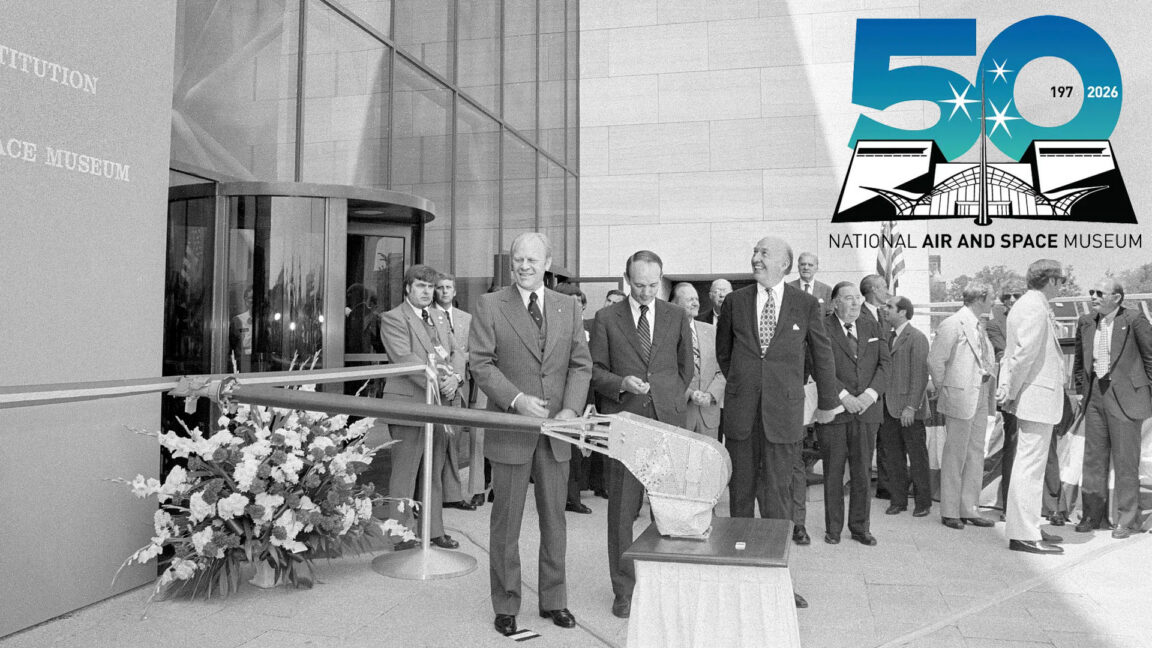
How a Viking Arm From 50 Years Ago Cut a Ribbon - and Everyone Held Their Breath
In 1976, a Viking Mars lander arm cut a ribbon at the National Air and Space Museum's opening - with a backup button-pusher ready - and 50 years later, no one's sure which arm it was.
Michael Collins looked down at his watch. The Apollo 11 astronaut had already beaten the original schedule for the opening of the National Air and Space Museum by three days, but no one would remember that if these final 36 minutes didn’t go perfectly. President Gerald Ford and Vice President Nelson Rockefeller took 35 seconds to find their seats. The Thunderbirds flyover was quick enough. At any other event, it would have been the only time-dependent concern.
Collins kept glancing at the time. The Presentation of Colors took 20 seconds. The national anthem, performed by the Air Force band, took about 85 seconds. Then came the invocation delivered by the Bishop of Washington, and then the Smithsonian Secretary Dillon Ripley welcomed everyone. Chief Justice Warren Burger made short work of introducing the president. Ford took the podium at 11:13 am.
“This beautiful new museum and its exciting exhibits of the mastery of air and space is a perfect birthday present from the American people to themselves,” Ford said. “Although it is almost impolite to boast, perhaps we can say with patriotic pride that the flying machines we see here, from the Wright brothers’ 12-horsepower biplane to the latest space vehicle, were mostly ‘Made in USA’.” Nine and a half minutes later, he concluded with a quote from Thomas Jefferson and John Adams: “I can only add, let the experiment continue.”
Everyone moved to the entranceway, where a 12-foot-tall teal backdrop with the museum’s name was flanked by traffic lights - two green lights (off) and a set of blinking red lights. Centered in front, on a white-draped table, sat a piece of NASA hardware: the surface sampler arm from an engineering model of a Viking Mars lander. A red, white, and blue ribbon was strung between the arm and the wall.
About 36 minutes earlier, NASA had sent a signal to the real Viking 1 probe - then 20 days from landing on Mars - which relayed it back to Earth. At that distance, communications took about 18 minutes one way. The command was received by a tracking station and sent to the engineering arm in front of the museum. As Ford, Collins, and Ripley looked up, the green lights blinked on, confirming the signal had been received.
“I was holding my breath,” Collins recalled decades later. “I was thinking about all those electrons going lost up there in space and all these VIPs standing around looking at this ribbon and this mechanical shearing device and nothing would happen.” The museum’s opening had been moved from July 4 to avoid competing with bicentennial celebrations, and Viking 1’s landing was delayed from July 4 to July 20 due to rough terrain at the primary landing site. So Collins was already dealing with date and time changes beyond his control.
“But believe it or not, all of the electrons did their cute little things and the ribbon got snipped and the building got opened. It was good,” he said. The doors then opened, and the public got their first look at the Wright Flyer, Spirit of St. Louis, and the Apollo 11 command module Columbia.
Of course, NASA and the Smithsonian were not going to allow a wayward signal to ruin the day. “We were prepared to cheat,” said Don Lopez, a museum staffer. “We had a guy in the back with a button to push if it didn’t happen.” With the ribbon cutting a success, the sampler was packed up and taken back by NASA.
Inside the museum on July 1, 1976, Viking was represented by a static model that had been in the US pavilion at the 1975 Paris Air Show. It was not until 1979 that NASA donated the proof test article that millions have since seen in the Boeing Milestones of Flight Gallery - the same model used on Earth during the Viking 1 and 2 missions to test responses to radio commands. It is unlikely, though not impossible, that NASA removed the arm from that test article for the ceremony.
At least three other active arms were made. In addition to the two on Mars and one at the National Air and Space Museum, engineering models are on display at the Virginia Air and Space Science Center (science test/thermal effects article) and the California Science Center (static or dynamic test model). The last one was at the Kennedy Space Center Visitor Complex until 2019, when it was returned to NASA; today it’s believed to be at a planetarium in New Jersey.
Unfortunately, photographs from the 1976 ceremony are not clear enough to read serial or part numbers, and no one at the museum seems to remember which model the arm came from. On Wednesday morning (July 1), before opening five newly renovated galleries to the public, the National Air and Space Museum will host a private ceremony to mark its 50th anniversary, featuring remarks by NASA Administrator Jared Isaacman and Amanda Wright Lane, the great-grandniece of Orville and Wilbur Wright. The half-century celebration will not hinge on a signal from space. But perhaps on some future commemoration, the arm that opened it all can be identified and given its long-awaited due.
The Good Times
News in your inbox.
One sardonic roundup, delivered on your schedule. Free. Unsubscribe whenever your tolerance for wit runs out.
Already subscribed but we never reach your inbox? Check your spam folder and hit 'Not spam' (or 'Remove from spam') to bust us out of junk-mail purgatory. You'll be helping everyone else too.
Don't open any of our emails for a month and you'll be automatically removed from the mailing list.
Rewrite Article
Select parts to regenerate with a fresh AI pass. Translations will be updated automatically.
Generate AI Image
Creates a sardonic version of the article image using OpenAI.