
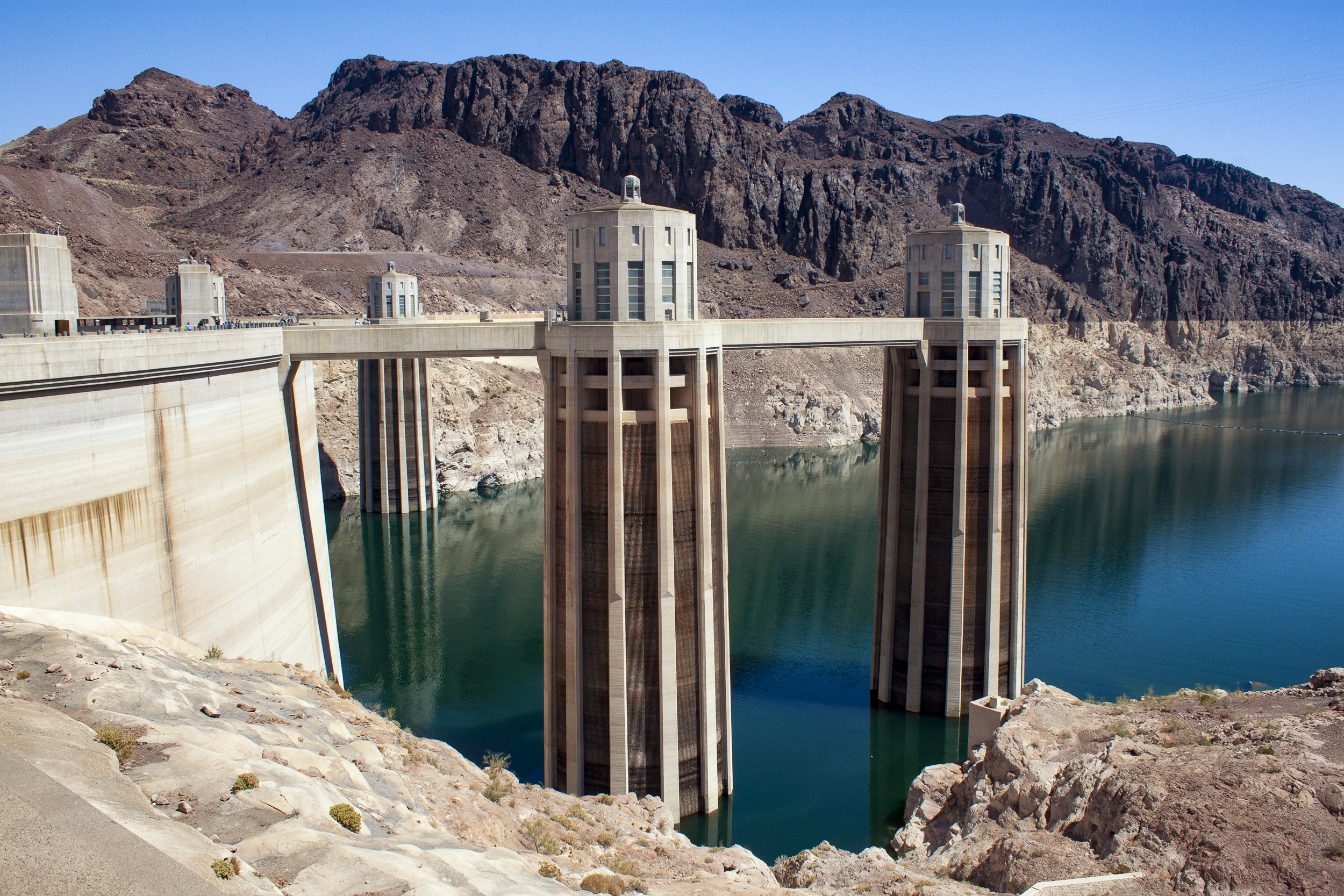
Sometime in the next 12 months - maybe late August, maybe next spring - Lake Mead will dip below the critical threshold of 1,035 feet above sea level. At that point, Hoover Dam, the largest hydropower generator in the Colorado River basin, will lose 70 percent of its generating capacity. Because nothing says "reliable infrastructure" like a massive concrete plug dependent on water that isn't there.
Water managers have known for at least 18 months that elevation 1,035 would be a problem. Twelve of the dam's 17 turbines can't handle low-water conditions. After record-low winter runoff, the reckoning is imminent. “We’re going to go to 1,035,” Tom Buschatzke, director of the Arizona Department of Water Resources, said in mid-May. “There’s no question that’s going to happen.” He didn't add "brace yourselves," but the tone was implied.
The Colorado River's big reservoirs, Lakes Mead and Powell, are essentially filled with trip wires - water-level elevations that, once breached, trigger unpleasant outcomes. Both are low enough that those trip wires are now in sight, and water managers are in triage mode, trying to minimize damage while acknowledging unfortunate tradeoffs.
Some help is supposedly on the way. The Bureau of Reclamation announced on May 21 it will spend $52 million on three new wide-head turbines that can generate power down to elevation 950 feet. “Unlocking these funds allows us to move forward with critical upgrades at one of the nation’s most important hydropower facilities,” said acting Reclamation commissioner Scott Cameron. Once installed - timeline unclear - the capacity cut at 1,035 feet will drop to 58 percent. Less bad, still bad.
Hoover's hydropower troubles stem from problems upstream at Glen Canyon Dam, which forms Lake Powell. In April, Reclamation decided to reduce water releases from Powell by 20 percent this year to protect Glen Canyon's infrastructure and keep its hydropower running. The side effect: less water flowing out of Powell accelerates Mead's decline. Earlier this month, Mead was dropping roughly one foot every five days. It's now at 1,050 feet. At this rate, the 1,035 mark will be breached later this summer.
But timelines are fuzzy. The lower basin states - Arizona, California, Nevada - have proposed a conservation plan that might keep Mead above 1,035 until next spring. The rate of decline has slowed to a foot every five to seven days. The cliff's timing depends on conservation, summer heat, and whatever moisture the monsoon brings. That means a lot of watching and recalibrating, said Dane Bradfield, general manager of Lincoln County Power District in eastern Nevada. “It’s not a kick-back summer by any means.” Because his district gets about 70 percent of its electricity from Hoover, serving about 5,000 people north of Las Vegas.
The district forecasts power generation and demand, then hedges against shortfalls with market contracts. Bradfield says he's confident the district has secured enough power through 2026, but he's already looking at 2027. Market conditions are favorable right now, but “it all changes so fast,” he noted. Lincoln County has also been acquiring solar power, which helped cushion the hydropower shortfall already occurring. Hoover's output today is 40 to 50 percent lower than in 2000, when Mead was full and Lincoln County got all its power from Hoover.
Hydropower has traditionally been cheap. That may change if Mead topples over the 1,035 cliff, warns Jordy Fuentes, executive director of the Arizona Power Authority. The rate Arizona customers pay includes operations, maintenance, visitor center costs, ecosystem protections, and repayment of the Central Arizona Project canal. Less hydropower to sell means the price per unit must rise to cover fixed costs. Fuentes reckons the rate could triple, but the timing is uncertain. “Will there be a lag in how they recover those costs? Or is there a period of time with a hole in the budget?”
Bradfield is having the same affordability conversations. “We are anticipating that the cost of hydropower will probably go up,” he said. “And that’s another discussion… is how much and when does that get to a point where that resource is priced out by other resources? Because typically hydropower has been the cheapest.”
Beyond customers, there's the grid. Hydropower is valuable not just for electricity but for maintaining steady flow - it can respond almost instantly to demand changes, like early evening when people return from work and crank up the AC. It's an extremely inexpensive way to provide ramping services, said Nathalie Voisin of Pacific Northwest National Laboratory. The Colorado River emergency, she said, demonstrates the need for more joint management of water and energy. “This doesn’t mean that the grid is going to go dark. It just means that other resources are being used to compensate… and it’s just more expensive.”
How large a grid effect? That remains to be seen, said Katie Rogers, manager of reliability assessment for the Western Electricity Coordinating Council (WECC). WECC's 2026 summer outlook speaks in general terms about drought, extreme heat, wildfire, and diminished hydropower. “We have to not just look at that one initial risk,” said Brian D’Agostino from San Diego Gas and Electric during a WECC webinar. “We have to start looking at what happens when we combine two or three of these simultaneously.”
Rogers said WECC is now collaborating with hydrologists and scientists to model grid operations with a drastic loss of Hoover capacity. Their computer models let them essentially turn Hoover off and see how the grid responds under different scenarios - weather, generation, demand. Will large-scale battery storage offset the loss? Is a spring heat wave worse than a summer spike? “We do those ‘what if’ scenarios and your question is spot on - can the other areas of the grid compensate for what may be lost?” Rogers said. “And we don’t necessarily have answers to those questions, but those are the exact kinds of questions we try to get at.”
Those questions are timely - and timeless. A warming climate is reducing water availability in the Colorado River basin. These pressures on hydropower from low reservoir levels aren't likely to let up. “Absent some hydrology changes, the hydropower resource at both the upper basin and the lower basin is absolutely in trouble and directly related to drought,” Fuentes said.