
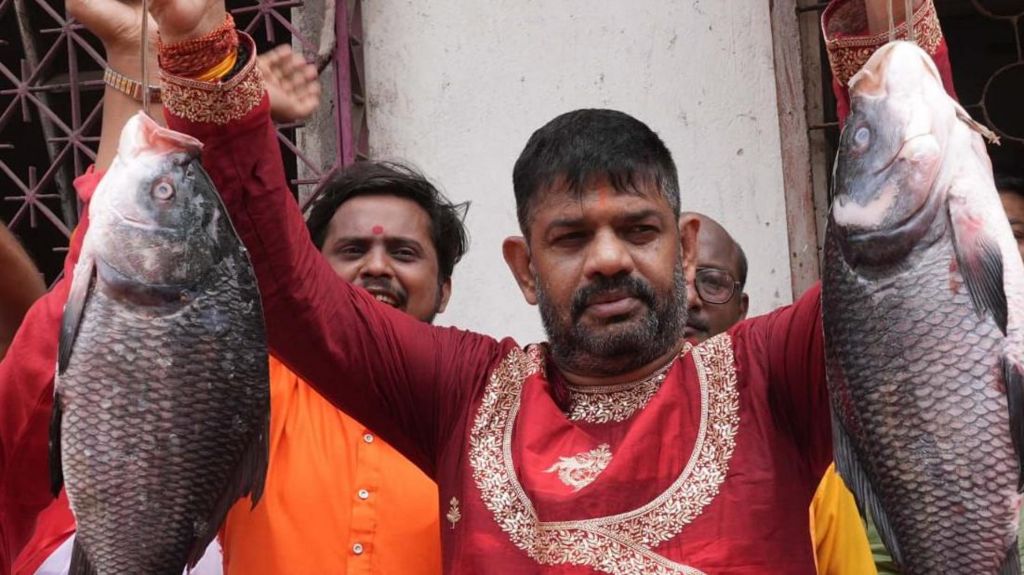
On a sticky morning in Kolkata, lawyer-turned-politician Koustav Bagchi, the Bharatiya Janata Party (BJP) candidate from Barrackpore, campaigned door-to-door in crisp white and red traditional attire. His key accessory? A fish. Drums thudded and supporters chanted, but the main message was visual: I am one of you.
A few kilometres away in Kolkata's port area, another BJP candidate, Rakesh Singh, staged a similar spectacle, hoisting a fish repeatedly as he moved through crowds to challenge the city's mayor, Firhad Hakim. In Bengal, fish is more than food; it's the bloodstream of the cuisine, woven into memory, ritual, and everyday life as a marker of identity and belonging. That resonance is now political theatre, with candidates brandishing fish to quell a specific anxiety.
In a country where food habits are deeply political, Prime Minister Narendra Modi's BJP is often associated with a more assertive, sometimes moralised vegetarianism. Periodic restrictions on meat sales in some BJP-ruled states and crackdowns linked to cow protection have cemented that perception, even though India remains overwhelmingly non-vegetarian. In the West Bengal election, fish has slipped from the plate into the campaign, recast as proof of cultural fidelity and a rebuttal to charges of intrusion.
Chief Minister Mamata Banerjee of the ruling Trinamool Congress, seeking a fourth consecutive term, has warned that the BJP "threatens Bengal's way" of life, invoking fish and rice as non-negotiable. "The BJP will not allow you to eat fish. Nor will they allow you to eat meat or eggs," she told a campaign meeting. The feisty 71-year-old leader challenged the BJP in another meeting: "Bengal lives on fish and rice. You are telling Bengal people you can't have fish, you cannot have meat, you cannot have eggs - what will they eat then?"
The BJP has pushed back sharply. Smriti Irani, a BJP leader campaigning in Bengal, called the claim "a lie," insisting that "Bengal and fish and rice are a part of its culture which will never end." Swapan Dasgupta, the party's candidate from Kolkata's Rashbehari seat, said Banerjee's charge was a distraction: "They are trying to divert public attention from their corruption with this false narrative that we will prohibit fish consumption. This is rubbish."
On the campaign trail, Modi himself, a vegetarian, turned to fish as a marker of governance failure. He accused Banerjee's government of failing to make Bengal self-reliant in fish: "Even after 15 years in power, the Trinamool Congress has failed to provide you with even something as basic as fish. Even fish has to be sourced from outside the state." Banerjee hit back instantly, saying 80% of Bengal's fish needs are met locally. "You [BJP] do not allow fish consumption in Bihar, Uttar Pradesh and Rajasthan, states that you govern, and organise attacks on fish shops in Delhi. Aren't you ashamed?" she told a campaign meeting.
Between cultural anxiety and economic critique, fish has become shorthand for everything the rivals say is at stake. India is the world's third-largest fish producer and second in aquaculture, yet ranks a low 129th globally in per capita fish consumption. But in West Bengal, fish is near-universal. A 2024 joint study by ICAR and WorldFish found that about 65.7% of people in West Bengal consume fish weekly. It sits alongside eastern and southern states where more than 90% of people eat fish, even as India overall sees a steady rise in fish consumption, now reaching over 70% of the population.
In Bengal, fish has always carried meanings far beyond the plate. In his acclaimed Bengali novel Padma Nadir Majhi (The Boatman of the Padma), Manik Bandopadhyay turns fish into fate and survival along a restless river. In The Hungry Tide, novelist Amitav Ghosh binds it to ecology and precarity in the Sundarban delta on the Bay of Bengal. The prized hilsa fish, writes Samanth Subramanian in Following Fish, is so central that "if Bengali cuisine were Wimbledon, the hilsa would always play on Centre Court." To eat it properly - deboning it deftly in the mouth - is almost a rite of belonging.
Fish also signals geography (river systems like the Ganges River versus the Padma River), history (the legacy of the Partition of India separating East and West Bengal), and class - who can afford prized varieties, who prepares them, and who has the cultural know-how. Even Bengal's fiercest football rivalry carries fish: fans of East Bengal FC - many with roots in what is now Bangladesh - are stereotypically partial to hilsa, while Mohun Bagan Super Giant supporters are said to favour prawns. It's a playful shorthand for deeper histories of migration, class, and taste.
Sociologists believe this dense symbolism has made fish politically useful. Parties aren't just invoking it; they are folding it into campaign choreography to bait opponents. For historian Jayanta Sengupta, fish is "inseparable from Bengali cuisine, shaped by geography and its long role as an affordable source of protein." "As the BJP has, at times, been associated with a push toward vegetarian norms, Bengal's ruling party has folded food into a broader pitch around cultural pride," says Sengupta. "Knowing the symbolic significance of fish, the BJP could not ignore the issue. That's how we see both sides countering each other's campaign over one of Bengal's favourite foods."
Last week, the BJP's state President Samik Bhattacharya offered journalists in Kolkata an invitation for results day on 4 May - when, he said, the party would welcome them with fried fish. After the results, Bhattacharya said, the BJP would send "different kinds of small fish" to Banerjee's house and invite her party workers over for mach bhaat, Bengali for fish and rice. The joke hinged on a quiet premise: that the BJP will be in a position to play host - and its rivals, to accept the invitation.
In an election shaped by identity, livelihoods, and playful baiting, fish may not decide the result. But it has already framed the contest - revealing how instinctively culture and politics bleed into each other on the campaign trail.