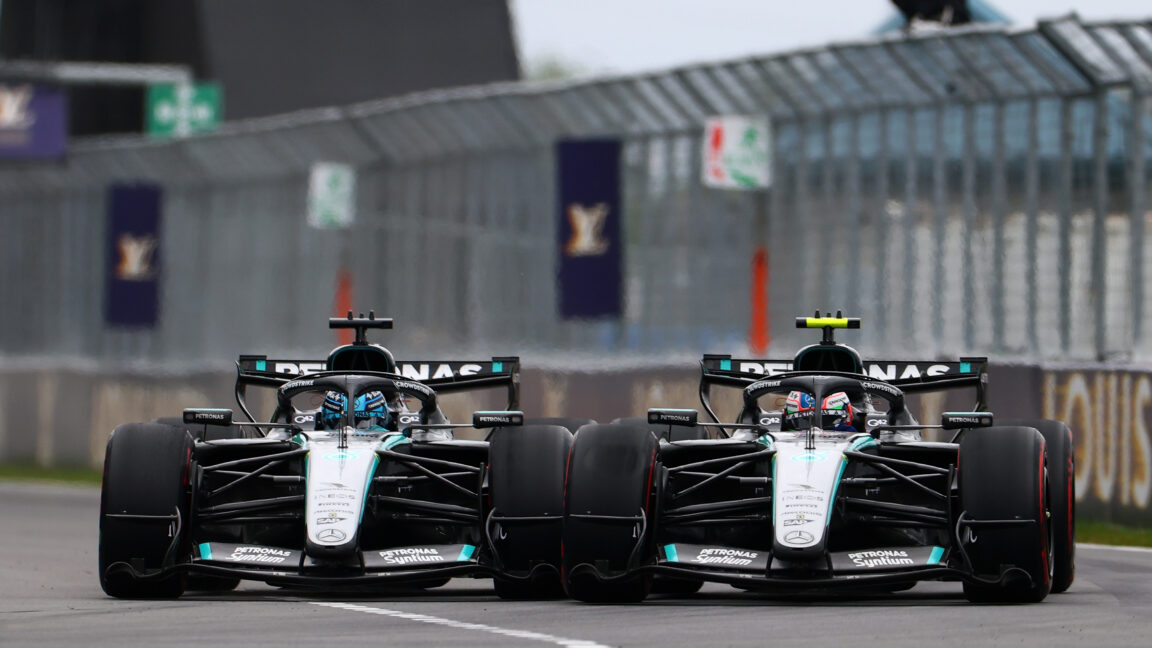
Apologies for the lack of a Canadian Grand Prix report; Ferrari decided to unveil its new electric vehicle last weekend, and between that and Memorial Day, the usual chaos ensued. Canada was another sprint weekend, meaning teams had limited practice to collect data on upgrade packages. The race, held on an artificial island from Expo 67, delivered excellent duels, but the real drama was mechanical.
Nineteen-year-old Italian sophomore Kimi Antonelli now leads Mercedes teammate George Russell by 43 points in the championship after four straight wins. With 25 points per win, Russell could soon be two race wins behind his young in-house rival - never comfy when equipment is identical. But last year Oscar Piastri led Max Verstappen by over 100 points at the Dutch Grand Prix (race 15 of 24) yet finished 11 points behind, so early declarations are foolish.
Russell was in control of the Canadian race until his battery catastrophically failed on lap 30. As the late Murray Walker said, "To finish first, first you have to finish" - obvious but crucial. The current cars' fragility seems odd only because the hyper-reliable hybrids from 2017 - 2025 were outliers. Even in the 2000s, drivers faced a 40% chance of failure before the flag.
Reliability has robbed drivers closer to victory: Felipe Massa dominated the 2008 Hungarian Grand Prix before a conrod failure three laps from the end. Mika Hakkinen's hydraulics failed on the final lap of the 2001 Spanish GP, handing the win to Michael Schumacher. Damon Hill's 1997 Hungarian race was heartbreaking - after being dumped by Williams for Heinz-Harald Frentzen (a catastrophic error), Hill led by half a minute with three laps to go in an underfunded Arrows before a hydraulic leak let Jacques Villeneuve steal the win.
Past practices contributed: taking cars apart nightly led to retirements when things went back together wrong. Now cars are left parked. Rules requiring engines to last multiple weekends also helped. This year's new power units are all-new, despite the same V6 layout: no MGU-H turbochargers, a 3,000 MJ/hour energy limit instead of 100 kg/hour fuel flow, and redesigned MGU-K and batteries. The 2014 hybrids also started unreliable.
Now the sport has a different problem: 2026 regulations limit battery energy to a fraction of a lap, forcing cars to divert V6 power to recharge. The fastest qualifying lap isn't flat-out anymore. A proposed fix - rebalancing V6 to MGU-K from 53:47 to 60:40 - has support from Mercedes and Red Bull (desperate to keep Verstappen), but Audi, Cadillac, Honda, and Ferrari oppose it. Ferrari hopes ADUO (Additional Development and Upgrade Opportunities) will let it catch Mercedes, but if everyone tweaks, the gap remains. So Ferrari prefers the status quo, even at the cost of shorter races or losing Verstappen. Audi and Honda are now key, per journalist Jon Noble.
Next up: Monaco, which swapped with Canada for better North American grouping. With many braking zones and few straights, it should flatter the new, smaller, nimbler cars.
The Good Times
News in your inbox.
One sardonic roundup, delivered on your schedule. Free. Unsubscribe whenever your tolerance for wit runs out.
Already subscribed but we never reach your inbox? Check your spam folder and hit 'Not spam' (or 'Remove from spam') to bust us out of junk-mail purgatory. You'll be helping everyone else too.
Don't open any of our emails for a month and you'll be automatically removed from the mailing list.
Rewrite Article
Select parts to regenerate with a fresh AI pass. Translations will be updated automatically.
Generate AI Image
Creates a sardonic version of the article image using OpenAI.