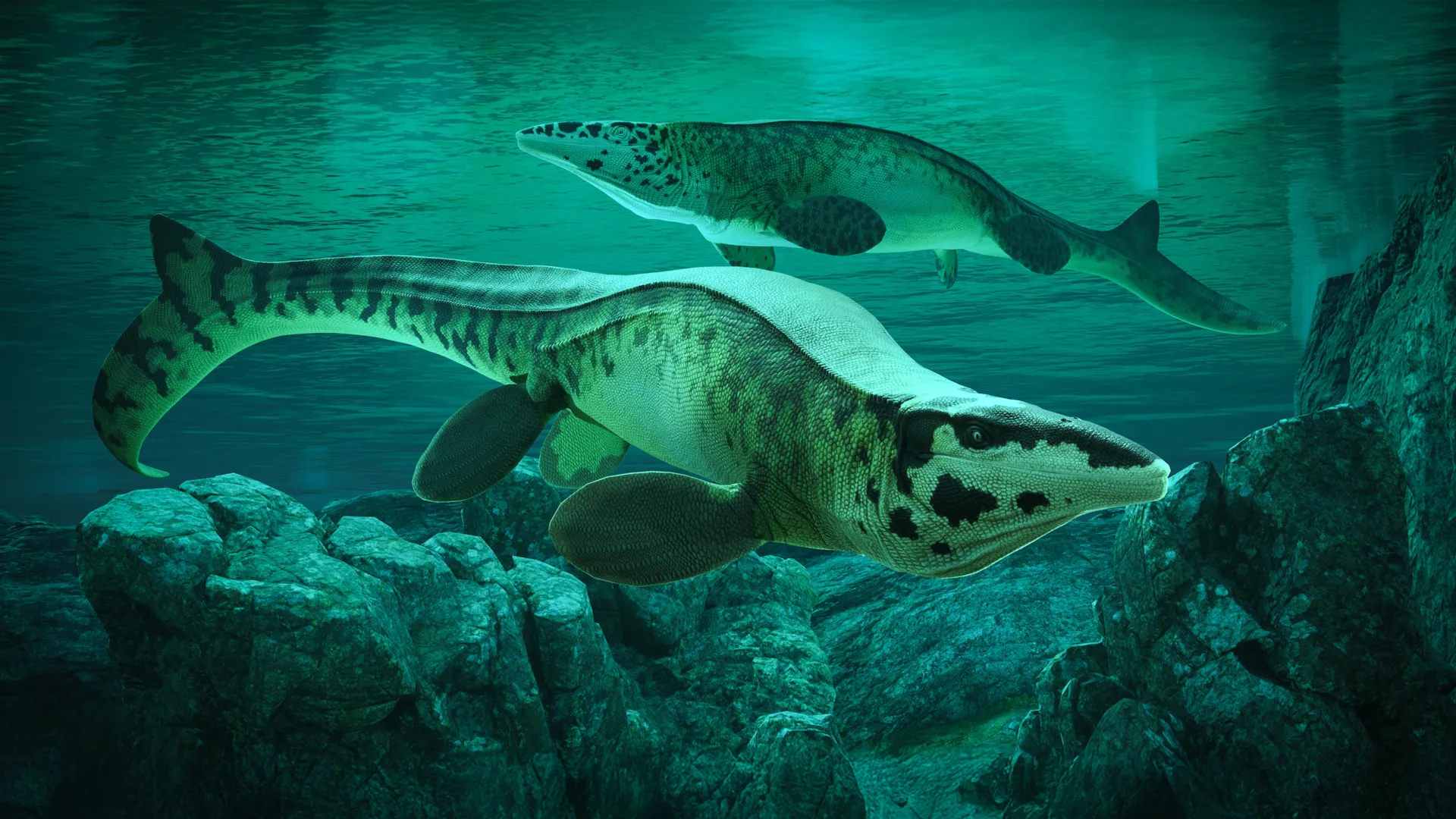
Everything Really Is Bigger in Texas: Scientists Discover 43-Foot Sea Monster Tylosaurus rex
Paleontologists confirm Texas mosasaur was 43 feet of serrated teeth and bad attitude, proving everything - including ancient sea monsters - is bigger in the Lone Star State.
Scientists have officially identified a new species of mosasaur that made ancient oceans its personal buffet, and of course it comes from Texas. The creature, dubbed Tylosaurus rex (or T. rex, because paleontologists love confusing the public), measured up to 43 feet long and ranks among the largest mosasaurs ever found.
The research, published in the Bulletin of the American Museum of Natural History, was led by scientists from the American Museum of Natural History, the Perot Museum of Nature and Science in Dallas, and Southern Methodist University. Fossils of the beast were found mainly in northern Texas and date back about 80 million years.
"Everything is bigger in Texas and that includes the mosasaurs, apparently," said Amelia Zietlow, lead author and a Ph.D. graduate who now works at the History Museum at the Castle in Wisconsin. She started investigating after noticing one fossil in the museum's collection had been misidentified as Tylosaurus proriger - a classic case of mistaken identity that took 80 million years to correct.
After comparing the specimen with the original T. proriger fossil at Harvard's Museum of Comparative Zoology, researchers realized the Texas fossils were a whole different animal. The new species was larger, had finely serrated teeth - rare in mosasaurs - and came from a different time and place. Most T. proriger fossils are from Kansas and date to 84 million years ago; T. rex lived in Texas about 80 million years ago.
Researchers chose the name Tylosaurus rex as a tribute to paleontologist John Thurmond, who in the late 1960s suspected giant tylosaurs from northeast Texas were special and informally called them "Tylosaurus thalassotyrannus" ("sea tyrant"). The holotype specimen is currently displayed at the Perot Museum in Dallas, discovered in 1979 near an artificial reservoir outside the city.
Beyond its enormous size - roughly twice the length of the largest great white sharks - T. rex was built for violence. Study co-author Ron Tykoski of the Perot Museum said the species had adaptations for powerful jaw and neck muscles, making it "a much meaner animal than other mosasaurs." Evidence includes a specimen nicknamed "The Black Knight" missing the tip of its snout with a fractured lower jaw, injuries likely caused by another member of the same species. Other famous fossils previously identified as T. proriger - including "Bunker" at the University of Kansas and "Sophie" at the Yale Peabody Museum - are now being reassigned to T. rex.
The study also takes a swing at decades-old mosasaur research, noting the main evolutionary dataset hasn't changed much in 30 years. The team created a revised dataset and framework, suggesting many earlier studies may need a do-over. "This discovery is not just about naming a new species," Zietlow said. "It highlights the need to revisit long-standing assumptions about mosasaur evolution." Co-author Michael Polcyn from Southern Methodist University added that the findings underscore Texas as a key region for understanding ancient marine ecosystems.
Support came from the National Science Foundation, the Dallas Paleontological Society, the Society of Systematic Biologists, the Richard Gilder Graduate School, the Gingrich Fund, and the Carter Fund.
The Good Times
News in your inbox.
One sardonic roundup, delivered on your schedule. Free. Unsubscribe whenever your tolerance for wit runs out.
Already subscribed but we never reach your inbox? Check your spam folder and hit 'Not spam' (or 'Remove from spam') to bust us out of junk-mail purgatory. You'll be helping everyone else too.
Don't open any of our emails for a month and you'll be automatically removed from the mailing list.
Rewrite Article
Select parts to regenerate with a fresh AI pass. Translations will be updated automatically.
Generate AI Image
Creates a sardonic version of the article image using OpenAI.