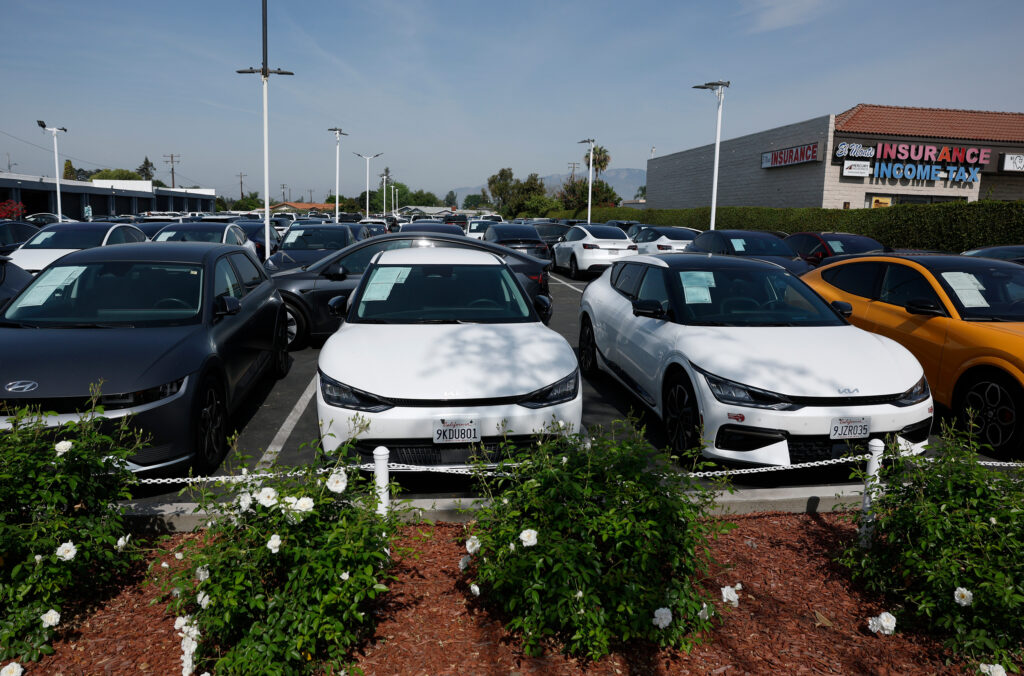
In a move that has all the subtlety of a sledgehammer, the Trump administration is citing slowed electric vehicle growth as its rationale for loosening automobile air pollution standards - after, it should be noted, it spent months actively strangling that growth. The U.S. Environmental Protection Agency announced plans Friday to delay the adoption of Biden-era Tier 4 air pollution standards for passenger cars and trucks, and to reconsider them entirely going forward. The agency said the proposed change responds to “the overwhelming rejection of Electric Vehicles (EVs) by the American people and manufacturers shifting away from them.” It’s a bit like a chef burning your dinner and then blaming you for not being hungry.
Established in April 2024, the Tier 4 Criteria Pollutant Standards were the latest batch of vehicle emissions rules under the Clean Air Act, requiring manufacturers to meet fleet-average limits on smog-producing volatile organic compounds, oxides of nitrogen (NOx) and particulate matter, with phase-in starting in 2027. Back then, EVs accounted for 8 percent of new light-duty vehicles sold in the U.S. - and growth was projected to continue. But after President Donald Trump took office for his second term in January 2025, he kicked off a deregulatory spree: revoking California’s special exemption for stricter rules, blocking the state’s emissions standards via three Congressional Review Act resolutions in June, and setting a September 2025 expiration date for federal EV tax credits through the One Big Beautiful Bill Act. Predictably, EV sales dropped sharply after the credits expired, per the U.S. Energy Information Administration. Auto manufacturers are also poised to gain more latitude following the reversal of the EPA’s 2009 endangerment finding, which underpins federal greenhouse gas regulation.
Despite all this, the EPA has pinned the Tier 4 rule change on “faulty assumptions” by the Biden administration. “In the intervening years since the Biden-Harris Administration established the 2024 Tier 4 emission standards, the assumptions about the trajectory of EVs have not come true,” the agency wrote, adding that the standards are now “unattainable for manufacturers.” EPA Administrator Lee Zeldin chimed in: “The American people have been very clear; they do not want EVs forced upon them.” In a follow-up to Inside Climate News, an agency rep doubled down: “Americans made this clear by leaving EVs unsold on car lots, and the Trump Administration listened to the American people.”
Not everyone is buying it. The League of Conservation Vectors questioned whether the EPA can call this consumer-oriented, especially with gas prices over $4.50 per gallon amid conflicts in the Strait of Hormuz. “The Trump administration’s decision to axe tailpipe standards that can help cars use less gas will further drive up costs for our families, while also making us sicker,” said Matthew Davis, a former EPA scientist and the league’s vice president of federal policy. The International Council on Clean Transportation noted that one in four cars sold globally last year was electric - a first - but the U.S. share of global EV production dropped from 7 percent in 2024 to 5 percent in 2025 as automakers delayed production and cut investment, likely hurting their “long-term competitive advantage.”
The automotive industry, however, is thrilled. “This is a smart and necessary step,” said John Bozzella, president and CEO of the Alliance for Automotive Innovation, a D.C.-based lobby group. “Not only do the emission standards finalized under the previous administration remain unachievable absent significant growth in electric vehicle sales, but they would also make gas-powered vehicles more expensive.” The EPA says the move to delay compliance phase-in dates is part one of a “comprehensive review”; part two will reconsider the entire Tier 4 program, potentially changing standards, dates, test procedures and schedules. So, basically: stay tuned for more of the same.
The Good Times
News in your inbox.
One sardonic roundup, delivered on your schedule. Free. Unsubscribe whenever your tolerance for wit runs out.
Already subscribed but we never reach your inbox? Check your spam folder and hit 'Not spam' (or 'Remove from spam') to bust us out of junk-mail purgatory. You'll be helping everyone else too.
Don't open any of our emails for a month and you'll be automatically removed from the mailing list.
Rewrite Article
Select parts to regenerate with a fresh AI pass. Translations will be updated automatically.
Generate AI Image
Creates a sardonic version of the article image using OpenAI.