
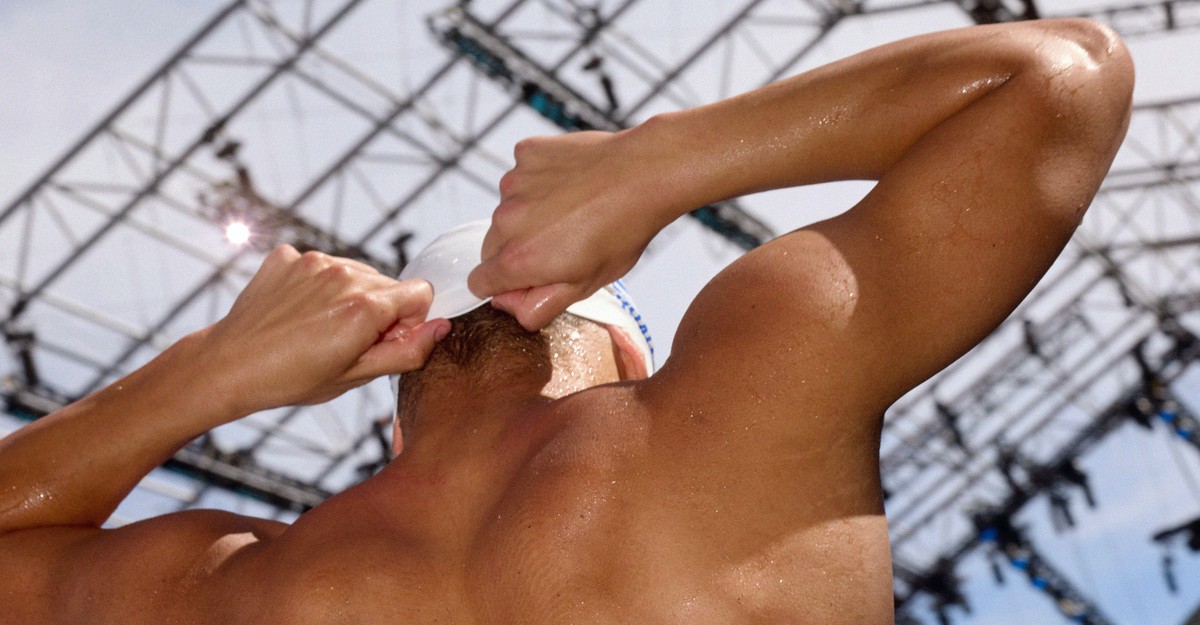
In person, they looked like action figures - or, more accurately, like someone had Photoshopped them and cranked the "big" slider to 125 percent. These were the athletes of the Enhanced Games, the so-called "doping Olympics" that took place in a $50 million Las Vegas venue built just for them. The premise is simple: take any FDA-approved substance you want, break a world record, win up to $1 million. The event, which has raised more than $300 million in venture capital from backers including Peter Thiel and Donald Trump Jr.'s 1789 Capital, is "built for social media, not for television," CEO Max Martin told reporters. Every competition lasts less than a minute, because attention spans are what they are.
Under the close supervision of doctors as part of a clinical trial in Abu Dhabi, athletes followed confidential "protocols" involving 37 substances including Adderall, beta-blockers, human growth hormone, and five forms of testosterone. Effects reported include mood swings, increased power, faster recovery times, and new facial hair. The Australian swimmer James Magnussen, 35 and a three-time Olympic medalist, looked so jacked that he was literally sinking in the pool and couldn't find a swimsuit big enough to fit him. He had to dial back his enhancement protocols for purely practical reasons.
Among the competitors: Kristian Gkolomeev, 32, who broke the 50-meter freestyle world record at a previous Enhanced event and claimed the first million-dollar check; Megan Romano, 35, a former world-champion backstroker who came out of retirement to "see what's humanly possible"; Hafþór Björnsson, 37, an Icelandic weightlifter aiming to deadlift 1,135 pounds (heavier than a yearling steer or most grand pianos); and Andrii Govorov, 34, a Ukrainian world-record holder in the 50-meter butterfly, who is doing it for the paycheck because high-end training costs at least five figures a month and Russia invaded his country.
Each athlete signed on partly as a reaction to their profession's cruelties: criminally low wages, the body's limitations, the fact that an elite 35-year-old is basically a senior citizen, and the reality that no matter how much sports agencies police doping, someone will always find a way. They also know they've made a choice from which there is no going back. Doping is understudied, but evidence suggests it can cause mood disorders, high blood pressure, infertility, and organ damage. Plus, the mainstream sports establishment has effectively excommunicated anyone who admits to juicing. "There's obviously a legacy impact for every athlete that joins," said Rick Adams, Enhanced's chief sporting officer and a 14-year veteran of the U.S. Olympic Committee.
Organizers initially invoked the Super Bowl as their template; they later downgraded to Wrestlemania. That seemed apt: both are interested in artifice and authenticity, both are stunts as much as sporting events, and both carry the distinct possibility that someone could get hurt. The audience was a curated collection of startup guys, longevity guys, bodybuilder guys, Diplo, and social-media influencers with free tickets and private-jet rides. "It's kind of like a circus for athletes," said Wyatt Aube, 21, who has 162,000 Instagram followers. "They're, well - not freaks but - out of the ordinary." The vibe was neither Super Bowl nor Wrestlemania but a brand activation, with empty stands and people eating sun-warmed shrimp cocktail behind them.
The games are really a vessel for Enhanced's broader business, which went public via a SPAC this month. The company's website leads not to event info but to an online store selling peptides, supplements, and prescription medications - many from the athletes' clinical trial. "When that happens, everyone's going to say, What is he on? And how do I get it?" co-founder Aron D'Souza told Joe Rogan. The event is the advertisement. And it's remarkably well-timed: cosmetic surgery is now Instagram-postable, one in eight Americans is on a GLP-1, gray-market peptides are a massive business, dentists are taking testosterone, and 20-somethings are getting Botox. "People are going to be hotter, smarter, younger," spectator Lisa Gonzalez-Turner said. (Naturally, she runs a supplements company.)
Kyle Kirvay, a New Jersey cop turned bodybuilding influencer with biceps the size of small watermelons, hopes to compete next year. "The way we're going, and the way the new generation is, it's like, who cares?" he said. On giant screens, guests could scan a QR code to use AI to turn a selfie into a yoked-out Enhanced athlete. In the broadcast booth, entrepreneur Bryan Johnson - famous for his multimillion-dollar lifespan-extension effort - served as commentator, sitting under an umbrella to avoid UV radiation. His presence reminded viewers that you don't need to be an elite athlete to be optimizing; you just need money to burn.
All sporting events are freak shows - watching superhuman bodies do superhuman things. The Enhanced Games just make it explicit. As CEO Martin likes to say, in this schema, scientists are engineers, and athletes are both the driver and the car: expensive, beautiful, meticulously maintained vehicles purpose-built to defy the laws of science. It's maybe a more honest way to talk about sports. After all, every elite athlete is already enhanced somehow - just usually with hyperbaric oxygen chambers and endorsement deals, not clinical trials of five types of testosterone.