
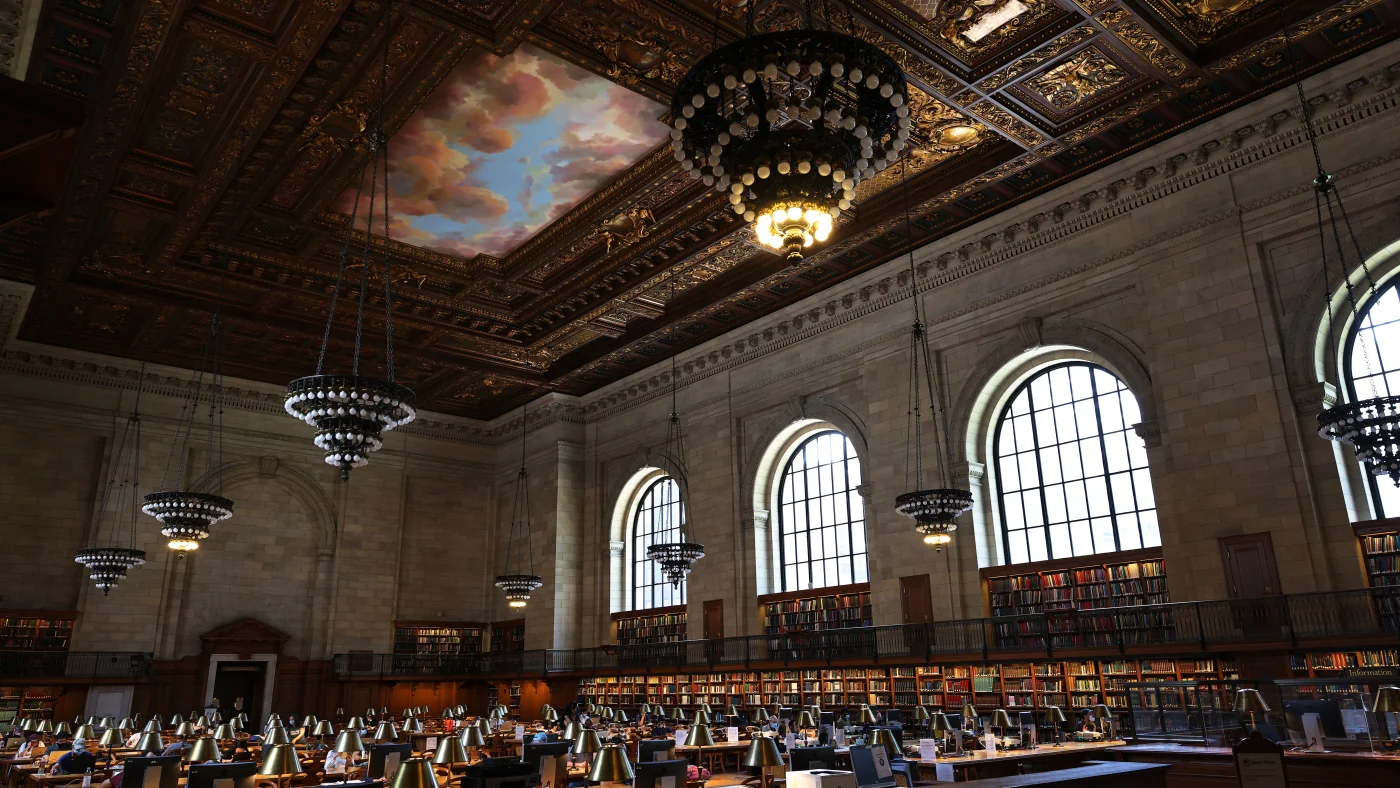
In a development that will surprise absolutely no one who has ever looked at a price tag lately, Americans are flocking back to public libraries as the cost of living continues its relentless climb. NPR reports that patrons and librarians across the U.S. are seeing a surge in library use, a phenomenon that has apparently been a truism in the library world for ages: when money gets tight, people remember the one place where borrowing things is still free.
Take Izzy Rivera, who reads at least one book every week but can't afford to buy them new while saving for law school. "Say I'm buying a few a month," she said. "It just isn't realistic." Instead, Rivera leans on libraries near her home in Topeka, Kan., checking out physical books and digital copies via the Libby app. Her recent reads include Sour Cherry by Natalia Theodoridou, Spoilt Creatures by Amy Twigg and Plastic Inc. by Beth Gardiner. She also hit her library's used book sale last month, snagging 15 books for about $20 - a sum that in today's economy might otherwise buy you a single artisanal coffee and a vague sense of regret.
Rivera's thrift doesn't stop at books. She watches movies on the streaming app Kanopy, reads the New York Times for free, and often just hangs out at a local branch. "It's somewhere I can go where I'm not expected to spend money," she said. "If I were to go to a coffee shop just to get out and do something, the expectation would be to buy a coffee, even though I probably didn't want a coffee." A radical concept: existing in public without a financial transaction.
The numbers back up the anecdotal flood. According to a Pew Research Center survey released in mid-October, 44% of Americans say they've struggled in the past year to afford at least one basic necessity, such as medical care or rent or mortgage payments. Seventy percent of adults said they've cut back on "extras" like streaming subscriptions. And with prices for food and everyday items still rising - partly due to the war with Iran - affordability was a top concern among voters heading into the midterm elections. Libraries, it turns out, are the original subscription service you don't have to cancel.
Data shared with NPR by several of the largest U.S. public library systems show recent upticks in cardholder membership, circulation and event attendance. Librarians attribute part of the boom to the rising cost of living - and to the growing realization that libraries offer far more than physical books. "People start off with Audible and then a friend tells them, 'Why are you paying for that? You can get that at the library if you're a smidgen bit patient,'" said Jeremy Reeder, director of the Maricopa County Library District in Arizona. Patience, it seems, is a small price to pay for not paying.
Of course, economic desperation isn't the only factor. Many libraries have gotten better at marketing themselves, and social media has helped foster a renewed cultural interest in reading. "Libraries have been popular for a really long time, but I think that there's heightened awareness of the wide range of offerings that our libraries are providing," said Maria McCauley, president of the American Library Association. "They are especially popular right now, I think, because people are aware that everything that we provide is free or very low cost." Free: the ultimate killer app.
History supports the pattern. An American Library Association analysis found circulation increased at 18 large public library systems during a brief U.S. recession in 2001. Another study of 541 libraries found higher library use during the Great Recession than in previous years. (A 1986 article that tried to draw a similar correlation found no data to support it - because sometimes the conventional wisdom is just early.)
While it's unclear exactly how much affordability concerns are driving the current surge, several large systems report striking growth. Usage of the Los Angeles Public Library's makerspace grew 37% between the last two fiscal years, while digital circulation and library visits both rose over 20%. At the Chicago Public Library, in-person visits, adult card applications and Wi-Fi sessions all jumped more than 11% year-over-year from January through July. The Maricopa County Library District, which saw its cardholder base grow sharply after moving applications online, recorded a 34% increase in Kanopy use and a 78% surge in Hoopla use over the past three years.
The Topeka and Shawnee County Public Library - Rivera's haunt - logged an 8.1% increase in digital media checkouts last year, though physical circulation is down. Requests for tech support, such as help with online job applications, have also surged. OverDrive, the company that owns Kanopy, reported a 41% spike in users of the streaming service last year alone.
Libraries are also enjoying a broader cultural moment, increasingly popular among Gen Z and Millennials - even those who aren't big readers - while social media phenomena like #BookTok fuel book sales. The pandemic accelerated a shift to digital media that was already underway. "It was already a trend pre-pandemic," said Los Angeles Public Library senior librarian Edwin Rodarte, "but the pandemic sort of boosted it and it just skyrocketed afterward."
Yet this popularity arrives just as federal funding is under threat. Last year, the Trump administration attempted to gut the federal Institute of Museum and Library Services and cancel its grants to libraries nationwide. The attorneys general of 21 states sued to block the move, and the administration ultimately reinstated the grants. But the IMLS appears to remain on the administration's radar: the White House's April budget proposal for the current fiscal year recommended zeroing out funding for the agency. Because nothing says "fiscal responsibility" like defunding the one institution that lets people borrow things for free.
McCauley, who also directs the Cambridge Public Library in Massachusetts, noted that libraries rely on a mix of federal, state and local funding. "Every year, libraries have to make a case for their funding, and especially when it's uncertain, it can be harder to get all the resources that we need," she said. She added that libraries return that investment to the community "in terms of expertise, in terms of beautiful facilities for our community members," as well as collections and programs.
Librarians also point out that libraries respond quickly to public needs, serving locals facing homelessness or food insecurity. One survey found that 56% of libraries offered food security support services last year - the same year a Republican tax and spending bill signed by President Trump ushered in major changes to the Supplemental Nutrition Assistance Program (SNAP) and millions of Americans began losing food benefits.
Many libraries also offer classes, meetups and a "library of things," lending out items patrons may be unable to afford or prefer not to buy: Wi-Fi hotspots, induction cooktops, birding kits, camping gear. At the Free Library of Philadelphia's Parkway Central Branch, a biweekly crafting meetup called "Sew What?!" provides sewing machines and materials at no cost. Chloe deBeus, working on her Halloween costume at a recent event, noted that attendees can try sewing and other crafts without paying steep upfront costs. "You do need to purchase yarn or you do need to purchase fabric. Maybe if you want to sew, you do need to get a machine," she said. "The question is do I even enjoy it enough to purchase these things up front?" A question libraries answer with a resounding "try before you buy."
Down the hall, Nathaniel Muns was playing a keyboard in the branch's music department. His own keyboard had broken and he hadn't replaced it yet. "Sometimes having a keyboard in your home is not accessible and not doable," he said. As he practiced the jazz standard "All the Things You Are" and other songs, Muns - a recent college graduate now working with an AI startup - said the cost of living had risen "astronomically." The library gave him a place to go. "Being able to come to the library really helps me kind of decompress at the end of the day," he said.
NPR does not offer or accept money for coverage or interviews. Anyone who makes such an offer or request is not an NPR employee and does not represent NPR.