Ebola Outbreak Reminds Us We're Great at Forgetting What We Learned
The third-largest Ebola outbreak ever shows we've learned some things, but the U.S. seems determined to unlearn the importance of actually maintaining the systems that stop pandemics.
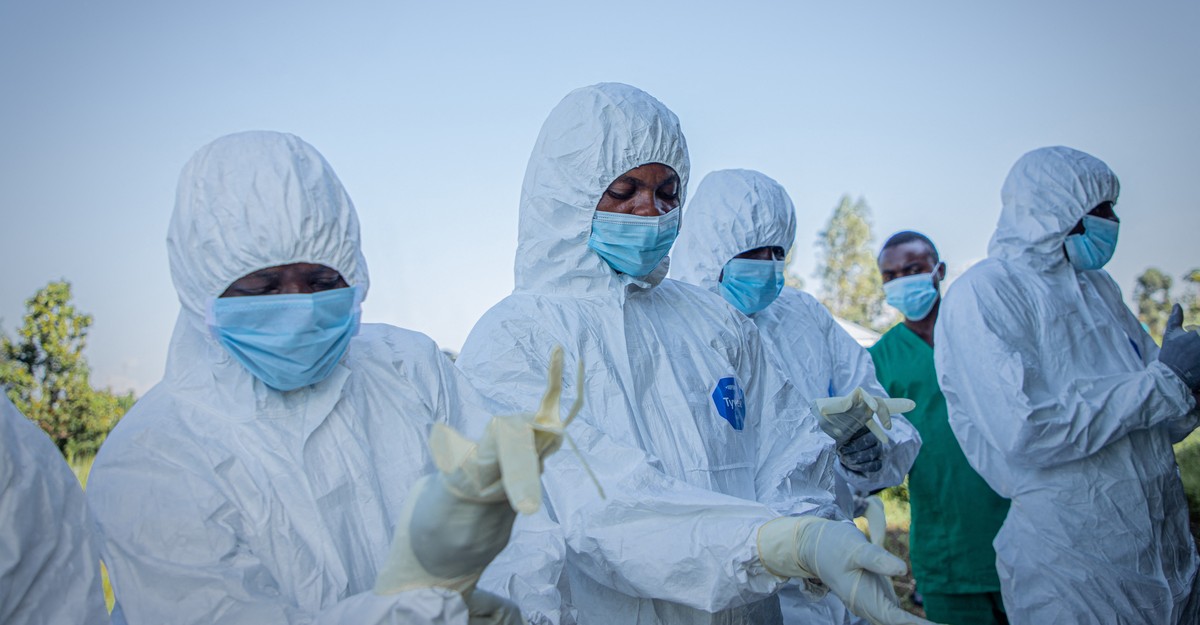
The Ebola outbreak in the Democratic Republic of the Congo is now the third-largest ever recorded, and it's on track to snatch the silver medal from a 2018-2020 outbreak in the same region. Current stats: over 2,000 cases and 754 deaths, with the World Health Organization predicting more than 8,000 cases and 1,400 deaths by mid-September. The CDC's worst-case scenario? Over 20,000 cases by mid-August. So, you know, fun times.
Dr. Craig Spencer, a physician and epidemiologist who survived Ebola himself in 2014 and worked in Guinea during the West African outbreak, has seen a dozen outbreaks since. He says this one worries him most. But hey, at least we're better at containment now? Much of that knowledge resides in Kinshasa, Kampala, and at the Africa CDC - institutions that didn't exist or weren't ready a decade ago. When this outbreak ends, it'll be thanks to people who learned from past mistakes. Yet it's also revealing how much the U.S., once the backbone of crisis response, seems eager to forget.
Detection has improved: in 2017, an outbreak in DRC was caught at just eight cases. Testing capacity has scaled up dramatically - Congo went from zero ability to test for the Bundibugyo strain two months ago to thousands of tests per day today. Research and clinical trials are faster too. A vaccine and antibody treatments exist for the Zaire strain, and an investigational vaccine for the Sudan species was ready to test within three months in a 2022 Uganda outbreak. Now, multiple organizations are racing to manufacture vaccines for the Bundibugyo strain, and a treatment trial has already started.
But the real game-changer is response speed and scale. In 2014, the world didn't take Ebola seriously until it threatened Western countries. An international emergency was declared days after the first Americans got sick - a coincidence not lost on West African colleagues. This time, the WHO declared an emergency within two days of Congo's and Uganda's declarations. Community mistrust and conflict still hamper efforts, but the machinery is faster, run jointly by WHO, Africa CDC, and the Congolese government.
However, the U.S. appears to have amnesia about the systems that make responses work. During the 2014 outbreak, the U.S. committed billions and extensive logistical support. Since then, much of the early-detection capacity was built with U.S. investment. But for the Uganda outbreak declared in February 2025, the CDC didn't send specialists, USAID wasn't deployed, and Elon Musk's DOGE canceled multiple contracts. The current response is a partial correction: the Trump administration has committed over $700 million, requested another $1.4 billion, deployed specialists, and filled the top role at the Office of Pandemic Preparedness and Response. The secretary of state is reportedly considering an Ebola czar. But these are deep reflexes triggered by big outbreaks, not sustained system maintenance.
The U.S. is focusing on keeping Ebola "over there" - transferring infected Americans to Germany instead of domestic treatment centers, and planning a quarantine center in Kenya. But as we learned a decade ago, the only reliable way to protect Americans is to end the outbreak. That's been made harder by deep cuts to global health funding and disinterest in international coordination. The U.S. isn't fully engaging with WHO, and a proposed State Department plan would remake CDC's overseas work on a pay-per-service basis, potentially closing a third of its 60 overseas offices. This country-by-country approach may be politically convenient, but it lowers defenses against pathogens.
The world's capacity to control infectious disease isn't self-sustaining. It relies on lab technicians, community health workers, stockpiles, and institutions with fluctuating budgets. American leaders are betting the rest of the world will keep doing the work with less help. White House spokesperson Kush Desai argued that moving global health functions to the State Department has made responses more effective and that other wealthy nations should step up. But weaknesses are already showing: health workers went on strike over unpaid wages and lack of supplies - 112 have been infected, and 35 have died. Since Zaire drugs were approved in 2020, only a third of Congolese Ebola patients have received them, even though one was developed from a Congolese survivor's blood. The doses exist, but manufacturers control them, and most sit in American stockpiles.
Rather than close these gaps, the U.S. is testing how much stress the system can take before breaking. The outcome of the next outbreak will rest not on what we know, but on what we've bothered to keep.
The Good Times
News in your inbox.
One sardonic roundup, delivered on your schedule. Free. Unsubscribe whenever your tolerance for wit runs out.
Already subscribed but we never reach your inbox? Check your spam folder and hit 'Not spam' (or 'Remove from spam') to bust us out of junk-mail purgatory. You'll be helping everyone else too.
Don't open any of our emails for a month and you'll be automatically removed from the mailing list.
Rewrite Article
Select parts to regenerate with a fresh AI pass. Translations will be updated automatically.
Generate AI Image
Creates a sardonic version of the article image using OpenAI.