
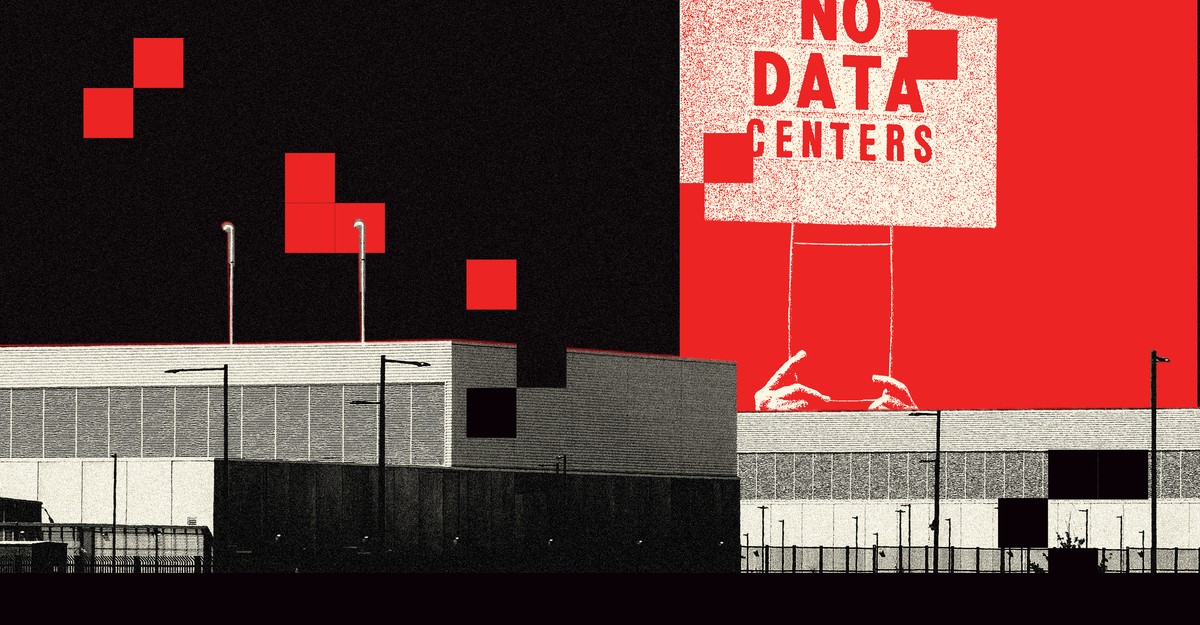
As AI data centers multiply across the American landscape, so too does public anxiety about their supposed harms. Some wariness is sensible - these industrial projects can indeed pose risks of carbon-dioxide emissions and noise pollution, depending on where they're built and how they're powered and cooled. But according to a new analysis in The Atlantic, the panic has well outpaced the evidence, leading communities to forgo massive tax revenue over threats that are inflated, confused, or sometimes simply nonexistent.
In June, a Massachusetts city near where the author grew up blocked a data center, largely over concerns about water use and pollution. Yes, data centers need water to cool equipment, and construction can introduce chemical additives into wastewater. But there are no confirmed cases of data-center pollution harming people, and this particular city has abundant fresh water. Most water-related fear stems from a game of telephone involving a New York Times story about a Georgia couple whose taps went dry after Meta broke ground on a $750 million data center nearby. The couple blamed sediment buildup from construction for damaging their well. Whether construction actually caused the problem remains unclear - sediment buildup is a standard construction risk, and most places don't ban large buildings over it.
As for the fear that data centers add toxic "forever chemicals" known as PFAS to local water, this seems to involve confusion about cooling systems. Some use fluorinated fluids classified as PFAS to cool servers and prevent fires, but these are designed as closed loops contained within equipment. Leaks are always possible, but that's a risk of any major industrial project. One known exception: Amazon data centers in Oregon used groundwater already contaminated from decades of local agriculture and food processing. Because much of the cooling water evaporates, the wastewater leaving the data center had higher nitrate concentrations, exacerbating existing contamination. Amazon settled for $20.5 million without admitting guilt, accurately noting the area had suffered from polluted water for decades - even if the data center made it worse.
The debate is full of dauntingly large numbers without context. Yes, data centers consume millions of gallons of water a day. The highest known consumer, Google's development in Council Bluffs, Iowa, uses about 1.3 billion gallons a year. Sounds massive - but so is irrigating Iowa's corn crops. If Google had bought a cornfield four to six times as large as its data center plot, about eight square miles (roughly 0.04 percent of Iowa's corn area), it would consume the same amount of water. All American data centers combined will consume about 1 percent of the water America uses to irrigate corn. Not nothing, but hardly horrifying in context.
Another misconception: data centers consistently raise local electricity prices. There's no clear positive relationship or broad pattern, but that doesn't stop people from spreading misleading claims. A common statistic - cited by Senator Elizabeth Warren in an op-ed earlier this year - is that electricity costs near data centers have skyrocketed by as much as 267 percent in five years. But that figure comes from a Bloomberg analysis of wholesale electricity prices at specific grid nodes, not what households pay. Residential prices are largely insulated from wholesale spikes and drops, and American household bills have not risen anywhere near 267 percent. When price hikes have been linked to data centers, the amount looks more like 10 percent.
Perhaps the most pernicious misunderstanding is the claim that data centers don't pay taxes. Early reports about sales-tax exemptions on machinery and equipment in most states have morphed into a sweeping assumption that data centers deprive states and municipalities of revenue. Reality: data centers are a reliable and lucrative source of tax revenue wherever built. Real-estate and personal-property taxes ensure a high tax burden regardless of sales taxes. Loudoun County, Virginia, with the largest concentration of data centers in the country, collects $1.3 billion a year in county taxes from these centers - about $2,800 per resident. That's nearly half of all local tax funding for county government and public schools, despite Virginia's waiver of sales taxes on related machinery. Local opposition has come to Loudoun too, but residents are unlikely to forgo hundreds of millions a year to shut down operating data centers.
Then there's the land-use concern: that data centers will "take up all the land." A rough estimate puts the combined footprint of all data-center buildings in America at about 25 square miles by 2028 - a little over half the size of Disney World, spread across the country. These projects also buy land around buildings and for future expansion, but the combined landholdings of all new and existing data centers would cover about 1,400 square miles, a little more than three times the land used to grow Christmas trees in the United States. In Loudoun, data centers take up 3 percent of land while generating nearly 40 percent of the county's general-fund revenue. Despite concerns that they depress local land values, a 2025 study of home sales in Northern Virginia found that homes closer to data centers sold for higher prices - perhaps because the infrastructure valuable for data centers is also valuable for homeowners.
And then there are the conspiracy theories, such as the idea that data centers emit harmful, inaudible low-frequency sounds known as infrasounds. Such claims sometimes misrepresent the studies they cite. No infrasounds at the levels data centers emit have been found to be harmful. This isn't to say data centers don't cause some noise pollution, but the idea that imperceptible infrasounds have mystical abilities to make people unwell is not borne out by evidence.
As for underlying anxieties about AI motivating the backlash, slowing down data-center construction is not the same as slowing down AI capabilities. Yet banning data centers has become shorthand for political candidates who wish to seem tough on AI - a distraction. The wiser and tougher move is to heavily regulate the industry.
No data center is a harmless boon for locals, but the real question is whether downsides outweigh benefits. Given the status-quo bias - where change seems inherently costlier than keeping things the same - the author offers a simple trick to make the trade-off clear: ask people, "Would we spend as much tax revenue as the data center will bring in to avoid its downsides?" For example, would Loudoun County residents each pay $2,800 a year to reduce some air pollution and water use, lower electricity bills by about $6 a month, and make about 3 percent of the county's land available for something else? Since this is the actual question before communities, spelling it out is handy. In Loudoun and other jurisdictions, many voters seem, on balance, to prefer the data centers.