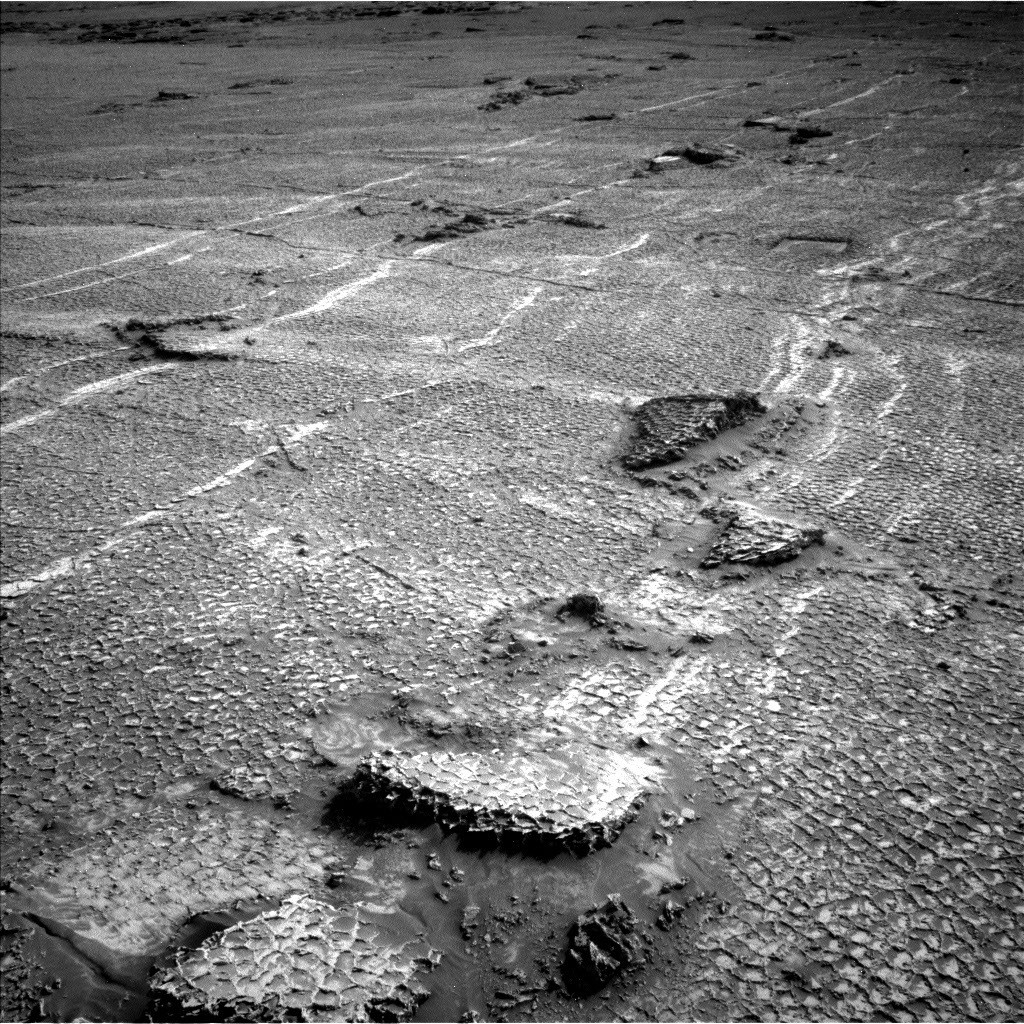
NASA's Curiosity rover, currently trundling about Mars, decided to head for a patch of ground that looked smooth and inviting from orbit. Because if orbital images have taught us anything, it's that you can always trust a bird's-eye view of an alien planet.
On Monday, the rover planned three sols (that's Martian days to you and me) in anticipation of a U.S. federal holiday. The workspace was a bit spiky, so the rover's Dust Removal Tool (DRT) couldn't find a nice clean spot. Still, the science team made do, studying bedrock targets like “Rio Baker” with the Alpha Particle X-ray Spectrometer (APXS) and Mars Hand Lens Imager (MAHLI), and zapping “Rica Aventura” and “Tabebuia” with ChemCam's laser. They also peered into the distance at the Cordillera base outcrop, because why not?
After all that, Curiosity drove about 35 meters (115 feet) to an area that looked smooth in every image available. The team was hopeful for a good DRT spot. Spoiler: they were wrong.
When the post-drive images came back on Thursday morning, the team was in for a surprise. The parking spot, from up close, was anything but smooth. Polygons, veins, lamination - the works. The features are small, just a few centimeters across, invisible from orbit or even from a distance. But up close, the terrain revealed all its bumpy, textured glory.
So what did the team do? They took more images, of course. Mastcam is snapping a full panorama with its left eye and close-ups with its right. ChemCam is investigating three targets with its laser: “Rio Chimore” (a lighter band), “Rio de Lava” (a vein), and “Rio de Salta” (one of the polygons). APXS is examining “Pampa Grande” and “Iquique Ridge.” MAHLI is getting a hand-lens look. Because nothing says planetary science like staring at rocks until they confess their secrets.
Curiosity then drove up a hill along terrain that was smooth-looking but littered with tiny polygons. The team is bracing for another surprise that will reverberate across two continents - wherever the first person to see the images happens to be. This terrain, they say, has a lot to say about Mars's geologic history. And it's saying it in polygonal, vein-riddled, beautifully bumpy detail.
The Good Times
News in your inbox.
One sardonic roundup, delivered on your schedule. Free. Unsubscribe whenever your tolerance for wit runs out.
Already subscribed but we never reach your inbox? Check your spam folder and hit 'Not spam' (or 'Remove from spam') to bust us out of junk-mail purgatory. You'll be helping everyone else too.
Don't open any of our emails for a month and you'll be automatically removed from the mailing list.
Rewrite Article
Select parts to regenerate with a fresh AI pass. Translations will be updated automatically.
Generate AI Image
Creates a sardonic version of the article image using OpenAI.