
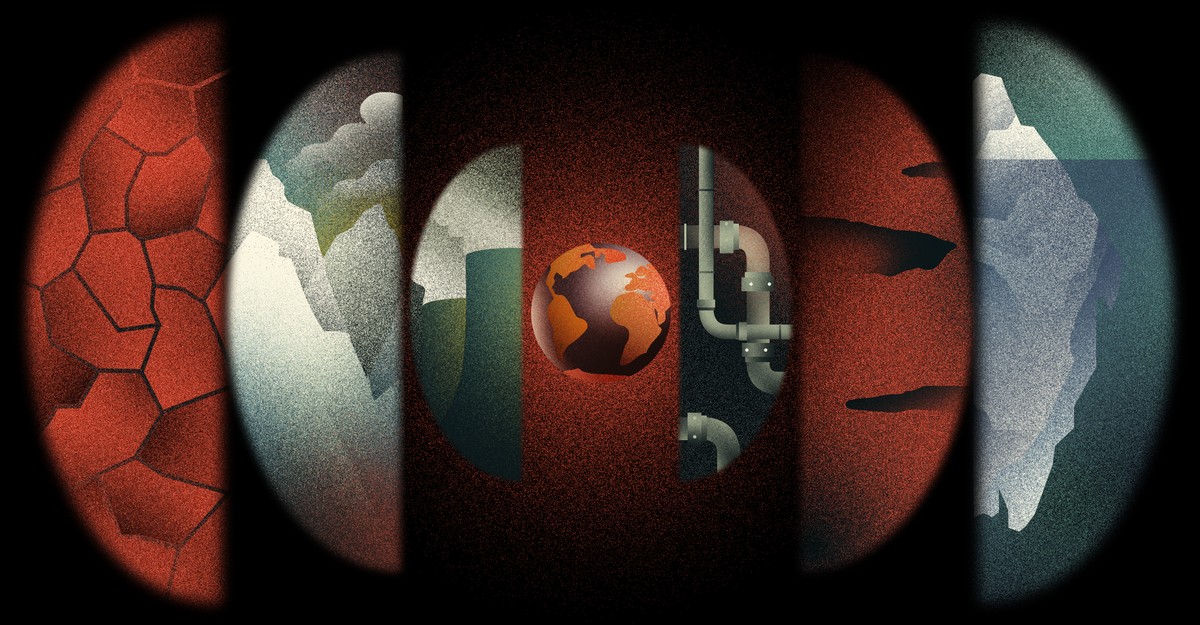
For most of human history, the ground has had the decency to stay put. Sure, on geologic timescales, Earth is a lively sort - tectonic plates shuffle, continents wander, mountains rise and fall. But during humanity's brief cameo, the floor has largely behaved. That stable era, it turns out, is over. Climate change, which began as a polite little blanket of greenhouse gases trapping heat, has now escalated to full-on geological insubordination.
The planet's waters reacted first - precipitation patterns shifted, glaciers and ice caps began melting, and the ocean graciously sponged up heat and carbon dioxide. But when Earth's waters move, solid ground follows. Warming is now destabilizing land across the planet, turning geology into a real-time spectator sport. In more and more places, the floor is literally giving way.
Mountains are crumbling in Alaska, Norway, Greenland, Chile, New Zealand, and the European Alps. As glaciers retreat - some at unprecedented rates - they leave behind unstable cliffs that once had the audacity to be supported by ice. In 2023, one such cliff collapsed into a Greenland fjord, generating a 660-foot wave that sent ripples through the Earth, detected on monitoring stations worldwide for nine days. Last year in Alaska, a landslide-generated tsunami struck a fjord frequented by cruise ships - because nothing says vacation like a sudden wall of water. In Switzerland, part of a mountain glacier detached entirely, burying the village of Blatten in a cataclysmic landslide. Scientists have collected enough dramatic examples over the past decade to confirm these aren't isolated incidents but a pattern linking glacier loss with landslide risk.
And the worst may be yet to come. When glaciers melted after the last glacial maximum, about 20,000 years ago, the resulting landslides were orders of magnitude larger than anything in recorded history. But today's glaciers, having persisted longer, have carved even steeper, more unstable cliffs. "We haven't seen the upper bounds of landslides yet," Kristian Svennevig, a geologist at the Geological Survey of Denmark and Greenland, told us. In Arctic regions, the magnitude of landslides could soon exceed anything in the geologic record. So, you know, enjoy the calm.
Permafrost, the glue holding mountains together at high altitudes and latitudes, is also in retreat - as scientists predicted in the 1980s and as is now painfully apparent across the Arctic. In the Brooks Range, home of the Trans-Alaska Pipeline, long-frozen mountains have started to spontaneously deform and collapse as their permafrost glue weakens. "We're pushing these mountains into a state of disequilibrium," said Bretwood Higman, an independent Alaskan geologist. They're essentially too steep for this warmer climate. "As a geologist, I've found it shocking how widespread the sudden increase in landslide activity is," Higman added. When you're used to thinking in tens of thousands of years, seeing changes unfold over human lifetimes is - how shall we put it - very dramatic.
The thaw is already threatening infrastructure. Denali National Park is close to finishing a $100 million bridge to span a moving permafrost landslide. In the Brooks Range, engineers are pumping refrigerant underground to refreeze permafrost and stabilize pipelines. And it's not just mountains: cement-solid Arctic ground is turning into bogs. Communities across Alaska have had to relocate as homes, fuel tanks, sewage lagoons, and garbage dumps tip, spill, or sink. Elsewhere, ancient underground ice chunks melt, causing the surrounding earth to collapse into voids, buckling roads and swallowing buildings. In Siberia, once-trapped methane explodes from under permafrost, creating 100-foot craters. "When permafrost thaws, it changes everything," said Sue Natali, an Arctic-climate scientist at the Woodwell Climate Research Center. And the thaw is speeding up. "That is not a maybe thing, and it is not a local thing. It is a pan-Arctic thing."
Lower latitudes aren't spared either. A warmer atmosphere holds more moisture, leading to more frequent and extreme rainfall. Scientists are now modeling how this rain increases landslide risk, linking individual events to storms made more dramatic by climate change. "Harder, more intense, longer-duration rainfall has a greater possibility to generate landslides," said Jonathan Godt, who leads the USGS's landslide-hazards program. These debris flows and mudslides threaten more communities: Hurricane Helene triggered more than 2,000 landslides in North Carolina in a week. In California, slopes stripped by logging and drought-fueled wildfires slough away after heavy rain - one mudslide in Montecito destroyed 100 homes and killed 23 people in 2018. Landslides already cause $20 billion in damage globally, and that cost will only climb.
Scientists have cataloged the effects of melting glaciers, thawing permafrost, and extreme rain. But other consequences - volcanic eruptions and earthquakes - are just coming into focus. More than a decade ago, in his book Waking the Giant, University College London volcanologist Bill McGuire predicted that climate change could lead to more volcanic eruptions and earthquakes. The Earth's crust, weighted down by ice for thousands of years, has been bouncing back, releasing pressure on long-subdued faults and volcanoes, like those in Iceland. Human-caused climate change is accelerating this. Water from extreme rainfall or glacial melt can percolate into cracks, increasing pressure on rock and reducing friction along faults, triggering quakes and eruptions.
Last year, researchers in Switzerland and France found some of the clearest evidence yet that glacial melt affects seismic hazards. After intense glacial melt in 2015, a series of small quakes struck the Grandes Jorasses on Mont Blanc Massif; the probability of a 3.0-magnitude earthquake rose by 10 times, according to Toni Kraft, a seismologist at the Swiss Seismological Service at ETH Zurich. These quakes are small, but they could trigger rockfall events already on the rise across the Alps.
Falk Amelung, a geoscientist at the University of Miami, has controversially argued that climate-driven extreme rainfall might have triggered the dramatic 2018 eruption of Hawaii's Kīlauea volcano. Scientists haven't found an obvious trigger, but Amelung hypothesized that rainfall infiltrated the volcano's edifice, increasing pore pressure in rock kilometers down to the highest rates in almost 50 years. USGS volcanologists are unconvinced - a link between heavy precipitation and some volcanic activity is accepted, but they reject the idea that water could reach magma below. If Amelung is right, as many as 700 volcanoes could be at risk of dome explosions and flank collapse over the next 80 years. "The system must be heavily stressed in a way that it's close to breaking anyway," he said. "And then this small stress change due to water brings it over the edge."
Throughout Earth's history, small perturbations have caused millennia-long swings between hothouse and icehouse conditions. The carbon dioxide we've pumped into the atmosphere - at a higher rate than ever before in geologic history - is a pretty significant perturbation. "The crust is not isolated. It's always connected. The climate, the fluid layers, the solid layer - you cannot separate them," said Benedikt Soja, a geoscientist at ETH Zurich. The atmosphere, ocean, and land are interacting systems, and their fragile equilibrium is reacting together to the stress we've applied. So, congratulations, humanity: we've made the ground itself unstable. You're welcome.