
Insurance is a social contract, which is a fancy way of saying your money fixes someone else's burned house and theirs fixes yours. We let companies sell policies on a private market, and we elect or appoint officials to oversee it. That's how it's supposed to work. Ask Lynn McIntyre how that panned out.
When McIntyre's mother died in 2022, she inherited a longtime house in the "Alphabets," a charming neighborhood not far from the coast in western Los Angeles. She and her daughter had lived there just one year when her insurer, Liberty Mutual, withdrew her fire coverage. Unable to find another private company, she enrolled in the California FAIR Plan, a state-backed "insurer of last resort," paying another $5,000 a year on top of her regular Liberty Mutual home insurance.
After the Palisades Fire raged through the Alphabets in early 2025, McIntyre's bungalow was still standing - but full of smoke and ash that crept in through vents and windows, with belongings stained beyond recognition. When she filed a FAIR Plan claim, adjusters told her she was out of luck. They'd pay for a temporary apartment and nothing else. McIntyre, a former real estate broker, spent months battling 10 different adjusters and dozens of FAIR Plan representatives. Employees batted her away at every turn, third-party adjusters got her nowhere, and her attorney professed himself confounded by FAIR's obstinance. Even as neighbors cleared debris and started building new fire-resilient homes - many much larger than their old properties - her bungalow sat stained with smoke.
Only in late August, more than 18 months after the wildfire, was she about to start repairs - not with insurance money, but with a nearly $200,000 federal loan she'll someday have to repay. FAIR has also been trying to cut off her apartment expenses, telling her power and water are back online and she needs to move home, never mind the boarded-up windows and scorched exterior. Meanwhile, Liberty Mutual informed her this summer it would cancel her non-fire coverage. "The next time a fire comes through, I'm just going to light it on fire, because I'm not going to go through this again," McIntyre said wryly, as construction machines rattled at other houses around us.
Ensuring Californians like McIntyre have access to affordable insurance falls to an elected official many Californians have likely never heard of: the insurance commissioner - one of eight elected state officials in California - who regulates the companies providing fire, home, and auto coverage.
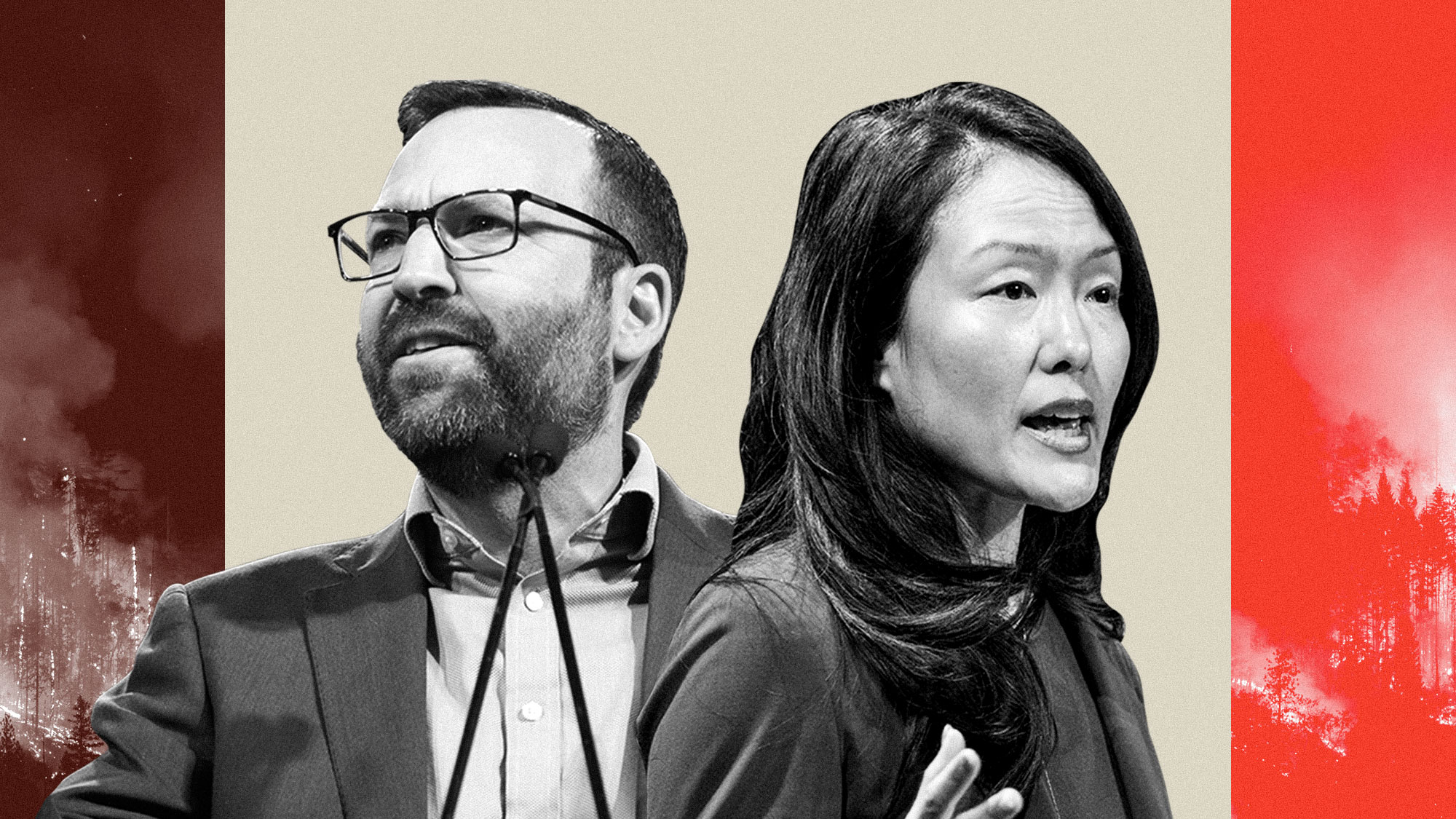
Over the last eight years, the incumbent presided over what parties on all sides have called a "disaster," a "crisis," and a "collapse" in the state's home insurance market. Now, as the current commissioner terms out, two Democratic candidates - Ben Allen and Jane Kim - claim they can fix it. They embody a Democratic Party debate over adapting to climate change: Allen, an established legislator representing Pacific Palisades, wants to rebuild the market; Kim, a left-wing organizer from San Francisco, wants to ditch the private market altogether.
Whoever wins in November inherits a system battered by a decade of devastating wildfires, insurers pulling out, and other upheaval. Climate change and decades of poor forest management have turned California's woodlands into tinderboxes, and it only gets worse as the planet warms. The crisis began with unprecedented wildfires between 2015 and 2020 that scorched around 4 million acres and destroyed 35,000 homes, many in areas that had never been known to burn. State Farm and Farmers paid out billions in claims - enough to negate two decades of fire insurance profits.
Companies believed they were charging far too little, but insurance prices aren't elastic like gasoline or paper towels. Insurers must seek permission from the state insurance commissioner to raise rates. California was strict, blocking attempts to pass the post-fire bill onto homeowners. The industry's response was to ditch California - dropping tens of thousands of customers and, in State Farm's case, announcing it would cease writing new policies altogether. "There's something broken that so many of us are facing the same issues," McIntyre said, "and they just think they can just roughshod right on over all of us."
The lack of insurance is hurting the economy: around 1 in 7 California realtors said a home sale fell through in 2024 due to insurance issues, the FAIR Plan ran out of claims money last year, and average premiums could rise 16 percent this year. The trend is spreading beyond the most flammable zones, with homeowners even in low-risk areas struggling.
The November election could determine insurance bills for millions and the fate of fire-prone areas - and serve as a bellwether for how Americans want to approach the expensive, difficult process of adapting to a warming world. Whoever wins must turn that mandate into policy offering short-term relief. Daunting in the best of times. These are not the best of times.
The crisis is new, but its origins are very old. Over the last century, California built millions of homes in the "wildland-urban interface," the flammable zone outside major cities. Developers rushed into the mountains around Lake Tahoe and the desert hills east of San Diego, building without thought for fire mitigation - wooden sidings, flammable fences, crowded lots. These are the areas burning up, and the areas insurers are dropping en masse.
This history of unwise development created what scholar Carolyn Kousky dubbed "a tale of two markets." Prices ticked up in places that weren't risky, like wet San Francisco and low-lying Fresno, but went haywire in risky areas like Malibu and the High Sierras. Nearly half of all households in high-fire-risk areas lost insurance between 2018 and 2024. The FAIR Plan, intended as a fringe supplement, became the only option for thousands - growing from less than 1 percent to 5 percent of the market, and reaching 80 percent market share in some places.
In theory, voters have some influence. Every state has an insurance commissioner, but California is one of around a dozen where the position is elected - a testament to the state's pro-consumer slant. In 1988, voters incensed about high car insurance prices passed a measure turning it from appointed to elected.
In practice, it's a job no one should want. The commissioner can approve or deny rate increases and police industry compliance. They oversee the FAIR Plan, which offers limited, expensive coverage to people like McIntyre. But the commissioner can't do much else to make private insurers offer coverage or reduce overall fire risk. "The insurance commissioner has a lot of power and authority himself or herself that they should use, but the insurance commissioner alone cannot address these challenges," said Dave Jones, commissioner from 2011 to 2019.
The outgoing commissioner, Ricardo Lara, has been in office for almost the entirety of the market collapse, vacillating between cozying up to insurers and clamping down and risking their flight. First he pledged to reject all industry campaign money, then accepted some, then appeared to cover for it by stalling on rate increases, leading State Farm to drop more policies. His fix was a deal: allow companies to pass on reinsurance costs to customers and use forward-looking catastrophe models every other state already allowed - translating to higher rates - in return for commitments to write more policies in risky areas. But the deal was full of loopholes; insurers can meet their mandate without returning to the riskiest areas, and the FAIR Plan kept absorbing market share after the 2025 Los Angeles fires. Lara told The New York Times earlier this year that the industry had "bullied" him. (His office declined interview requests, and FAIR Plan representatives did not respond to requests for comment.)
Despite these entrenched problems, a dozen candidates piled into the race to replace Lara - four Democrats, five Republicans, and two independents in a crowded primary, none with funding for a full statewide campaign and limited public polling. The results surprised even the candidates: the top two advancing to November were Democrats. First, with around 27 percent, was Kim, a former San Francisco supervisor and Bernie Sanders ally pitching a government-run single-payer disaster insurance program. Second was Allen, the state senator representing the Palisades and one of the legislature's foremost insurance experts.
Allen and Kim agree on a lot: simplifying typical policies, forcing transparency about spending and fossil fuel investments, beefing up the FAIR Plan to cover smoke and other damages (which would have saved McIntyre months of confusion), cracking down on insurers who delay and nitpick claims, and rejecting industry campaign contributions. Where they differ is how to get people off the FAIR Plan and stabilize the market - the fundamental question of the state's insurance system. Allen believes allowing rate increases on risky homes, investing to harden vulnerable homes, and taking a data-driven approach to wildfire risk can entice insurers back and restore a healthy market. Kim would prefer to discard the market altogether, proposing a state