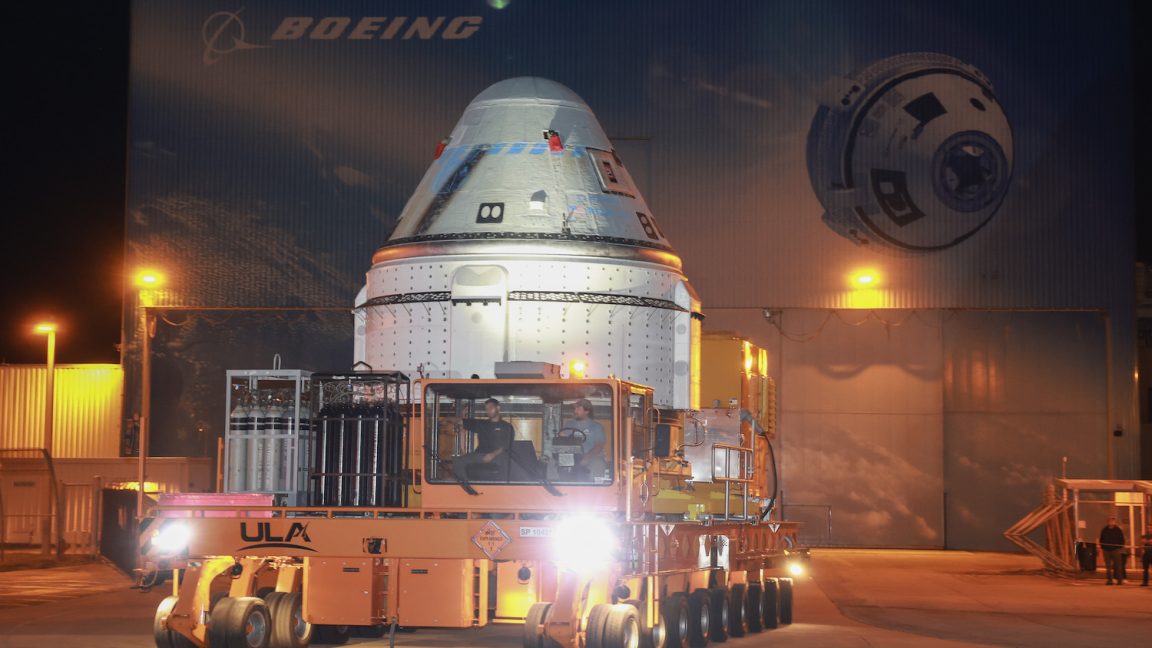
Boeing’s Starliner Might Actually Fly This Year, If NASA Can Find a Parking Spot
Boeing says Starliner's redesign is going well and the main delay is now just finding a free parking spot at the ISS - so maybe it'll fly this year, if NASA can pencil it in.
When we last checked in on Boeing’s Starliner spacecraft in February, NASA had formally classified its 2024 crewed flight as a “Type A” mishap - which is bureaucratese for “we messed up royally.” NASA Administrator Jared Isaacman said the agency was working with Boeing to “fully understand the risks,” and Starliner wouldn’t fly again until those risks were identified and remediated. He declined to put a date on it, which is usually a bad sign.
But lo and behold, during a quarterly earnings call on Tuesday, Boeing CEO Kelly Ortberg offered some encouraging remarks: “The redesign of the Starliner deficiencies is going quite well, and we’re feeling pretty good about that.” The deficiencies primarily involve the propulsion system that stranded astronauts Butch Wilmore and Sunny Williams on the ISS, forcing them to hitch a ride home on a Crew Dragon in early 2025. Ortberg hinted that much of the redesign work is done, and the main holdup now is scheduling a launch date with NASA for a cargo flight - specifically, finding an open docking port and astronaut time to unload the vehicle.
An official confirmed to Ars that port availability is indeed the primary factor, meaning Starliner could launch this year. If the cargo test goes well and the propulsion fixes hold, a crewed mission might be possible in late 2027. Further delays, Ortberg noted, would only deepen Boeing’s losses on the fixed-price contract signed with NASA in 2014 under the Commercial Crew program. To date, Boeing has taken roughly $2 billion in charges due to Starliner’s endless delays and failures.
If Starliner does come online in the next year or two, it would arrive at an interesting moment for crew access to low-Earth orbit. SpaceX has told industry officials it plans to retire Crew Dragon (which flies on the Falcon 9) no later than 2030, raising concerns for NASA and private space stations that need rides. Crew Dragon is currently the preferred option - reliable, reusable, and cheap. Starliner, by contrast, has disadvantages: its Service Module burns up in the atmosphere after each flight (costing tens of millions of dollars), and after its initial NASA missions, it will have no rocket to fly on once the Atlas V retires. United Launch Alliance’s Vulcan rocket is an option, but human-rating it would be expensive.
Boeing has been shopping Starliner around for a year and a half, but no sale has closed - allegedly because Boeing’s asking price is too high. Blue Origin, a potential buyer with deep pockets, has instead decided to build its own crew vehicle. So in a world where SpaceX retires Dragon for Starship, the space community isn’t yet comfortable with Starship for humans, and Starliner is actually flying, things could get interesting. One thing seems clear: the cost of human spaceflight to low-Earth orbit in the 2030s is going to be significantly higher than in the 2020s - at least until Starship really takes off.
The Good Times
News in your inbox.
One sardonic roundup, delivered on your schedule. Free. Unsubscribe whenever your tolerance for wit runs out.
Already subscribed but we never reach your inbox? Check your spam folder and hit 'Not spam' (or 'Remove from spam') to bust us out of junk-mail purgatory. You'll be helping everyone else too.
Don't open any of our emails for a month and you'll be automatically removed from the mailing list.
Rewrite Article
Select parts to regenerate with a fresh AI pass. Translations will be updated automatically.
Generate AI Image
Creates a sardonic version of the article image using OpenAI.