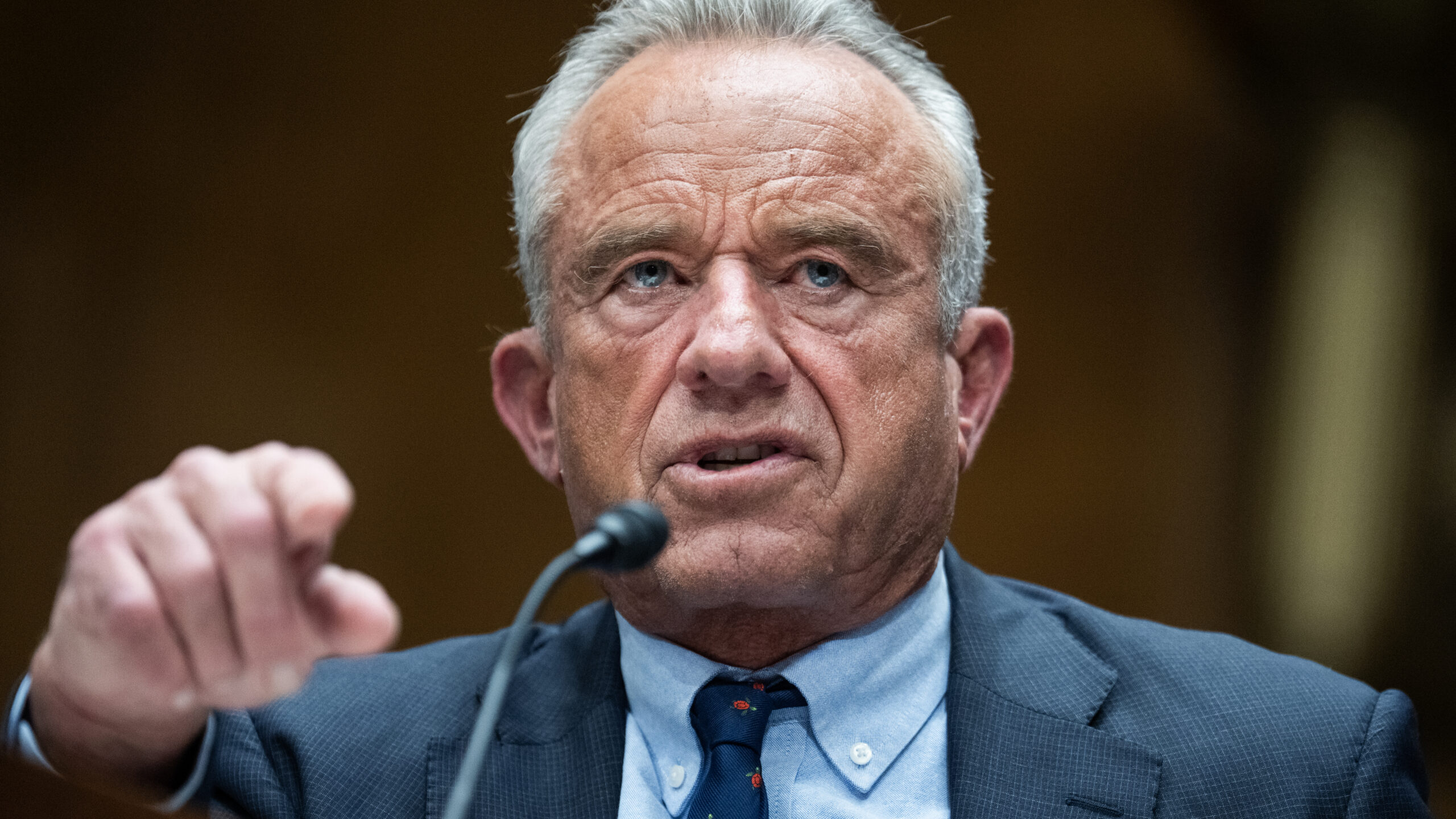
In a Congressional hearing on Wednesday that was part health policy debate, part public service announcement, Sen. Bernie Sanders (I-Vt.) confronted Health Secretary Robert F. Kennedy Jr. about his rejection of germ theory - the widely accepted scientific concept that specific microbes cause specific diseases. Kennedy, who has no background in science, medicine, or public health but does have a background in being an anti-vaccine activist, defended his fringe view. Then Sen. Bill Cassidy stepped in to fact-check and debunk Kennedy's denialist arguments live, because apparently the Health Secretary needed a quick science lesson.
The exchanges marked a rare moment where Kennedy's dismissal of germ theory got the high-profile public scrutiny it probably should have received earlier. Kennedy, best known for peddling conspiracy theories and being an ardent anti-vaccine activist, wrote about his germ theory denialism in his 2021 book "The Real Anthony Fauci." In it, he maligned germ theory as a tool of pharmaceutical companies, scientists, and doctors to push modern medicines. Instead, he promotes a concept akin to the discarded "terrain theory," where diseases come from imbalances in the body's inner "terrain" - caused by poor nutrition, environmental toxins, and stress. (He erroneously calls this "miasma theory," which is actually about breathing bad air from decaying matter, but close enough.)
Kennedy's embrace of terrain theory over germ theory is foundational to his "Make America Healthy Again" (MAHA) movement, which emphasizes healthy diets, clean living, and fighting chemical pollutants like glyphosate - though he recently shifted on that to support increased production of the weed killer, in line with Trump's policies. Because consistency is for lesser health secretaries.
During the hearing, Sanders referenced a passage from Kennedy's book claiming that the idea vaccines dramatically reduced infectious disease mortality in the 20th century is "simply untrue." Sanders then pointed to a 2024 WHO study in The Lancet that found vaccines saved an estimated 154 million lives since 1974 - the equivalent of six lives every minute over 50 years. Sanders asked Kennedy if he still believed that claim was untrue. Kennedy responded by trying to discredit the WHO study for using modeling, then redirected to a cherry-picked 2000 study in Pediatrics by Bernard Guyer.
Kennedy's argument: improvements in nutrition, hygiene, and sanitation drove declines in infant and child deaths - not vaccines. Cassidy, however, had actually read the study and pointed out that it noted vaccination virtually eliminated diseases like diphtheria, pertussis, measles, and polio. Cassidy also debunked Kennedy's reliance on a 1977 Milbank Memorial Fund Quarterly study that only looked at mortality from 1900 to 1973 - before the measles vaccine was even introduced. "There's 3.5 million cases of measles per year before the vaccine came along and about 550 deaths, and then the vaccine took those to less than 100 [cases] and like zero deaths," Cassidy noted.
Sanders summed it up: "You're entitled to your view ... But according to the World Health Organization and scientists all over the world, vaccines have played an enormous role in saving lives."
The Good Times
News in your inbox.
One sardonic roundup, delivered on your schedule. Free. Unsubscribe whenever your tolerance for wit runs out.
Already subscribed but we never reach your inbox? Check your spam folder and hit 'Not spam' (or 'Remove from spam') to bust us out of junk-mail purgatory. You'll be helping everyone else too.
Don't open any of our emails for a month and you'll be automatically removed from the mailing list.
Rewrite Article
Select parts to regenerate with a fresh AI pass. Translations will be updated automatically.
Generate AI Image
Creates a sardonic version of the article image using OpenAI.