
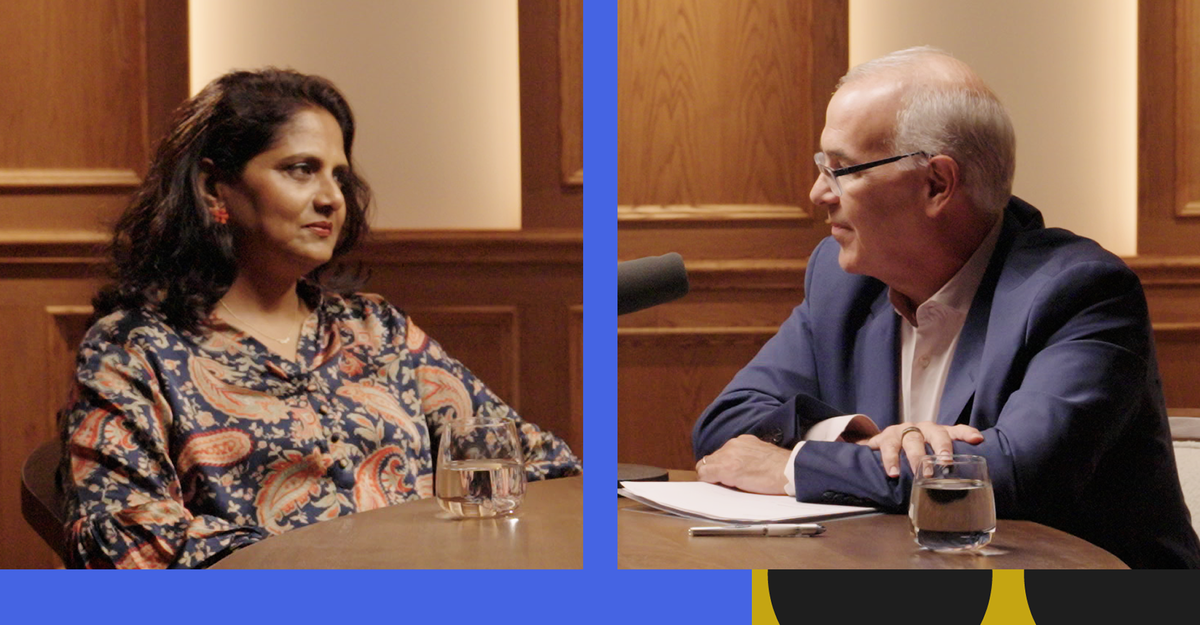
For all of human history, we've looked up at the night sky and asked the big questions: Where are we? Why are we here? And why does that one constellation look vaguely like a ladle? David Brooks, a man who once dreamed of being an astronomer until he discovered it involved math, sat down with Priyamvada Natarajan on The Permanent Questions to discuss the latest scientific view of the universe and what it says about our place in it. Natarajan is a world-renowned theoretical physicist who has made important breakthroughs in the study of black holes and dark matter, and is the author of Mapping the Heavens: The Radical Scientific Ideas That Reveal the Cosmos. She is also a scholar of the history and philosophy of science, which is a fancy way of saying she thinks about thinking.
Natarajan grew up in Delhi, where she pestered her parents with questions until they bought her a telescope and a microscope. She chose the telescope, apparently because she preferred the thing she couldn't touch. This is either profound or a red flag, depending on your therapist. She got a Commodore 64 before anyone else in India had a computer, learned to program, and eventually caught the attention of Nirupama Raghavan, who ran the Nehru Planetarium in Delhi. Raghavan encouraged young students to study astronomy, so Natarajan showed up as a teenager and offered to make her a star map. She taught herself spherical geometry, programmed the positions of stars and planets and their orbits, and delivered. This is the scientific equivalent of showing up to your first day of work having already reorganized the entire filing system.
Brooks asked Natarajan about her lifelong obsession with maps, which she traces to old exploration maps that marked unknown territories as terra incognita. She loved that cartographers would just write 'we don't know what that is' and move on. This is a refreshing approach to uncertainty that we could all stand to adopt, especially when reading the news. Natarajan went to MIT, where she studied philosophy of science and encountered Thomas Kuhn, author of The Structure of Scientific Revolutions, who had retired by then but would still come around. Kuhn's idea was that science moves forward in paradigm shifts - Newtonian physics works until it doesn't, and then someone comes along and chops it up into a new paradigm. Natarajan felt even then that this was a simplistic view, because science is actually a complex combination of evolution and revolution, which is also a good description of any long-term relationship.
At MIT, Natarajan deferred her Ph.D. in physics to pursue a Ph.D. in history and philosophy of science, because she loved to read, write, and generally be torn between the humanities and sciences. She was interested in string theory but found it untestable, and she preferred science that could be proven wrong. This is a healthy attitude that more people should adopt, particularly on social media. She ended up at Princeton to work with Martin Schwarzschild, son of Karl Schwarzschild, the person who discovered the black-hole solution while serving as a soldier in World War I. Karl found the first exact solution to Einstein's theory of general relativity within days of hearing about it, which Einstein himself didn't expect. This is the scientific equivalent of solving a Rubik's Cube while being shot at.
Martin Schwarzschild told Natarajan she had to be doing science, not just thinking about it, and asked what she liked. She said she liked building storylines for the universe and making predictions. He sent her to Cambridge to work with Martin Rees. She is still ABD in that Ph.D., which is a polite way of saying she never finished it. This is either a cautionary tale or proof that you don't need a completed doctorate to become a world-renowned astrophysicist. Probably both.
Natarajan now studies black holes and dark matter, the invisible entities that fundamentally shape our universe. Dark matter makes up 86 percent of the matter in the universe, and we only know it's there because of the gravity it exerts. Black holes are similar - we never directly see them, only infer their presence because they bend light. All matter bends light, but black holes do it severely and dramatically, like a toddler throwing a tantrum in a grocery store. The draw of black holes, according to Natarajan, is that they have the most bizarre properties. This is also true of people who work on black holes, but that's a different interview.
The conversation also touched on the place of emotion in scientific research, why science alone can't solve human problems, and the greatest space movie ever made. The transcript cuts off before we get to that last one, which is a shame, because we could all use a definitive answer on whether it's 2001: A Space Odyssey or The Fifth Element. Natarajan's work reminds us that the universe is vast, mysterious, and largely invisible, which is also a good description of the plot of most space movies. Humanity's place in the cosmos remains an open question, but at least we have maps. And terra incognita.