Arctic Sea Ice Hits 2026 Minimum, Ties Three Other Years for 10th-Lowest, Because of Course It Does
Arctic sea ice hit its 2026 minimum on September 12 at 4.6 million square kilometers, tying 2008, 2010, and 2025 for 10th-lowest - because the Arctic loves a group project.
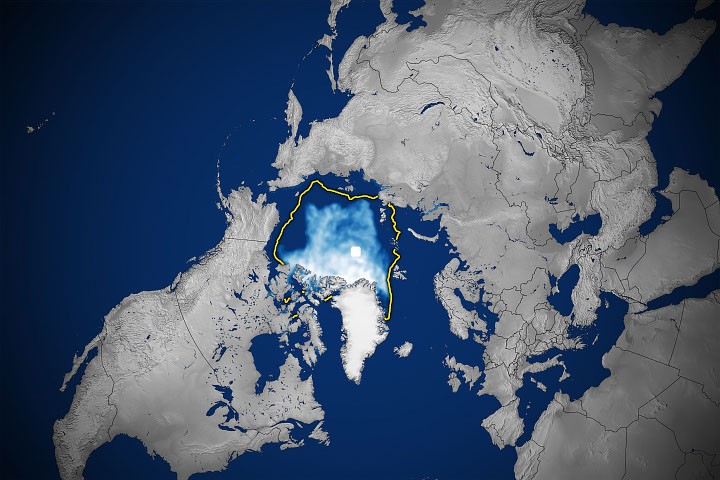
The Arctic Ocean's frozen cap has done its annual disappearing act, and the 2026 edition is nothing if not consistent. Sea ice reached its minimum extent on September 12, covering an estimated 4.6 million square kilometers (1.78 million square miles), according to NASA and the National Snow and Ice Data Center (NSIDC). That ties 2008, 2010, and 2025 for the 10th-lowest minimum in the satellite record - a four-way tie nobody wants to win.
For context, this is a natural fluctuation that has persisted for millennia: ice grows through the long polar winter, usually peaking in March, then melts through summer to its annual low in September. The catch is that satellites have been watching since late 1978, and the ice now covers less of the Arctic Ocean at both its annual maximum and minimum than it did a few decades ago. The downward trend steepened in the 2000s and set off a run of record and near-record lows. Each of the past 20 summers, from 2007 through 2026, ranks among the 20 lowest minimum extents on record. The all-time low? September 2012, which apparently decided to show off.
More recently, the September minimum has been relatively steady. Weather can swing how much ice melts from one summer to the next - over the past decade, increased cloud cover has kept sunlight from accelerating the melt, according to NASA scientists. So the plateau is real, but the summer minimum remains well below the long-term average. Think of it as failing a test slightly less badly.
Across the Arctic, the ice that remains is younger and thinner. Observations show a decline in multiyear ice - the stuff that survives at least one melt season - leaving an Arctic dominated by thinner first-year ice. Winter ice is shrinking too: the March 2026 maximum statistically tied the 2025 maximum for the lowest in the satellite record. Natural cycles like the Arctic Oscillation play a role, but the decline throughout the satellite record cannot be explained by natural variability alone. Natural variability and rising global temperatures have worked together to melt greater amounts of Arctic sea ice, and scientists have projected an essentially ice-free Arctic could occur at least once before the middle of the 21st century. Mark your calendars, loosely.
To measure sea ice extent, scientists rely on satellites with passive microwave sensors that detect the microwave energy Earth naturally emits. Sea ice emits more of this energy than open water, so it stands out in microwave images - and because microwaves pass through clouds, the satellites can observe sea ice regularly, regardless of weather. The record began in 1978 with NASA's Nimbus-7, followed by Defense Meteorological Satellite Program (DMSP) satellites starting in 1987 and NASA's Aqua satellite between 2002 and 2011. Starting in 2025, scientists began using observations from the Japan Aerospace Exploration Agency's GCOM-W satellite. The white circle at the center of each image is the 'pole hole,' north of which satellite sensors have historically been unable to collect data; the sea ice estimates assume that hole is ice-filled. NASA Earth Observatory images by Michala Garrison, using data from the National Snow and Ice Data Center.
The Good Times
News in your inbox.
One sardonic roundup, delivered on your schedule. Free. Unsubscribe whenever your tolerance for wit runs out.
Already subscribed but we never reach your inbox? Check your spam folder and hit 'Not spam' (or 'Remove from spam') to bust us out of junk-mail purgatory. You'll be helping everyone else too.
Don't open any of our emails for a month and you'll be automatically removed from the mailing list.
Rewrite Article
Select parts to regenerate with a fresh AI pass. Translations will be updated automatically.
Generate AI Image
Creates a sardonic version of the article image using OpenAI.