Ancient Scorpion the Size of a Coffee Table Stuns Scientists, Probably Didn't Need a Table
A scorpion the size of a coffee table roamed Earth 415 million years ago, before trees existed, because apparently ecological opportunity beats oxygen levels.
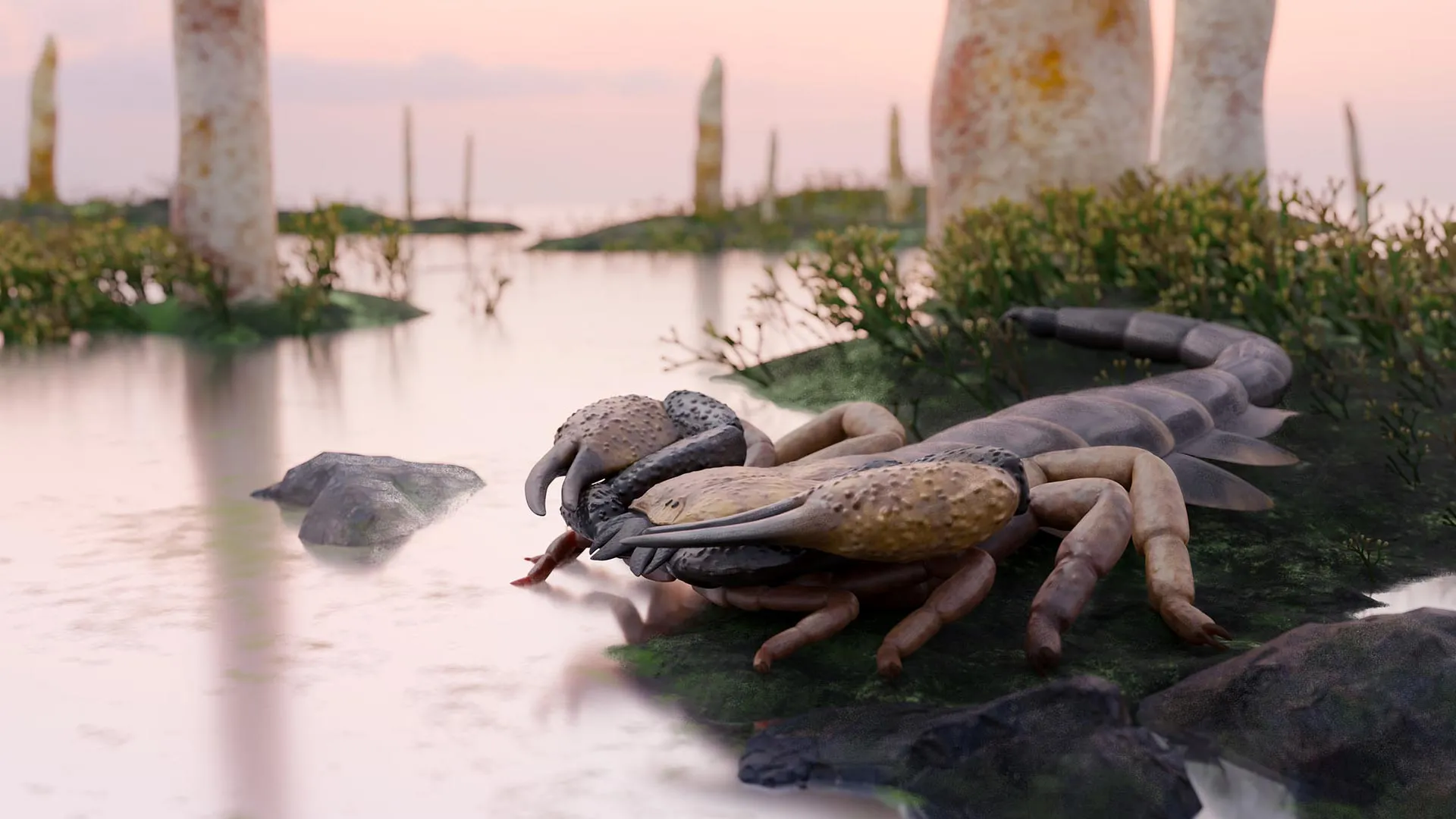
Researchers from The University of Manchester and the Natural History Museum have finally identified a fossil predator that had been gathering dust in museum collections for over 150 years. Meet Praearcturus gigas, the largest scorpion known to science, which roamed what is now England and Wales around 415 million years ago. At roughly one meter (about 3.3 feet) in length, with pincers over 16 centimeters (6.3 inches) long, this beast would have been the stuff of nightmares - if nightmares existed back then, which they probably didn't, because life on land was just getting started.
The study, published in Palaeontology, used modern analytical methods and comparisons with more recently described fossil species to confirm that Praearcturus was indeed a scorpion and a distinct species. Dr. Richard J. Howard, Curator of Fossil Arthropods at the Natural History Museum and lead author, noted that while we often associate giant arthropods with the Carboniferous rainforests and their giant millipedes, Praearcturus lived at least 50 million years earlier, well before trees evolved. "Confirming that this animal is a scorpion fundamentally changes our understanding of how and when these creatures evolved to such extraordinary sizes," he said, in what might be the understatement of the Devonian.
Dr. Russell Garwood, a paleontologist at The University of Manchester, added that Praearcturus has puzzled scientists for over a century. By combining material from several collections and using cutting-edge imaging, they've built a clearer picture of the animal. "What makes Praearcturus so interesting is that it became enormous at a time when life on land was otherwise very small," he said, noting that it lived in a world that could somehow support a giant predator. The team compared the size of fossil scorpions with other animals of the time and concluded that perhaps it lived in water, where life was bigger - because, you know, water is where the big stuff hangs out.
Praearcturus gigas existed during the Early Devonian, when terrestrial ecosystems were in their infancy. Small plants and fungi had just begun spreading, and forests were still a distant dream. This timing is crucial because it predates the high atmospheric oxygen levels often linked to later giant arthropods. Instead, the researchers suggest that ecological opportunity - namely, a lack of competing large predators - may have allowed Praearcturus to dominate its environment and reach such impressive proportions. Because nothing says 'dominance' like being the biggest thing on a planet with no trees.
The fossils also hint that Praearcturus might have spent part of its life in water. Some specimens preserve flap-like structures on the abdomen resembling features in modern crustaceans like lobsters, suggesting the giant scorpion could move between water and land. An analysis of the broader arachnid fossil record, led by Dr. Garwood, found that scorpions are unusually common in rocks from this period, supporting the idea that some early scorpions occupied freshwater environments, where their remains were more likely to be preserved. This places Praearcturus at a pivotal moment in Earth's history when animals were first experimenting with life outside the oceans - a sort of prehistoric 'try before you buy' for land living.
Dr. Greg Edgecombe, Merit Researcher at the Natural History Museum and co-author, noted that the boundary between land and sea was much less defined back then. "Praearcturus gives us a fascinating glimpse into how early animals adapted to these changing environments," he said, adding that it might even represent a lineage that returned to the water after earlier ancestors had already begun living on land. Because why commit to a lifestyle when you can just switch back?
First described in 1871, Praearcturus was originally thought to be a giant crustacean resembling a woodlouse. The fossils were incomplete, lacking a tail, which made identification tricky for over a century. The breakthrough came when researchers compared the historic specimens with better-preserved fossils found recently, revealing anatomical traits specific to scorpions. This discovery highlights how old museum specimens can still yield major insights. As Dr. Howard put it, "Specimens collected over a century ago can still hold entirely new insights. By revisiting them with modern techniques, we can uncover discoveries that reshape our understanding of life on Earth." So next time you're cleaning out your attic, remember: that dusty old rock might just be a giant scorpion in disguise.
This finding challenges traditional ideas about prehistoric arthropod gigantism, suggesting that high oxygen levels weren't the only factor. Ecological opportunity - the absence of competing large predators - may have allowed Praearcturus to reach such sizes. So, in a world without trees, without forests, and without competition, a coffee-table-sized scorpion thrived. And you thought your living room furniture was intimidating.
The Good Times
News in your inbox.
One sardonic roundup, delivered on your schedule. Free. Unsubscribe whenever your tolerance for wit runs out.
Already subscribed but we never reach your inbox? Check your spam folder and hit 'Not spam' (or 'Remove from spam') to bust us out of junk-mail purgatory. You'll be helping everyone else too.
Don't open any of our emails for a month and you'll be automatically removed from the mailing list.
Rewrite Article
Select parts to regenerate with a fresh AI pass. Translations will be updated automatically.
Generate AI Image
Creates a sardonic version of the article image using OpenAI.