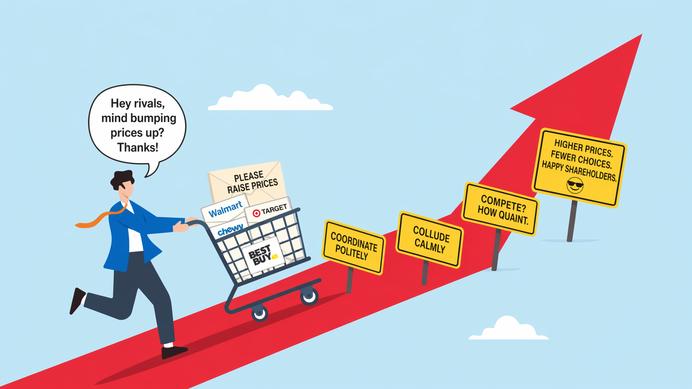
Amazon's Emails Reveal How to Politely Ask Your Rivals to Please Raise Prices
Internal emails show Amazon allegedly orchestrating price hikes with competitors on everything from pants to pet treats, because why compete when you can collude?
Newly unsealed emails show the charmingly direct ways Amazon allegedly coordinates with competitors to ensure you pay more for everything, according to California Attorney General Rob Bonta. The lawsuit, filed in 2022, claims the $2.66 trillion empire pressures vendors into a three-step dance of price manipulation.
In the first scheme, Amazon and a competitor agree to stop price matching, allowing one to hike a price so the other can match it, thus creating a new, higher baseline for everyone. The second involves Amazon spotting a rival's price it deems too low, pressuring the vendor to get that rival to raise it, and then Amazon graciously matching the new, inflated figure. The third, more aggressive path sees Amazon pushing vendors to simply remove products from platforms offering lower prices, thus avoiding the whole messy business of competition.
The requests were often met with urgency, with prices spiking within a day as vendors feared being dropped. The increases ranged from subtle to staggering: Amazon pushed Walmart and Levi’s to raise khaki pants by about $1.50, while another vendor, All the Rages, got Walmart to increase lamp prices by about $15 each.
Even pet treats weren't safe. Emails show vendor GlobalOne used a "happy face emoji" after Chewy agreed to raise prices on 13 kinds of Canine Naturals treats, with Amazon then immediately pushing for even higher prices. "Overall this looks like it’s working!" a GlobalOne spokesperson reported.
Some hikes were permanent; others were timed for maximum leverage. Amazon threatened furniture company Armen Living with removing four products right before Black Friday and Cyber Monday if "drastically" lower prices on sites like Home Depot weren't increased, seeking to mark up a barstool from $156.58 to $172.97 and a dining chair from $103.56 to $119.99. Similarly, it pushed lawn/garden vendor Scotts to request a price increase for the three days leading up to Prime Day.
Amazon spokesperson Mark Blafkin dismissed the filing as a "transparent attempt to distract from the weakness of its case," claiming the evidence isn't new and that Amazon is "consistently identified as America’s lowest-priced online retailer." Bonta countered that the emails are "not outliers" but evidence of "countless interactions" constituting explicit price-fixing.
Discovery also revealed Amazon trains employees to use vague language or schedule calls for these "delicate" negotiations to avoid a paper trail. Bonta is seeking a preliminary injunction by July 23 to block the alleged price-fixing ahead of a trial scheduled for January 2027, arguing Amazon cannot show "grave or irreparable harm" from being prohibited from illegal acts. "You don’t see price-fixing so explicitly and egregiously in writing like this," Bonta noted.
The Good Times
News in your inbox.
One sardonic roundup, delivered on your schedule. Free. Unsubscribe whenever your tolerance for wit runs out.
Already subscribed but we never reach your inbox? Check your spam folder and hit 'Not spam' (or 'Remove from spam') to bust us out of junk-mail purgatory. You'll be helping everyone else too.
Don't open any of our emails for a month and you'll be automatically removed from the mailing list.
Rewrite Article
Select parts to regenerate with a fresh AI pass. Translations will be updated automatically.
Generate AI Image
Creates a sardonic version of the article image using OpenAI.