
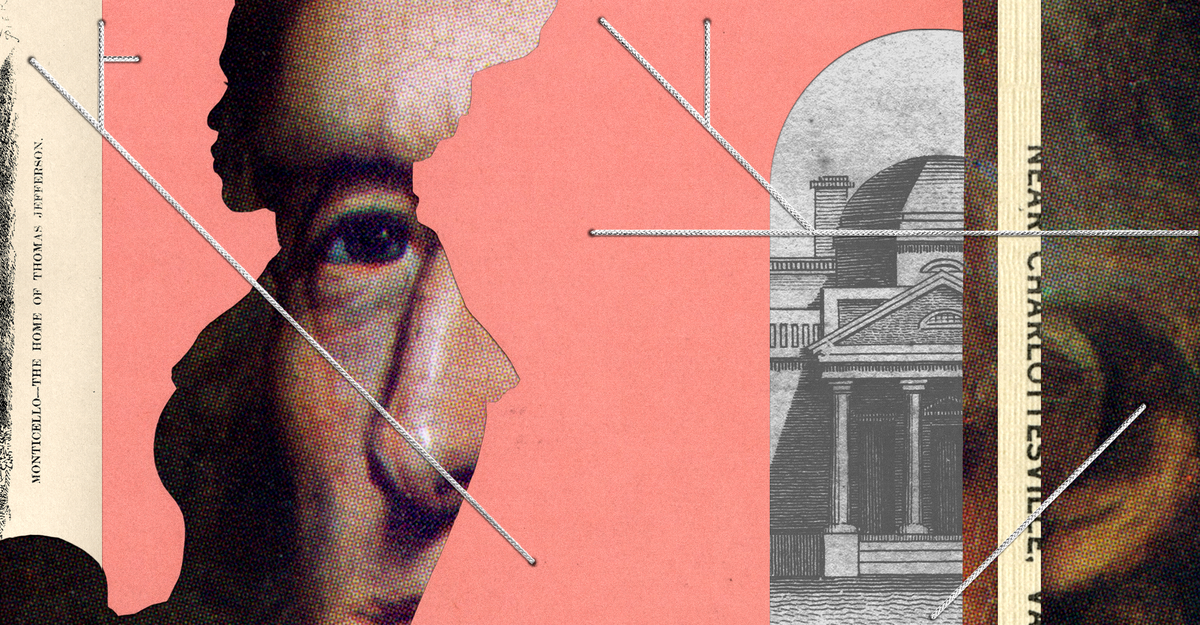
Three hours after Thomas Jefferson died at Monticello on July 4, 1826, his personal secretary, Nicholas Trist, snipped a lock of the Founder's gray hair - still faintly reddish blond - tied it with orange thread, and tucked it into a paper packet with a note. At the time, it was just a sentimental keepsake. Two centuries later, it became key evidence in one of America's oldest and most contentious historical debates: whether the author of the Declaration of Independence fathered children with Sally Hemings, a woman he enslaved for half a century and never freed.
After a covert, exhaustive 15-year effort led by the Smithsonian Institution, a team of geneticists, genealogists, historians, and anthropologists believes it has proof that Jefferson fathered at least two of Hemings's six children. Richard Kurin, a Smithsonian cultural anthropologist who led the multidisciplinary research, will publish a book detailing the findings on Tuesday. A scientific paper is currently under review for publication in Proceedings of the National Academy of Sciences (PNAS). The researchers, who spoke with The Atlantic before publication, reassembled Jefferson's genome from the hair and matched it with DNA from descendants of Hemings's sons Madison and Eston. (Of her other four children, two died in infancy, and the other two had no known offspring.) Not only did they find that Madison's and Eston's descendants share Jefferson's DNA - many have more of it than his known descendants through his wife, Martha Wayles.
For many Americans, the matter was settled years ago. In 1998, Nature published a two-page peer-reviewed paper titled "Jefferson Fathered Slave's Last Child." Newspapers declared the case closed, and Oprah Winfrey staged a tearful family reunion of Jefferson's descendants. Most historians accepted the finding when combined with other evidence. But a vocal minority has continued to doubt the relationship, pointing out - correctly - that the limited biological data in the Nature study didn't definitively prove Jefferson was the father, only that he was one of several candidates in the Jefferson male line. They also dismissed oral histories from Hemings's descendants as unreliable or wishful thinking. Some detractors saw a more nefarious agenda: one researcher called the 1998 study "a deliberate attempt to select and mold the evidence to fit a pre-selected theory." Others, many white Virginians, defended the Founder. "Jefferson's personal reputation has been all but assassinated," wrote William G. Hyland Jr., a lawyer and author. "The face on Mount Rushmore has been vilified as a slave-owning hypocrite, misogynist, and racist."
Though the new results might convince some holdouts, the backlash has already arrived. The Heritage Foundation has criticized Monticello's depiction of Jefferson for failing to tell visitors "that historians disagree about Jefferson's relationship with Sally Hemings." The Thomas Jefferson Heritage Society, a nonprofit formed in response to the Nature report, still accuses "historical revisionists" of inaccurately portraying Jefferson as a "liar, fraud, hypocrite, and child molesting slave rapist." The Trump administration has made clear it wants a version of American history that doesn't disparage the Founders. In a report released on the Fourth of July, the White House condemned what it called "extreme political activism" guiding the 180-year-old Smithsonian, which President Trump has said is too focused on "how bad Slavery was."
For Clara Nutt, the results are simply confirmation of a long-known fact. Her African American father told his freckled daughter early on that she was a direct descendant of Jefferson through Madison Hemings. Nutt provided saliva samples that found 5.1 percent of Jefferson's genetic makeup in her DNA - nearly twice the amount expected by genetic averaging. She was delighted but not surprised. "I have always known who I am," Nutt said.
The story first surfaced in a Richmond newspaper in 1802. The writer, Scottish-born journalist James Callender, had once been a Jefferson champion and received financial support from him. But when Jefferson won the 1800 election, he denied a government job to the volatile Callender, who had been jailed during John Adams's administration for sedition. Ally turned enemy. "By this wench Sally, our president has had several children," Callender wrote in The Recorder. "The AFRICAN VENUS is said to officiate, as housekeeper at Monticello."
The Hemings-Jefferson matter became one of the nation's first major political scandals - and one of its most enduring. "This engaged six of the seven first presidents," Kurin said. "You could call it the longest-running American soap opera" - one involving race, inequality, and liberty.
Jefferson, after all, declared in 1814 that "amalgamation with the other color produces a degradation to which no lover of his country, no lover of excellence in the human character can innocently consent." By that date, his youngest child with Hemings, Eston, was 6 years old. Jefferson's granddaughter Ellen Randolph Coolidge, in an 1858 letter to her husband, referred to the possibility of a relationship with Hemings as that which "will not bear telling. There are such things, after all, as moral impossibilities." The Founder went to his grave without publicly acknowledging the relationship or any children with Hemings.
A 1974 book by historian Fawn Brodie reignited the debate with fresh historical evidence of Jefferson's long-term liaison with Hemings, but Brodie's assertions gained little traction among scholars. If the Hemings story was true, one skeptical historian wrote in 1977, then Jefferson "deserves to be regarded as one of the most profligate liars and consummate hypocrites ever to occupy the presidency." Gore Vidal summarized the prevailing sentiment: "No gentleman would have gone to bed with a slave. Since Thomas Jefferson was the greatest gentleman of his period, he could not have done so either. That takes care of that."
Two decades later, Harvard law professor Annette Gordon-Reed sharply criticized the academic community for spending "generations either ignoring or explaining away" the nearly four-decade relationship and accepting white narratives denying the tie while dismissing those left by Black families.
The 1998 Nature report brought genetics to bear. The authors based their data on the Y chromosome, passed down by Jefferson's male descendants. But some researchers accused the authors of misleading the public, and the authors had to acknowledge that Jefferson could "neither be definitively excluded nor solely implicated" by their data. Other candidates included his younger brother, Randolph, a frequent visitor to Monticello. One enslaved informant called Randolph "a mighty simple man" who "used to come out among black people, play the fiddle & dance half the night."
A month after the Nature study, the Thomas Jefferson Foundation, which owns and operates Monticello, convened scholars to examine the genetic and historical data. A 2000 statistical analysis by a Monticello archaeologist strengthened the case by examining the timing of Jefferson's presence at Monticello and the conceptions of Hemings's children. A majority of the foundation's panel found "a high probability" that at least one of Hemings's children had been fathered by Jefferson, and likely all six. A minority rejected the conclusions, calling the research a cynical campaign by academics and the media "to denigrate and destroy the legacy of one of the greatest of our founding fathers and one of the greatest of all our citizens."
Critics united to form the Thomas Jefferson Heritage Society, which undertook a second independent review and declared the foundation's report "the product of shallow and shoddy scholarship" that ignored exculpatory evidence "in order to achieve an apparently desired conclusion." John Works, a Jefferson descendant and founding member, wrote that defending the author of the Declaration "has come to mean defending what America means, and we feel compelled to rise to that defense." The society's 2001 report found the Nature results "almost certainly false" and insisted that "Sally Hemings appears to have been a very minor figure in Thomas Jefferson's life."
The controversy spawned books with subtitles such as An American Travesty and Fallacies, Omissions, and Contradictions in the Hemings Genealogical Search. "Jefferson is completely innocent of this sordid charge," William Hyland maintained in In Defense of Thomas Jefferson, citing "an obsessive agenda on the color of Sally's skin, and slave status." Another doubter, David N. Mayer, a law and history professor in Ohio, fingered "'political correctness,' radical multiculturalism, and postmodernism."
Hemings was born in 1773 as the youngest child of the enslaved Elizabeth Hemings, described by one enslaved man at Monticello as "a bright mulatto woman." Sally, he recalled, was "mighty near white" and "very handsome; long straight hair down her back." One of Jefferson's grandsons described her as "light colored and decidedly good looking." Both enslaved and free contemporaries reported that her father was John Wayles, the father of Jefferson's wife, Martha. If true, Hemings was Martha's half sister.
On her deathbed in 1782, Martha is said to have made her husband promise not to remarry. Five years later, he was in Paris as minister plenipotentiary when his daughter Maria arrived, accompanied by the 14-year-old Hemings. Madison Hemings later claimed that Jefferson and his mother began a sexual relationship in France, where she was legally free, and that she agreed to return to the United States on the condition that any future children would be freed at age 21.
In an interview with a journalist, Madison stated that his mother was pregnant by Jefferson on their return in 1789, though it is unclear whether any child from that time survived. Hemings served in the main house of Monticello while her owner joined George Washington's Cabinet as the nation's first secretary of state, then became president from 1801 to 1809. Jefferson recorded the birth of Hemings's six children, including Beverly in 1798, Harriet in 1801, Madison in 1805, and Eston in 1808. Two other daughters, born in 1797 and 1799, died in infancy. The three sons trained as carpenters, and Harriet spun and wove cloth. Both Beverly and Harriet fled Monticello in 1822. Jefferson, [Article truncated]