240-Million-Year-Old Giant Salamander Cousin Finally Emerges From Someone's Retaining Wall
A fossil that spent decades as part of a garden retaining wall turns out to be a 240-million-year-old amphibian with serious teeth and a name that translates to 'supine sand creeper.'
A fossil that spent decades hiding in plain sight - specifically, inside a garden retaining wall - has finally been formally identified, proving that one person's landscaping material is another paleontologist's treasure. Researchers from UNSW Sydney and the Australian Museum have named and described the ancient amphibian, bringing new attention to an unusual discovery that began in the 1990s.
The specimen was first uncovered by a retired chicken farmer, who had sourced rocks from a nearby quarry to build a garden retaining wall. Among those stones was the fossil, which was later donated to the Australian Museum in Sydney. So the next time you're admiring your neighbor's rock wall, just remember: it might contain a 240-million-year-old surprise.
Paleontologist Lachlan Hart, affiliated with both UNSW Science and the Australian Museum, explains that the fossil, now named Arenaerpeton supinatus - meaning 'supine sand creeper' - is exceptionally well preserved. It includes almost the entire skeleton and even faint outlines of the animal's skin. "This fossil is a unique example of a group of extinct animals known as temnospondyls, which lived before and during the time of the dinosaurs," says Mr. Hart, a PhD candidate in the School of Biological, Earth and Environmental Sciences (BEES) at UNSW. "We don't often find skeletons with the head and body still attached, and the soft tissue preservation is an even rarer occurrence."
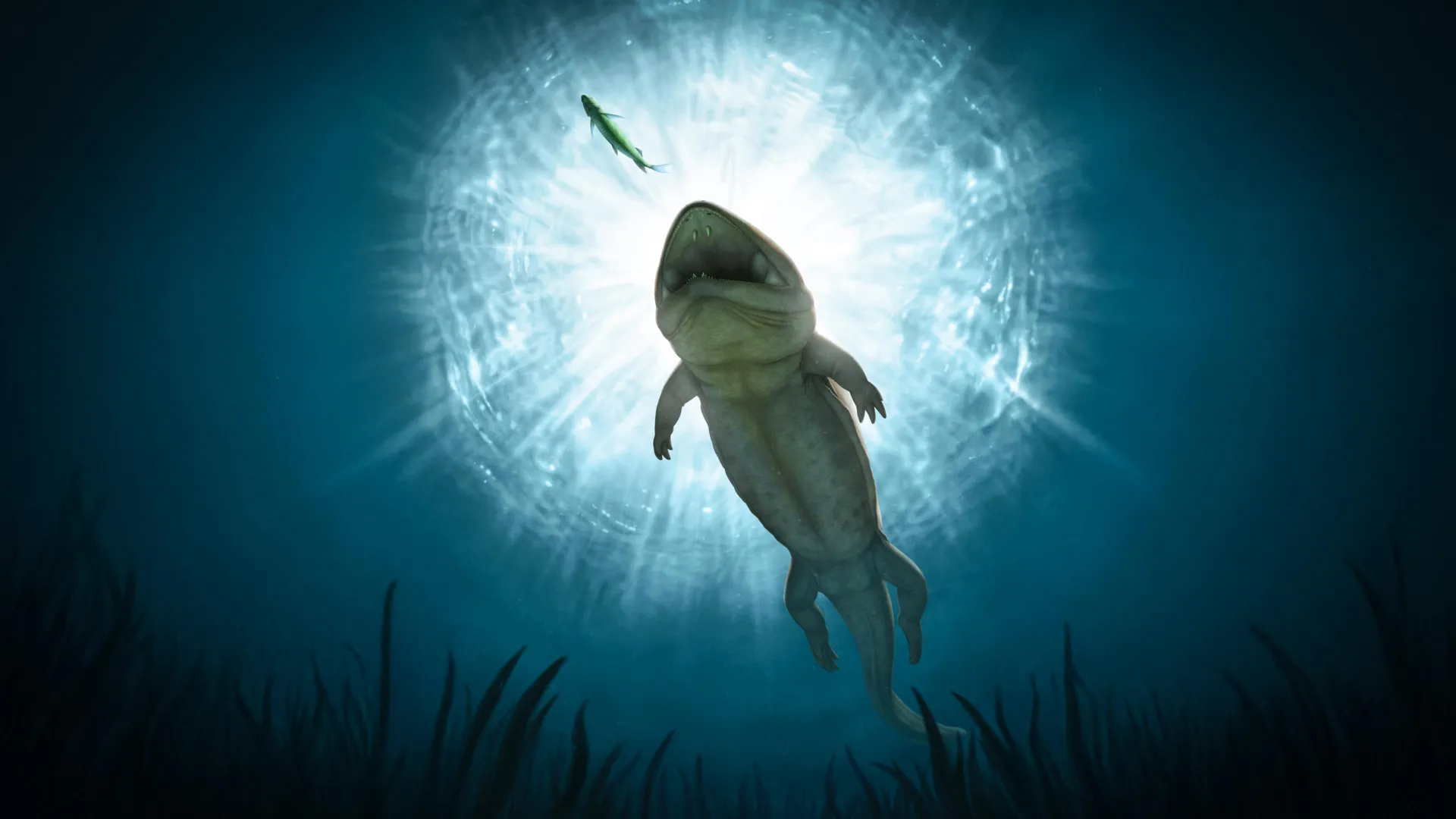
Arenaerpeton lived in freshwater environments within what is now the Sydney Basin during the Triassic period, around 240 million years ago. According to Mr. Hart, it likely preyed on ancient fish such as Cleithrolepis. Beyond that, there is limited evidence about the other species that shared its habitat. In appearance, the creature may remind people of a modern Chinese Giant Salamander, particularly when looking at its head shape. "Superficially, Arenaerpeton looks a lot like the modern Chinese Giant Salamander, especially in the shape of its head," Mr. Hart says. "However, from the size of the ribs and the soft tissue outline preserved on the fossil we can see that it was considerably more heavyset than its living descendants. It also had some pretty gnarly teeth, including a pair of fang-like tusks on the roof of its mouth."
One of the most notable aspects of Arenaerpeton is its size. Mr. Hart estimates it measured about 1.2m from head to tail, which is unusually large compared to many of its close relatives from the same period. He notes that later temnospondyls continued to exist in Australia for another 120 million years, with some species reaching even greater sizes. This long history spans two major mass extinction events, suggesting that increasing body size may have played a role in their survival. Dr. Matthew McCurry, Senior Lecturer in UNSW's School of BEES and Curator of Palaeontology at the Australian Museum, emphasizes the importance of the find. "This is one of the most important fossils found in New South Wales in the past 30 years, so it is exciting to formally describe it," says Dr. McCurry, who is also a co-author on the study. "It represents a key part of Australia's fossil heritage." The research has been published in the Journal of Vertebrate Paleontology.
The Good Times
News in your inbox.
One sardonic roundup, delivered on your schedule. Free. Unsubscribe whenever your tolerance for wit runs out.
Already subscribed but we never reach your inbox? Check your spam folder and hit 'Not spam' (or 'Remove from spam') to bust us out of junk-mail purgatory. You'll be helping everyone else too.
Don't open any of our emails for a month and you'll be automatically removed from the mailing list.
Rewrite Article
Select parts to regenerate with a fresh AI pass. Translations will be updated automatically.
Generate AI Image
Creates a sardonic version of the article image using OpenAI.