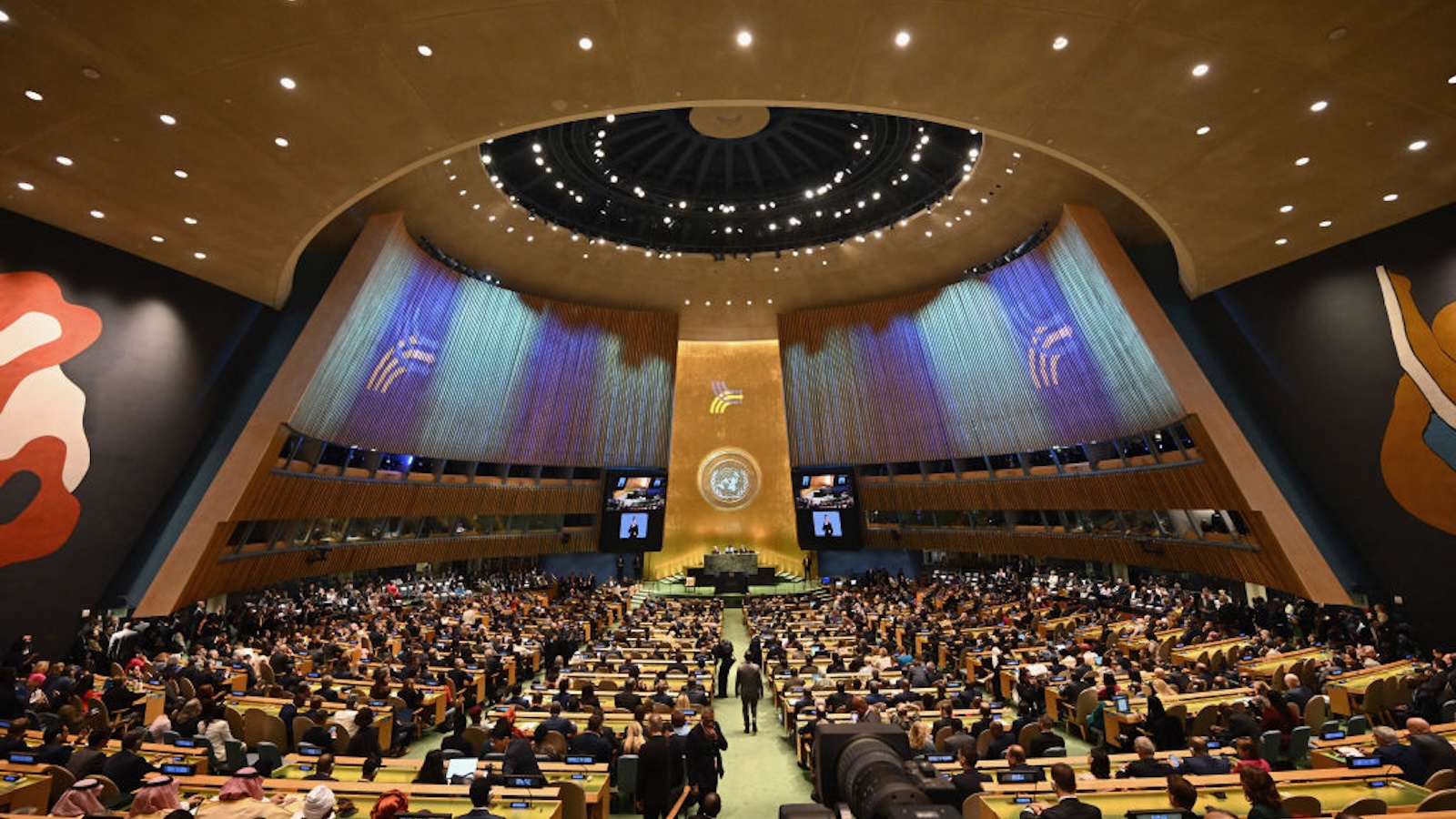
World Agrees Climate Change Is Bad, 8 Countries Disagree (Guess Which Ones)
UN votes overwhelmingly to back ICJ ruling that climate inaction is a 'wrongful act' - U.S., Iran, Israel, Saudi Arabia, and Russia say 'nah, we're good'.
About six years ago, some law students at the University of the South Pacific convinced the government of Vanuatu to take climate change all the way to the International Court of Justice - the legal equivalent of trying to get your landlord to fix the heating by filing a complaint with the Supreme Court. Against all odds, it worked. In 2025, the ICJ unanimously ruled that failing to tackle climate change is a “wrongful act,” and that harmed nations could seek reparations. Now, the United Nations has voted overwhelmingly - more than 140 countries in favor, just eight against - to adopt a resolution backing that ruling. The dissenters include the United States, Iran, Israel, Saudi Arabia, and Russia, which is a bit like the kids who refuse to clean their room banding together to declare that messiness is a myth.
“This must be a turning point in accountability for damaging the climate,” said Vishal Prasad, director of the Pacific Islands Students Fighting Climate Change, who helped start this whole thing. “The journey of this idea from classrooms in the Pacific to The Hague and the United Nations gives us continued hope that when people organize, the world can be moved to act.” The near-unanimous decision is a rare sign that multilateral cooperation on climate hasn’t completely unraveled, which is good, because over the past year it’s looked like a sweater with a single thread holding it together. After Donald Trump’s administration announced it would withdraw from the Paris Agreement, the U.S. has actively opposed climate action, derailing a carbon tax on the shipping industry (which emits about 3 percent of global carbon emissions) and helping kill a cap on plastics production. The U.S. also berated the International Energy Agency into projecting future energy demand under a scenario where climate action stalls out - because nothing says “leadership” like assuming the worst and then making it happen.
“The unity and clarity expressed by the vote was striking,” said Nikki Reisch, director of the Center for International Environmental Law’s climate and energy program. She said the resolution puts “political weight behind legal norms” and will help translate the court’s conclusions into practical action. The Trump administration had mounted a campaign to block the vote, with the State Department sending a missive noting it “strongly opposed” the resolution because it “could pose a major threat to U.S. industry.” In remarks before the vote, Tammy Bruce - a former conservative radio host now serving as deputy U.N. representative - called the resolution “problematic” and objected to “alarmist political statements, such as the idea that climate change is an unprecedented challenge of civilizational proportions.” Because apparently calling a civilization-threatening crisis “civilization-threatening” is hyperbolic. The resolution reiterates the ICJ’s core findings, calls for keeping global temperature rise to 1.5 degrees Celsius, transitioning away from fossil fuels, and affirms that harmed nations can seek redress. It’s not legally binding - because U.N. resolutions are essentially strongly worded suggestions - but it signals political priorities.
The vote comes as countries are cracking down on climate activism and litigation. In Aotearoa New Zealand, the government moved to amend climate laws to limit civil court proceedings against major emitters. Māori climate advocate Mike Smith, who is pursuing high court proceedings against six of the country’s largest emitters, described the U.N. vote as a “major shift” reflecting a changing understanding of climate change as something with legal consequences. “We know as Māori that the islands are part of our journey across the Pacific,” he said. “New Zealand has a responsibility to stand with Pacific countries like Vanuatu, Kiribati, Tonga, and Tokelau. Not just symbolically, but in supporting stronger legal and international action.” The activists pushing this believe many countries still need to be pushed to uphold their obligations. As Prasad put it: “The law is clear that climate action cannot sit on the shelf, it must be turned into action.” In other words, the world has the ruling, the resolution, and the moral high ground. Now it just needs the follow-through.
The Good Times
News in your inbox.
One sardonic roundup, delivered on your schedule. Free. Unsubscribe whenever your tolerance for wit runs out.
Already subscribed but we never reach your inbox? Check your spam folder and hit 'Not spam' (or 'Remove from spam') to bust us out of junk-mail purgatory. You'll be helping everyone else too.
Don't open any of our emails for a month and you'll be automatically removed from the mailing list.
Rewrite Article
Select parts to regenerate with a fresh AI pass. Translations will be updated automatically.
Generate AI Image
Creates a sardonic version of the article image using OpenAI.