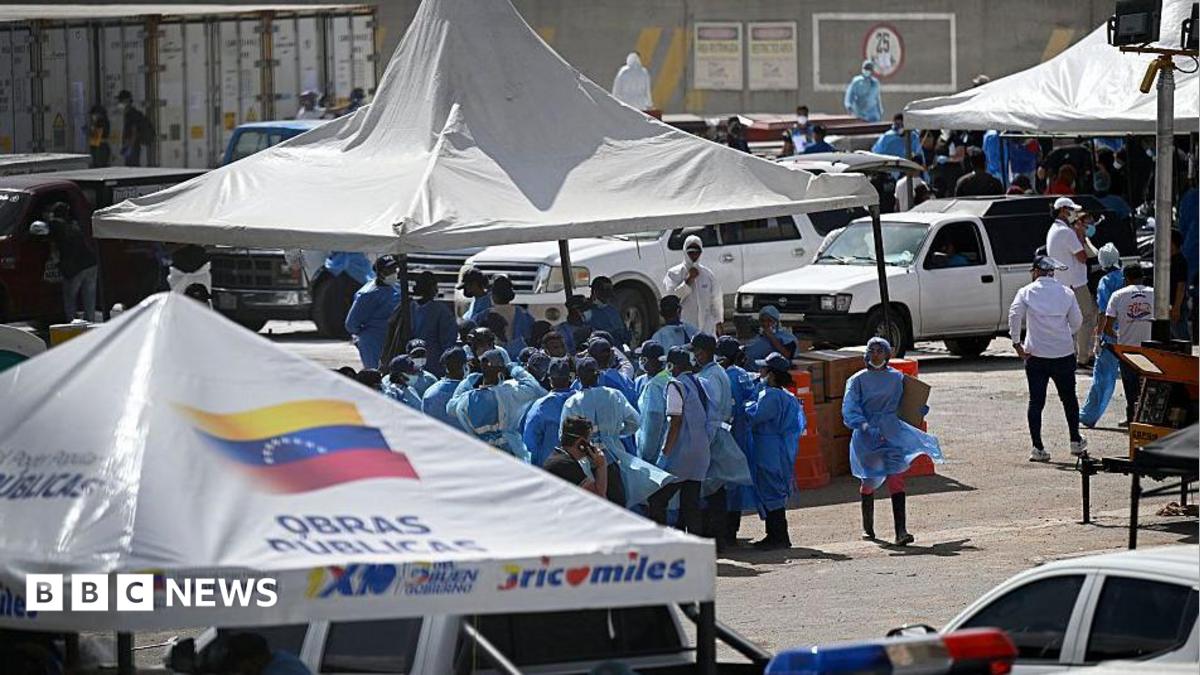
At a port storage facility in La Guaira that has been hastily repurposed into a morgue, a grimly repetitive scene unfolds: families who've spent days combing through hospitals, shelters, and rubble now wait hours to confirm the worst. With Venezuela's twin earthquakes pushing the death toll past 2,600, officials are struggling not just to recover bodies but to figure out who they are. Local services are overwhelmed, forcing institutions to improvise - which, nine days after the tremors, means bodies are stored outside or in tents under the blazing sun.
Rows of chairs line the area inside and outside Los Silos, where sadness is contagious. No one speaks. Some stare blankly; others scroll their phones reading news or answering messages. Armed personnel from the Bolivarian Armed Forces control access, adding a touch of authoritarian ambiance. "I'm afraid of what I'm going to see in there, but it's the only way to end this agony," says a woman searching for her nephew. Inside, the smell of decomposition hits first. Family members cover their mouths; cloth masks offer little relief. Soon, they stop reacting - the human capacity for adaptation is disturbing.
Hundreds of bodies lie in rows, wrapped in plastic and exposed to the sun, arranged by recovery time. At one end, a tent offers free cremation; at the other, forensic specialists use dental records. Families face a choice: identify by clothing, or sit before two TV screens flashing over 1,000 images of swollen, darkened, injured bodies. They search for tattoos, bracelets, or a dusty blanket. One woman bursts into tears recognizing her son by such a blanket; a stranger embraces her. A young man whispers into his phone, trying to identify his mother but says the state of the bodies makes it hard. "This is like a horror movie," says Liliana González, 60, who came for her aunt but identified her 37-year-old nephew by his tattoo.
Modesta Alemán, 56, traveled from Carayaca to find her older sister Matilde, who lived in Playa Grande - one of the hardest-hit areas. Volunteers heard voices from the building but couldn't reach anyone. Modesta waits outside while relatives handle the identification. Perhaps it's better this way, she says. The process takes hours: identification, fingerprints (if possible), coffins, death certificates, then collection. Jéssica Soto, 42, has waited two days for the remains of her 15-year-old daughter and three-year-old granddaughter, trapped in their apartment. Their bodies were recovered nearly a week later. "They keep you waiting for paperwork, trucks, and who knows what else," she tells BBC Mundo. "They've had them in a coffin in the sun since yesterday. I have no choice but to wait and trust in God."
Liliana panicked when told she'd identify her nephew alone, but two workers accompanied her. "Thank God, because in a moment like that, it's good to feel someone's hand." Her aunt remains buried in the rubble. She fears returning to the morgue to repeat the process all over again.
The Good Times
News in your inbox.
One sardonic roundup, delivered on your schedule. Free. Unsubscribe whenever your tolerance for wit runs out.
Already subscribed but we never reach your inbox? Check your spam folder and hit 'Not spam' (or 'Remove from spam') to bust us out of junk-mail purgatory. You'll be helping everyone else too.
Don't open any of our emails for a month and you'll be automatically removed from the mailing list.
Rewrite Article
Select parts to regenerate with a fresh AI pass. Translations will be updated automatically.
Generate AI Image
Creates a sardonic version of the article image using OpenAI.