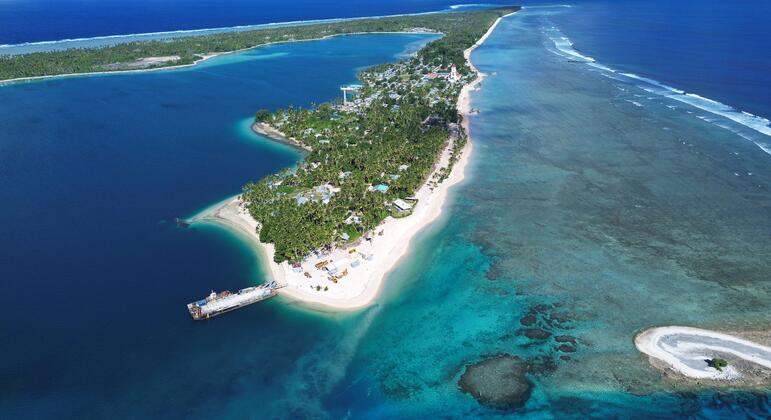
Tuvalu Builds Digital Nation, Literal Land, As Sea Levels Rise Twice Global Average
Facing seas rising twice the global average, Tuvalu is spending $55 million to build new land, sending citizens to Australia, and creating a backup nation in the metaverse.
The Pacific island nation of Tuvalu, averaging under two meters above sea level, is battling a sea-level rise of 21 centimeters in 30 years - nearly double the global average. With projections suggesting 95 percent of the country could be underwater by 2100, its citizens are preparing for the worst while the government attempts to safeguard the future, one expensive, novel, and digital solution at a time.
In 2025, over 90 percent of Tuvaluans applied for a visa scheme for residency or citizenship in Australia, following the 2023 Falepili Union treaty allowing 280 Tuvaluans to relocate there annually. Just before that, in 2022, the government created the world's first 'digital nation' in the metaverse to preserve statehood and culture if the physical territory vanishes. "Our islands are drowning," said Tuya Altangerel, a senior official at the UN Development Programme (UNDP) in the Pacific.
Traditional coastal protection methods like seawalls or planting mangroves "no longer work" against the increasing number and intensity of high tides, Altangerel noted. "If we plant mangroves, the mangroves will be simply swallowed by the sea." With support from UNDP and the Green Climate Fund, Tuvalu started a drastic adaptation plan in 2017: dredging sand to create new, elevated land. The Tuvalu Coastal Adaptation Project has created over seven hectares so far on the islands of Funafuti, Nanumea, and Nanumaga at a cost of close to $55 million.
Phase two began in 2024, adding eight more hectares along the southern shoreline of the capital, Funafuti, on Fongafale island, where 60 percent of the population lives. The UNDP is also providing an insurance scheme, with an initial 400 households in Funafuti set to receive automatic payments of up to $1,500 per high-tide flooding event. Meanwhile, a 2025 International Court of Justice ruling clarified that loss of physical territory does not automatically mean loss of statehood, allowing Tuvalu to retain sovereignty and UN rights even if submerged.
Other Pacific nations face similar fates. Australia has visa agreements with Kiribati and Vanuatu, New Zealand offers 75 residency visas per year to those two nations, and the United States has an agreement with the Marshall Islands. The concern, as Altangerel put it, is that "it's not just about coastal areas disappearing, it's also the people's sense of nationhood." The measures in Tuvalu may offer a survival template for Kiribati and the Marshall Islands - three of the world's four lowest-lying countries.
The Good Times
News in your inbox.
One sardonic roundup, delivered on your schedule. Free. Unsubscribe whenever your tolerance for wit runs out.
Already subscribed but we never reach your inbox? Check your spam folder and hit 'Not spam' (or 'Remove from spam') to bust us out of junk-mail purgatory. You'll be helping everyone else too.
Don't open any of our emails for a month and you'll be automatically removed from the mailing list.
Rewrite Article
Select parts to regenerate with a fresh AI pass. Translations will be updated automatically.
Generate AI Image
Creates a sardonic version of the article image using OpenAI.