
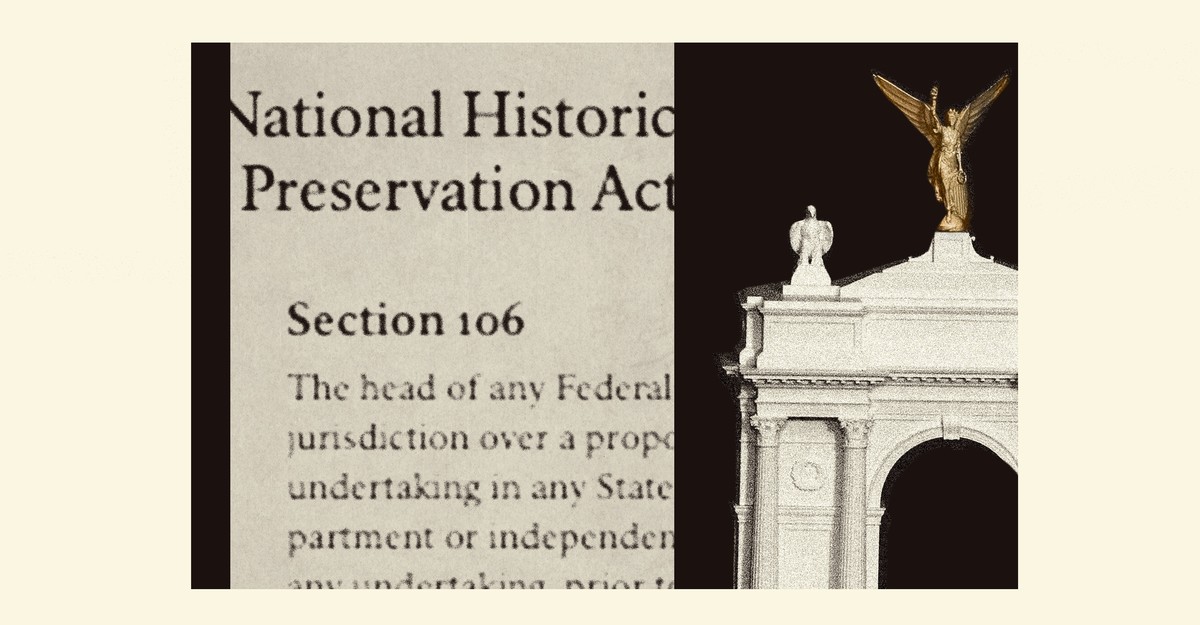
Building a monument in Washington, D.C., is usually a slow, agonizing process involving plans, revisions, studies, and consultations with preservationists, historians, tribes, and architects. The idea is to preserve the city's carefully choreographed symbolism. Donald Trump, however, prefers to leave his mark before leaving office - and he's not big on choreography.
His proposed United States Triumphal Arch - a 250-foot granite behemoth planned for Memorial Circle, across from the Lincoln Memorial - is currently trotting through the standard process, including a historic-preservation review known as Section 106. But as the proposal proceeds, an independent federal agency Trump has quietly reshaped is contemplating changes to the rules governing Section 106. The move could speed up not only Trump's arch but also federal projects affecting historic places nationwide, while shrinking scrutiny.
A July 17 email and draft amendments obtained by The Atlantic show that the Advisory Council on Historic Preservation (ACHP) will consider a vote to revise Section 106 rules. The proposal would give federal agencies broader discretion over preservation reviews, prioritize mitigation over avoiding harm, and scale back expectations to consider alternative designs or locations. The changes could make it easier to build the arch how - and where - Trump wants it.
Sara Bronin, a law professor and former ACHP chair, told The Atlantic the proposal goes further: it would narrow protected historic properties, weaken tribal consultation, curtail public participation, and exempt large categories of projects. “If adopted, these regulations will be challenged in court, and I doubt they will survive judicial scrutiny,” she said.
Even before the rewrite, the Trump administration compressed the review process. The arch has passed one key commission and appears likely to get another sign-off in September, despite a lawsuit from Vietnam War veterans and a preservationist, and mounting public opposition (52% opposed in a recent poll). The structure, mounted with gilded winged statues, has been called a “monstrosity,” a “garish tasteless eyesore,” a cheap copy of the Arc de Triomphe, and a “McMonument” - a jab at its $100 million price tag.
The Department of the Interior (DOI) hasn't received congressional authorization for the project, though new monuments in D.C.'s civic core typically require legislation. Nor has DOI considered moving the arch to another site. Instead, crews plan to work 20 hours a day, year-round, to complete it before the end of Trump's second term.
A White House official said the administration “has and will follow all legal requirements.” Indeed, the process exemplifies how the administration has technically observed benchmarks while distorting them enough to ensure fast approval. By speedrunning through red tape, Trump may prove the rules that shaped the capital are now obsolete.
Under the Commemorative Works Act of 1986, new monuments in the “reserve” area of the National Mall are prohibited, but Memorial Circle sits just outside. Proposals must undergo steps that typically start with an act of Congress - which hasn't happened. DOI cites a 1925 plan for columns that were never built, even though columns and arches look nothing alike.
Instead, the administration advanced the proposal through the Commission of Fine Arts and the National Capital Planning Commission, both led by Trump appointees. The National Park Service initiated a Section 106 review, which can take years but is expected to conclude by September. Participants don't have veto power, but preservationists say the Trump administration rushed the process by extending late invitations, limiting public comment, and excluding alternative sites.
Preservationists see Section 106 as a dialogue, not a rubber stamp. For the arch, DOI largely blocked routine consulting parties from joining discussions, instead resorting to a “boilerplate” list. Six groups that requested status were initially excluded, which the National Trust for Historic Preservation called “an abuse of discretion.” They eventually got invitations, but only one meeting has occurred. No further meetings are scheduled, despite plans for a final vote in September.