
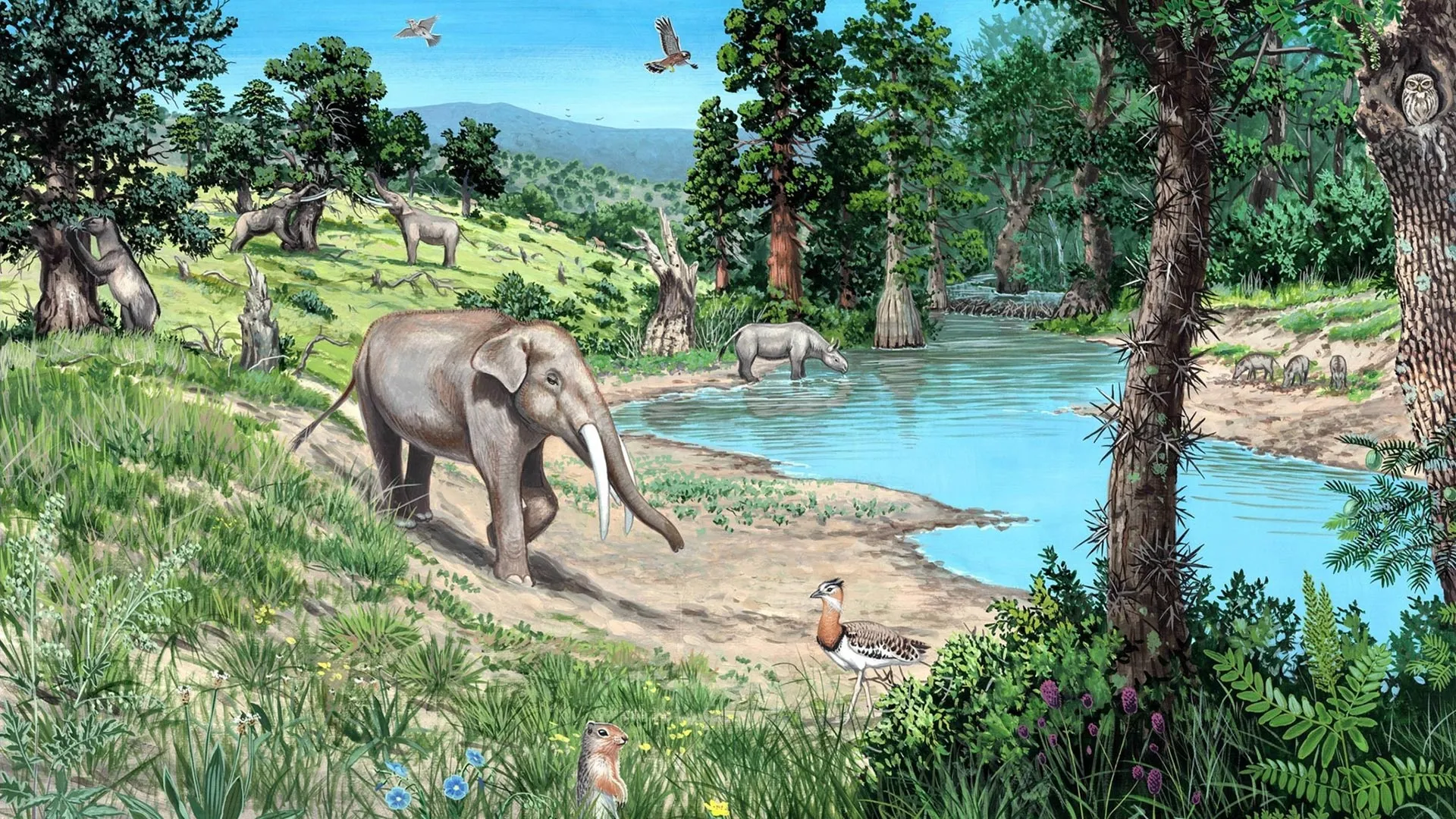
Picture central Europe 100,000 years ago - or a million, if you're feeling ambitious - and you probably imagine an endless wall of towering trees, canopies so thick the sun never bothers showing up. According to a major new study, that image is, to put it scientifically, wrong. Instead, much of the continent was a lively patchwork of scattered trees, open woodlands, grassy clearings, and colorful wildflower meadows, where birds and butterflies flourished in the sunlight while enormous grazing animals stomped around preventing trees from taking over. Nature, it turns out, was less "impenetrable forest" and more "well-managed parkland with very large landscapers."
Researchers led by Aarhus University found that this habitat mixture dominated Europe's landscapes for more than 20 million years. The dense, dark forests common in many parts of Europe today aren't the continent's original natural condition at all - they're a relatively recent development in its ecological history. Published in Biological Conservation, the findings challenge a longstanding assumption about pre-human Europe and raise pointed questions about modern reforestation programs that prioritize planting dense forests to combat climate change and protect biodiversity.
"The study shows that current reforestation practices are on the wrong track - both here in Denmark, where subsidies are only granted for planting dense forests, and elsewhere in Europe," said Professor Jens-Christian Svenning from the Center for Ecological Dynamics in a Novel Biosphere (ECONOVO), Department of Biology at Aarhus University, senior author of the study. "This will not only be harmful for biodiversity; it will be in direct contradiction to the type of ecosystems that Europe's species have evolved in over millions of years." In other words, we've been planting the ecological equivalent of a windowless basement and calling it home improvement.
For decades, conservation strategies have been guided by the "closed-forest paradigm" - the belief that dense forests with nearly continuous canopies were Europe's natural landscape before humans started clearing land for agriculture and settlements. Under this view, restoring nature means letting trees reclaim open areas or planting forests where they no longer exist. The new research suggests this approach overlooks a crucial chunk of Europe's ecological history. Rather than uniform dense forest, the continent featured changing combinations of grasslands, shrubs, and woodlands with varying tree cover, supporting species adapted to both wooded and open environments. Large plant-eating animals maintained this diversity by grazing, browsing, and generally disturbing vegetation in the way only a rhino-sized herbivore can.
To reconstruct Europe's ancient environments, the researchers examined an unusually extensive evidence base spanning millions of years - far beyond the more recent periods previous studies typically focused on. They analyzed paleoecological records from the Miocene epoch, which began around 23 million years ago, through the pre-industrial era. Paleoecology is the study of ancient ecosystems using clues preserved in fossils, sediments, and other natural records, and because no single method paints a complete picture, the team combined several independent approaches: fossilized pollen and larger plant remains, charcoal left by ancient wildfires, chemical signatures preserved in the teeth and bones of plant-eating animals, fossil insects and mammals, and ancient environmental DNA recovered from sediments - genetic material left behind by organisms in their surroundings that can identify plants and animals from long ago.
"Each type of proxy offers its own perspective, but together they let us see whether the landscapes were covered by dense forests, open grasslands, or a mix of the two," explained lead author Szymon Czyzewski, an ECONOVO PhD student at Aarhus University. "By combining these datasets across time - from the Miocene to the pre-industrial era - we could trace long-term changes in vegetation and the role of large herbivores with much greater confidence than earlier studies that used only one method." The evidence points to a consistent pattern: across more than 20 million years, Europe's landscapes were typically a shifting mosaic of trees, open spaces, and flowering plants rather than continuous closed forest - and these mixed landscapes weren't limited to one climate, existing under temperate conditions comparable to much of Europe today as well as during warmer and colder periods.
One of the most striking findings concerns the influence of large wild herbivores. Ancient Europe was home to elephants, rhinoceroses, aurochs, and bison, which fed on vegetation and disturbed the ground as they moved, helping keep parts of the landscape open and creating opportunities for grasses, wildflowers, and other plants that would otherwise have struggled beneath dense tree cover. This constant interaction between animals and vegetation sustained a diverse mixture of habitats suitable for many different species. Modern Europe, however, is missing much of this ecological influence: many of the large wild herbivores that once shaped its landscapes have disappeared, and traditional grazing practices have declined.
"The ecosystems we see in Europe today lack the large wild herbivores that not only shaped landscapes but also sustained its biodiversity for millions of years," Czyzewski said. "The most dramatic shift has largely taken place within the last hundred years, when traditional extensive grazing disappeared from large parts of the landscape." This loss of grazing pressure has changed how vegetation develops across much of the continent, helping explain why present-day European ecosystems differ so dramatically from those of the distant past.
The research also offers a different perspective on species commonly associated with farmland and other human-managed environments. Birds such as larks and jackdaws, along with mammals such as the European hamster, are often regarded as characteristic of agricultural landscapes, yet the researchers suggest their evolutionary histories likely extend back to open woodland environments that existed long before modern farming. Even familiar wildflowers have ancient connections: wild poppies, now frequently seen in agricultural fields, also thrived in areas where large grazing animals disturbed vegetation within ancient woodlands. These findings challenge the sharp distinction between "forest" and "open habitats" that often guides conservation planning today. In Europe's ecological past, trees, meadows, shrubs, and grazing animals weren't separate parts of nature - they frequently existed together, forming interconnected habitats that supported a wide range of wildlife.
The findings arrive as European countries continue expanding forests to capture carbon dioxide, address climate change, and restore biodiversity. Although forests can provide important environmental benefits, the researchers argue that planting large areas of uniformly dense woodland may not be the best approach when the goal is restoring Europe's native ecosystems. Many European species evolved in landscapes containing a mixture of trees and open areas, so converting these habitats into continuous closed-canopy forests could reduce the variety of environments available to wildlife. The study suggests restoration efforts should focus more strongly on maintaining diverse landscapes, including open grasslands, scattered woodland, and areas shaped by natural grazing.
"Instead, restoration efforts should place greater emphasis on creating and maintaining mosaics of woodland and open habitats - not least through the restoration of natural-living large herbivores," Svenning concluded. The findings add to a growing body of research from the same scientific group suggesting large animals played a far greater role in shaping Europe's ecosystems than previously recognized, and they reinforce the idea that Europe's ancient landscapes were generally brighter, more open, and more varied than the dense primeval forests of popular imagination. Rather than restoring nature by simply planting more trees, protecting biodiversity may require recreating the complex balance of woodlands, meadows, and grazing animals that shaped the continent for millions of years. The familiar image of Europe as a vast, dark, unbroken forest may be deeply rooted in our understanding of nature, but millions of years of evidence are painting a very different picture - one with considerably better lighting.