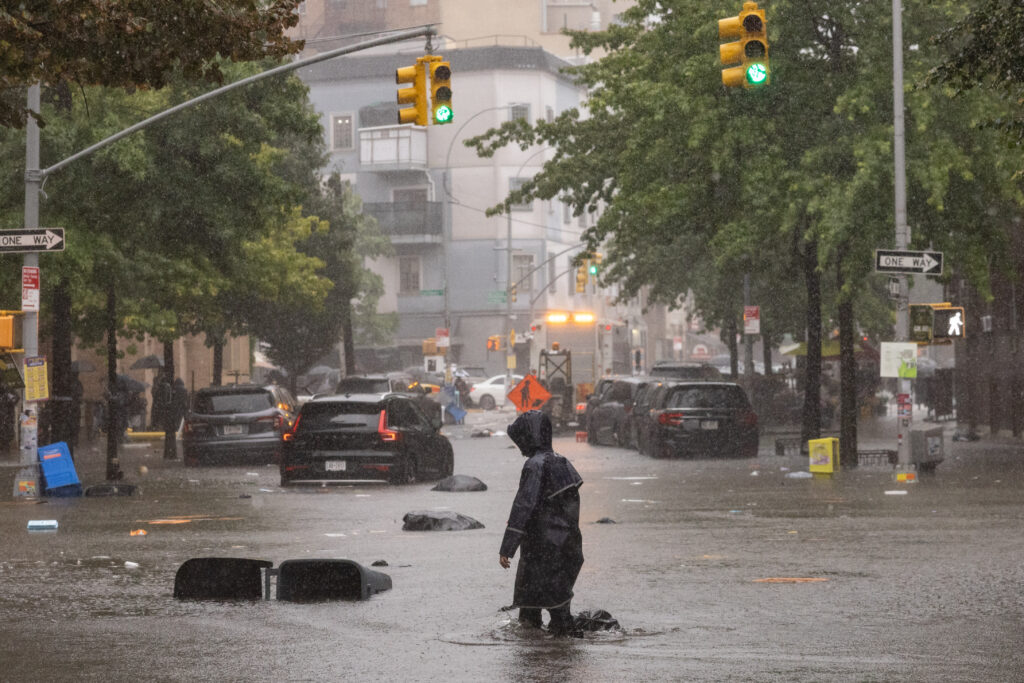
'Sponge Cities' Sound Great Until a Superstorm Shows Up and Laughs at Their Best Efforts
Cities worldwide are turning into sponges to fight flooding, but climate change keeps making storms so extreme that even the best soggy infrastructure might not cut it.
In 2011, a cloudburst dumped over 5 inches of rain on Copenhagen in a single day, causing more than $1 billion in damages and catalyzing a transformation that turned the Danish capital into a giant sponge. Officials spent the next decade installing a matrix of green spaces and engineered stormwater infrastructure designed to soak up future floods, inspiring cities from Hong Kong to New York to adopt similar "Sponge City" approaches. But as the movement spreads worldwide, experts say major challenges are keeping cities from reaching their full absorptive potential - and global warming is giving rise to wetter storms and more severe droughts that push nature's absorbent abilities to the brink.
Urban landscapes, with their sprawling skyscrapers and busy highways, are notorious for flooding because materials like concrete and asphalt are mostly impermeable, wicking water into streets or storm drains. Franco Montalto, a civil engineer at Drexel University, explained that "we superimposed what we wanted onto the landscape … and then by doing that, we essentially sealed the surface." These drainage systems, he noted, were not built to withstand the increasingly severe rainfall brought by climate change. In New York City, roughly 60 percent of sewers are part of a centuries-old combined system where stormwater and sewage share pipes, so extreme rain events often trigger sewage overflows into key waterways - a fact this reporter has personally experienced (and smelled).
The Big Apple and other American cities have spent billions installing rain gardens, green roofs, constructed wetlands, and other stormwater-control measures. In Los Angeles, green spaces and porous basins helped soak up 8.6 billion gallons of water during an atmospheric river in 2024. But Montalto argues that these efforts remain more of a patchwork than a network in the U.S., saying, "Yes, we have a lot of green infrastructure, but that green infrastructure is not designed, cited, scaled [and] implemented in a way that helps us to reduce flood risks from the extreme events." Retrofitting existing city infrastructure is costly and difficult, while China - where the sponge city movement took off after President Xi Jinping endorsed it about a decade ago - has seen more success by integrating such efforts earlier in urbanization.
Meanwhile, climate change is making things worse. A study published in May forecasts that annual rainfall in much of the world will condense: more rain falling in heavy storms faster than the land can absorb it, which actually dries out the land overall. Prolonged droughts can also kill organic matter and dry out soils enough to make them hydrophobic, repelling water instead of soaking it in. In 2021, China's Zhengzhou - which invested billions in sponge city elements - was overwhelmed by the heaviest rainfall in its recorded history, with more than a year's worth of rain in a few days. Experts told Reuters that no level of green infrastructure in the developed area could have handled that storm. Climate scientist Justin Mankin of Dartmouth College, a co-author of the May study, noted, "There's kind of a sweet spot, like you want your soils to be a little bit wet."
Still, Boise State University climate scientist Jen Pierce stressed that increasing tree cover and vegetated areas in cities has multiple benefits: improving mental health, cleaning waterways, and absorbing climate-warming carbon. Even in severe storms, green spaces outperform impermeable cement or asphalt. As she put it, "If you've already paved paradise and put in a parking lot, then you really don't have many options."
The Good Times
News in your inbox.
One sardonic roundup, delivered on your schedule. Free. Unsubscribe whenever your tolerance for wit runs out.
Already subscribed but we never reach your inbox? Check your spam folder and hit 'Not spam' (or 'Remove from spam') to bust us out of junk-mail purgatory. You'll be helping everyone else too.
Don't open any of our emails for a month and you'll be automatically removed from the mailing list.
Rewrite Article
Select parts to regenerate with a fresh AI pass. Translations will be updated automatically.
Generate AI Image
Creates a sardonic version of the article image using OpenAI.