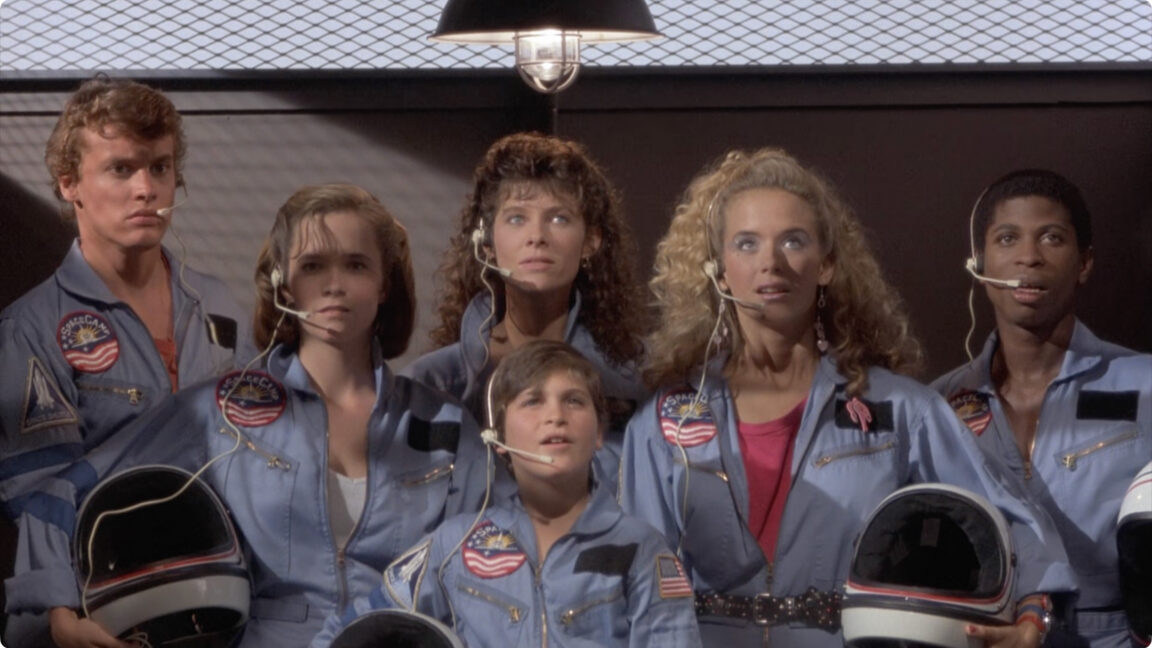
SpaceCamp at 40: The Movie That Launched Five Kids Into Orbit (and One Robot Into Our Hearts)
Forty years after Challenger, we revisit the film that dared to launch five kids into orbit via a rogue robot - and somehow made space camp look like a reasonable career choice.
Forty years ago, the future was supposedly just around the corner, and NASA's Space Shuttle was the vehicle meant to take us there. The fully reusable dream machine was supposed to make monthly - even weekly - trips to low Earth orbit, transform spaceflight from extraordinary to mundane, and perhaps blast Big Bird into space. Then Challenger exploded in January 1986, carrying teacher Christa McAuliffe, and all those dreams went up with it.
Into that post-Challenger gloom of summer 1986, Hollywood delivered SpaceCamp - a film completed before the disaster that left 20th Century Fox with a nightmare choice: shelve it and lose millions, or release it and risk a PR catastrophe. Fox chose the latter, and the movie made about $9.6 million on a reported $25 million budget. Ouch. Audiences, it turned out, weren't clamoring to watch kids in peril on a space shuttle. Today, it's mostly remembered with derision by geeks of a certain age: Kids! Robots! Thermal curtain failures! Preposterous!
But is it actually a bad movie? Senior Space Editor Eric Berger and I grabbed the DVD to find out. Lee: "It's been about 18 hours since we watched SpaceCamp, which is maybe just a bit longer than the kids spent in orbit. What did you think? Are we tearing it apart or praising it?" Eric: "We are bearing witness to it, I think. As a 53-year-old who has written about space for decades, the movie was clearly not made for me. But for what it was - an '80s dramedy aimed at kids and teens - it did an admirable job of engaging its audience and building interest in the space program."
Lee: "I damn near wore the VHS tape out as a kid. It held up better than I expected. There's epic levels of cheese, but a lot of love went into this movie. For every huge detail they get wrong - like why the shuttle keeps shaking after MECO - there are countless minor details they nail: cockpit switch positions, authentic patches, terminology. This was not a B-movie." Eric: "There were cringeworthy misses too. A reference to a '180×33' orbit? That's not stable. At perigee of 33 miles, the shuttle would experience serious atmospheric braking and meet a bad end. But the cast - a mix of established actors and young up-and-comers like a 12-year-old Joaquin Phoenix - shows this was a serious effort with poor timing."
Lee: "Poor timing is the understatement of the century. SpaceCamp debuted June 6, 1986, barely four months after Challenger. A movie about a space near-disaster arriving so soon after an actual disaster was box office poison. The plot: five kids and a rookie astronaut accidentally launched into space when a routine main engine test of Atlantis goes sideways - thanks to Joaquin Phoenix's robot friend Jinx, a spherical maintenance bot apparently exhibiting full AGI in 1986 with unrestricted access to the entire space center. Jinx conspires with the all-powerful NASA mainframe to arrange a 'THERMAL CURTAIN FAILURE,' and just like that, kids are in orbit."
Eric: "NASA did perform Flight Readiness Firings - igniting the main engines on the pad for about 20 seconds - in the early shuttle days. Astronauts were typically on board, so that part is plausible. But campers never would have been allowed near the vehicle, let alone on board during a dynamic test. And don't get me started on 'thermal curtain failure.' The solid rocket boosters were never ignited during such a test, and I can't see how one could be ignited."
Lee: "What's striking is the movie's long shelf life despite its poor timing. It came out only four years after the actual Space Camp opened in Huntsville, and I've spoken with space enthusiasts who watched it and then signed up for a week in Alabama. The film helped fuel interest in human spaceflight during the late '80s and '90s when not much exciting was happening. It also correctly anticipated NASA having a large space station called Daedalus - nearly a decade and a half before one existed - with a truss design featuring so much metal for no apparent purpose other than serving the plot."
Eric: "The climax involves Lea Thompson's character Kathryn Fairly, who struggles to fly the shuttle during reentry and must learn to rely on teammates. It's screenwriting 101: if we see the multi-axis trainer on the mantlepiece in Act 1, it's going to shoot someone by Act 3. Contrived, silly, unrealistic, but genre-appropriate. This movie wasn't for the two old farts who can quote shuttle abort modes - it was for the kid who positively knew he could do a better job in space than Phoenix's Star Wars-obsessed Max, if only given the chance."
Lee: "The movie has giant gaping faults, but it's trying to condense real spaceflight concepts into forms understandable by viewers who can't tell an AJ10-190 from an RS-25. Some glossing over is expected. Though I still don't like the autonomous AGI robot that can infiltrate NASA systems and launch shuttles at will. Seriously, someone would get fired over that."
The Good Times
News in your inbox.
One sardonic roundup, delivered on your schedule. Free. Unsubscribe whenever your tolerance for wit runs out.
Already subscribed but we never reach your inbox? Check your spam folder and hit 'Not spam' (or 'Remove from spam') to bust us out of junk-mail purgatory. You'll be helping everyone else too.
Don't open any of our emails for a month and you'll be automatically removed from the mailing list.
Rewrite Article
Select parts to regenerate with a fresh AI pass. Translations will be updated automatically.
Generate AI Image
Creates a sardonic version of the article image using OpenAI.