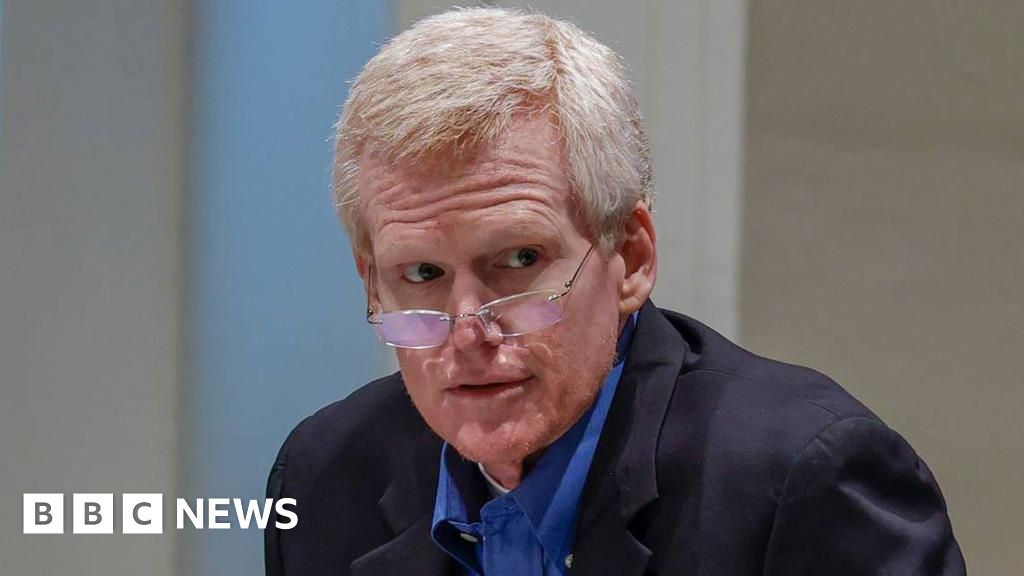
South Carolina Supreme Court Overturns Alex Murdaugh's Murder Convictions, Citing Clerk Who Allegedly Played 'Let's Influence a Jury'
South Carolina's highest court rules that a clerk who allegedly told jurors to 'watch Murdaugh closely' and later plagiarized a book about the trial did indeed mess things up enough to warrant a do-over.
In a development that has true-crime podcasters scrambling to update their episode notes, the South Carolina Supreme Court has overturned the 2023 murder convictions of Alex Murdaugh, the disgraced lawyer who was convicted of killing his wife and son. The state's highest court ruled unanimously on Wednesday that Murdaugh deserves a new trial for the June 2021 killings, because the local county clerk allegedly did more than just keep the coffee flowing.
Murdaugh, 56, has been serving two life sentences for the murders of Maggie and Paul Murdaugh, plus an additional 27 and 40 years for state and federal financial crimes - because apparently, when you're already in prison for life, why not add a few more decades for good measure? His legal saga, which inspired documentaries, podcasts, and book deals, captivated a global audience, making him the rare lawyer who became more famous for being a defendant than a biller.
In a 5-0 ruling, the justices said Murdaugh's right to a fair trial was compromised by Colleton County Clerk of Court Rebecca Hill, who allegedly placed her fingers on the scales of justice - and not in a helpful, balancing sort of way. "Both the State and Murdaugh's defense skillfully presented their cases to the jury as the trial court deftly presided over this complicated and high-profile matter," the justices wrote. "However, their efforts were in vain because Colleton County Clerk of Court Rebecca Hill placed her fingers on the scales of justice, thereby denying Murdaugh his right to a fair trial by an impartial jury."
South Carolina Attorney General Alan Wilson, presumably not thrilled about having to redo this whole thing, said his office would "aggressively seek to retry Alex Murdaugh for the murders of Maggie and Paul as soon as possible." Murdaugh's lawyers, meanwhile, told US media that their client "has said from day one that he did not kill his wife and son" - a claim that, until now, had not exactly been winning over the jury pool.
The ruling cites a series of comments Hill allegedly made to jurors during the trial. One juror wrote in an affidavit that Hill told them to "watch [Murdaugh] closely," which the juror said influenced her guilty verdict because she thought the clerk was implying he was guilty. Because nothing says "impartial juror" like a court official giving you a subtle wink and nod.
The jury had found Murdaugh guilty after a six-week trial that included testimony about his drug addiction, financial crimes, and the murders themselves - which involved shooting his wife and son at close range near the family's dog kennels. In their bid for a new trial, Murdaugh's lawyers argued that Hill tampered with the jury, telling them not to trust his testimony and to speed up the verdict. Jurors also said Hill told them during deliberations: "[T]his shouldn't take us long." Which, as jury instructions go, is not exactly the standard "consider all the evidence" approach.
A few months after the trial, Hill published a tell-all book called "Behind the Doors of Justice: The Murdaugh Murders." The justices noted that the book was pulled from publication because Hill plagiarized portions of it. "As her book's title suggests, it turns out Hill was quite busy behind the doors of justice, thwarting the integrity of the justice system she was sworn to protect and uphold," the justices wrote. Hill denied making most of the comments, though she admitted that on the day of Murdaugh's testimony, she told the jurors it was a "big day" - which, to be fair, is probably what she said about her book deal too.
The supreme court did not take up Murdaugh's financial crimes case, but said too much evidence from that case was allowed in his murder trial, creating "considerable danger of unfair prejudice." A new trial date has yet to be set, but legal experts say jury selection in such a high-profile case will be an uphill battle. "It will be the rare juror that knows nothing about the case," said New York Law School professor Anna Cominsky. "Rather they will be looking for jurors that can contain their analysis to only the evidence in front of them during the new trial." In other words, good luck finding 12 people who haven't already watched the Netflix documentary.
The Good Times
News in your inbox.
One sardonic roundup, delivered on your schedule. Free. Unsubscribe whenever your tolerance for wit runs out.
Already subscribed but we never reach your inbox? Check your spam folder and hit 'Not spam' (or 'Remove from spam') to bust us out of junk-mail purgatory. You'll be helping everyone else too.
Don't open any of our emails for a month and you'll be automatically removed from the mailing list.
Rewrite Article
Select parts to regenerate with a fresh AI pass. Translations will be updated automatically.
Generate AI Image
Creates a sardonic version of the article image using OpenAI.