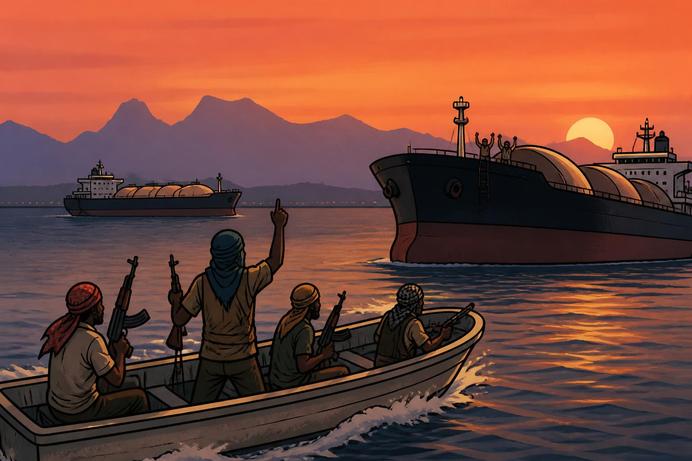
Somali pirates have hijacked an oil tanker off the coast of Yemen, according to multiple Somali security officials who spoke with the BBC, proving that old habits die hard - especially when there's oil involved.
The Yemeni coastguard earlier said the tanker MT Eureka had been hijacked and was headed towards Somalia. Sources said it was overrun by pirates in the Gulf of Aden, near the port of Qana. The pirates departed a remote coastal area near the seaside town of Qandala, which sits on the Gulf of Aden, according to three separate security officials from the semi-autonomous Puntland region who spoke with the BBC.
This marks the second hijacking of an oil tanker in the area in a 10-day period, following the hijacking of Honor 25 by Somali pirates on April 22. Honor 25 was carrying 18,500 barrels of oil bound for Mogadishu - because nothing says "we're back" like a repeat performance.
MT Eureka was sailing under the flag of the west African nation of Togo prior to the hijacking and was overrun by the gunmen at 5:00 AM local time (03:00 BST) this morning, the security official told the BBC. It is now sailing in the Gulf of Aden between Yemen and Somalia, and is expected to anchor in Somali waters in the coming hours - presumably to drop off the guests of honor.
In a separate incident, the United Kingdom Maritime Transportation Operation (UKMTO) reported on Friday that "armed persons" on a "skiff" approached a bulk carrier near Al-Mukala, Yemen. Those armed persons departed a remote coastal area near the fishing town of Caluula (Alula), according to three separate security officials. Caluula is 209km (130 miles) from where hijackers departed to seize the MT Eureka, suggesting the pirates are either getting more ambitious or just enjoy the scenic route.
The two separate incidents indicate piracy is expanding across Somalia's vast coastline, which is the longest in mainland Africa at 3,333km (2071 miles). Today's hijacking marks the fourth successful pirate hijacking in two weeks - a rate that would make even the most prolific film franchise jealous.
Somali authorities and the European Union Naval Force (EUNAVFOR), which oversees anti-piracy operations in Somali waters, are yet to address the latest hijacking. Perhaps they're busy drafting a strongly worded letter.
Somali piracy, which was on the decline since 2011, has surged again since late 2023, when Houthi rebels began attacking ships in the Gulf of Aden and Red Sea. The attacks forced international navies to instead tackle the Houthi threat, thus allowing armed groups on the Somali coast to take advantage of the security lapse - a textbook case of "when the cat's away, the mice will play... with oil tankers."
"The on-going crisis with the pirates is much worse than many realize. There are increasing movements (of armed groups) all over the coast," a security official from the semi-autonomous Puntland region told the BBC, presumably while shaking their head.
The Good Times
News in your inbox.
One sardonic roundup, delivered on your schedule. Free. Unsubscribe whenever your tolerance for wit runs out.
Already subscribed but we never reach your inbox? Check your spam folder and hit 'Not spam' (or 'Remove from spam') to bust us out of junk-mail purgatory. You'll be helping everyone else too.
Don't open any of our emails for a month and you'll be automatically removed from the mailing list.
Rewrite Article
Select parts to regenerate with a fresh AI pass. Translations will be updated automatically.
Generate AI Image
Creates a sardonic version of the article image using OpenAI.