Astronomers Finally Solve 50-Year-Old X-Ray Mystery, Blame Unseen Star for Being a Hungry Little Jerk
After 50 years of cosmic whodunit, astronomers used XRISM to catch a white dwarf red-handed, stealing gas from gamma-Cas and belching X-rays. Mystery solved, universe.
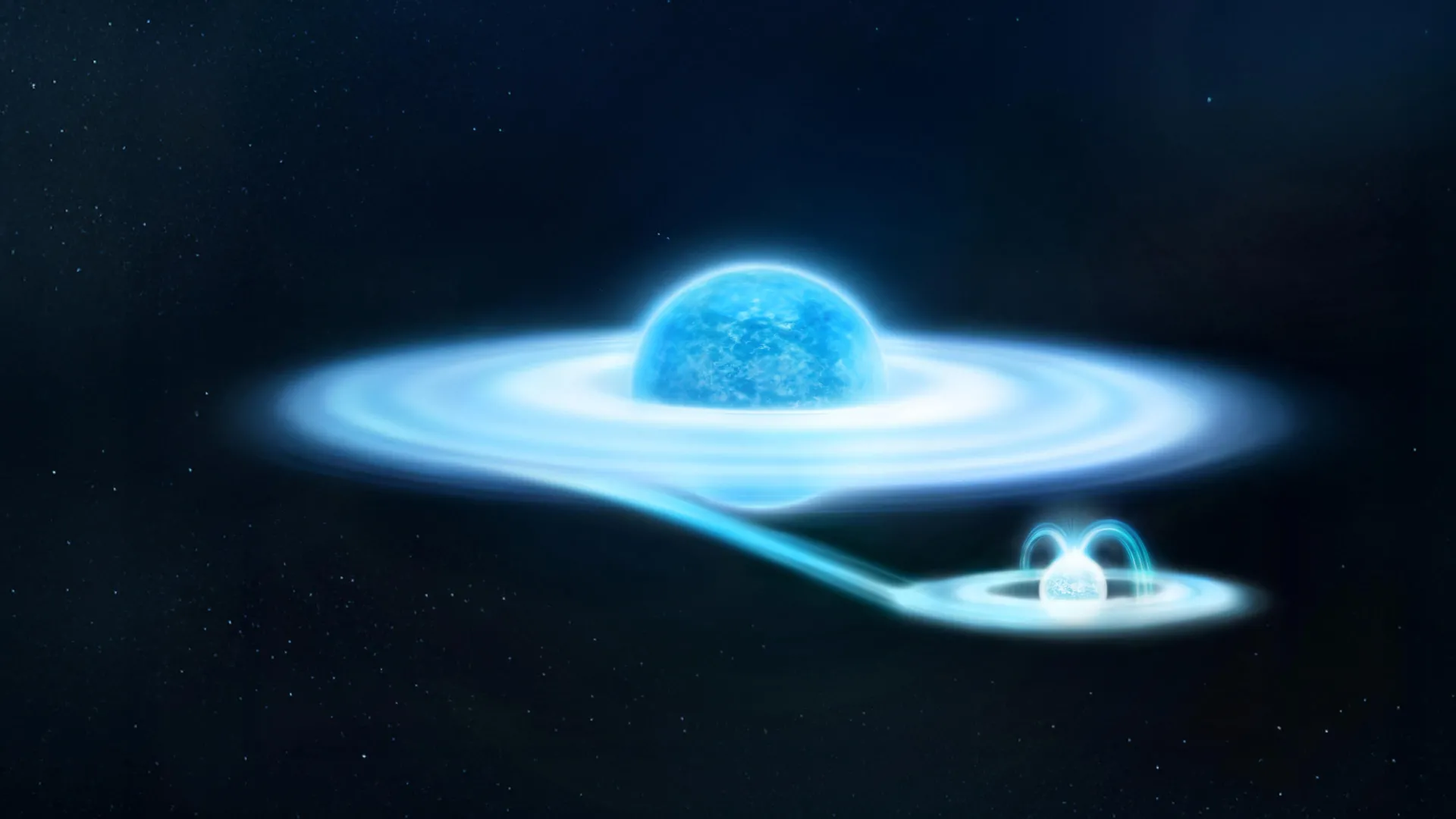
After half a century of head-scratching, astronomers have finally pinned down the source of the unusual X-rays coming from the bright star gamma-Cas. The culprit? An unseen companion star that's been sneakily hoovering up material from its larger neighbor. Basically, it's the cosmic equivalent of someone snitching the last slice of pizza.
New high-resolution data from the X-Ray Imaging and Spectroscopy Mission (XRISM) revealed that the X-rays are tied to the orbit of a nearby white dwarf star. By tracking this motion, researchers led by Yaël Nazé of the University of Liège, Belgium, confirmed the true origin of the emissions. "There has been an intense effort to solve the mystery of gamma-Cas across many research groups for many decades," says Nazé. "And now, thanks to the high-precision observations of XRISM, we have finally done it."
Gamma-Cas, which forms the central point of the familiar W-shaped constellation Cassiopeia and can be seen with the naked eye across Europe, has been a troublemaker since 1866. That's when Italian astronomer Angelo Secchi noticed its light had a bright hydrogen line instead of the dark one seen in the Sun. This led to the creation of a new category: 'Be' stars, for hot, blue-white stars with distinctive emission lines. Eventually, scientists figured out those emissions come from a spinning disc of material thrown off by the rapidly rotating star, which grows and fades over time.
In the 1970s, gamma-Cas was found to emit unusually strong X-rays from plasma reaching about 150 million degrees - far hotter and brighter than expected. Using advanced observatories like ESA's XMM-Newton, NASA's Chandra, and Germany's eROSITA, astronomers identified about two dozen similar systems. For years, two theories battled it out: magnetic interactions between the star and its disc, or material falling onto a hidden companion. XRISM's spectrometer Resolve settled the debate, showing the hot plasma moves in step with the unseen companion's orbit. That confirms the white dwarf is pulling in matter and generating X-rays as it heats up.
"The previous work using XMM-Newton really cleared the way for XRISM," says Nazé. "It's extremely satisfying to have direct evidence to solve this mystery at long last!" Identifying gamma-Cas systems as pairs of Be stars and accreting white dwarfs answers the X-ray question but raises new ones about how these binary systems form. Scientists once thought such pairings were common, but recent findings suggest they're less frequent and more often associated with massive Be stars. "Now that we know the true nature of gamma-Cas, we can create models specifically for this class of stellar systems," Nazé adds.
"It's incredible to see how this mystery has slowly unfolded over the years," says Alice Borghese, an ESA Research Fellow. "XMM-Newton did so much of the groundwork… and now with the next generation of advanced instrumentation, XRISM has brought us over the finish line." Matteo Guainazzi, ESA's XRISM Project Scientist, notes the strong collaboration between Japanese, European, and American teams. Materials provided by the European Space Agency.
The Good Times
News in your inbox.
One sardonic roundup, delivered on your schedule. Free. Unsubscribe whenever your tolerance for wit runs out.
Already subscribed but we never reach your inbox? Check your spam folder and hit 'Not spam' (or 'Remove from spam') to bust us out of junk-mail purgatory. You'll be helping everyone else too.
Don't open any of our emails for a month and you'll be automatically removed from the mailing list.
Rewrite Article
Select parts to regenerate with a fresh AI pass. Translations will be updated automatically.
Generate AI Image
Creates a sardonic version of the article image using OpenAI.