Oregon Locals Attempt Improbably Dangerous Whale Rescue; Whale Experts Show Up With Clipboards
A viral Facebook plea brings a ragtag crew of civilians to push a beached humpback whale back to sea. The experts arrive with cones, tape, and bad news.
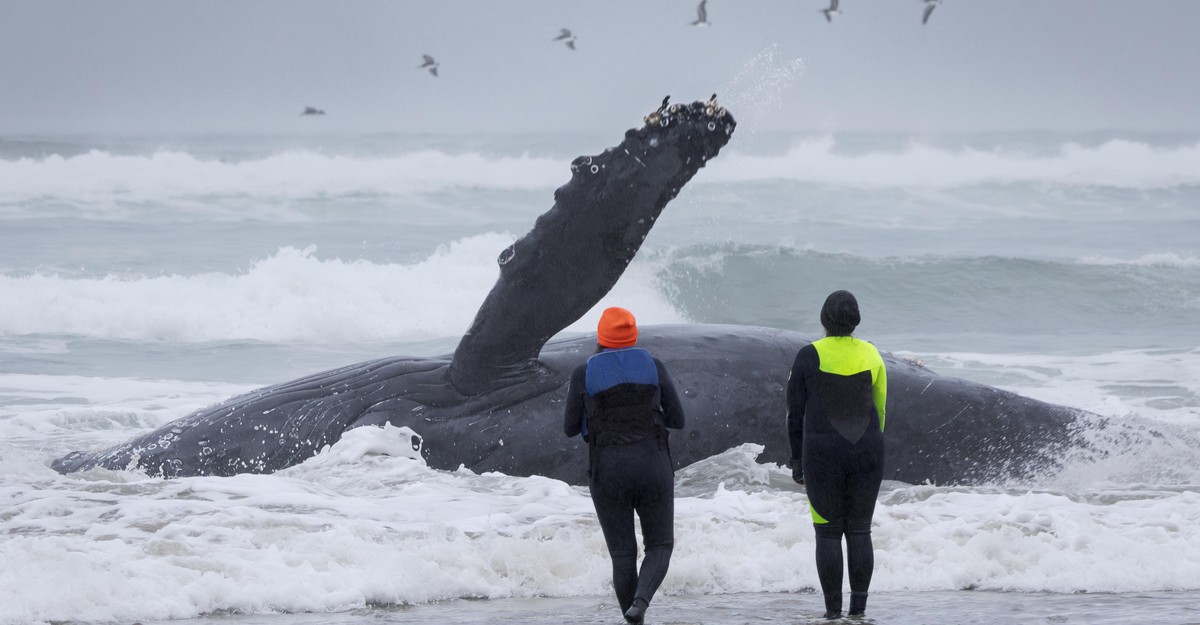
In a story that combines plucky community spirit with a sobering dose of reality, a juvenile humpback whale beached itself near Yachats, Oregon, in November, sparking a chaotic, all-night rescue effort by locals who apparently didn't get the memo that whales are very large and rescue is very hard.
The whale, entangled in crabbing gear, was spotted thrashing offshore before washing up. One heroic local actually swam out and cut it free, but the whale, perhaps overwhelmed by gratitude, failed to swim away. As darkness fell and experts from the Oregon Marine Mammal Stranding Network decided to wait until morning, resident Amy Parker took to Facebook with grainy photos and a plea that went viral. "He's alive he's crying out," she wrote, inadvertently summoning a small army of well-meaning civilians to the beach.
Rob Heater, a 62-year-old retired contractor with waist-length gray hair, closed his escape room, loaded his German shepherd, and drove 20 miles to join the fray. For hours, he and about six others pushed against the 26-foot, 80,000-pound whale in waist-high water, unsure if they were moving the animal or just themselves. A bucket brigade formed to keep the whale wet. Someone built a fire. Another person watched the valuables. One woman sat quietly nearby, interpreting the whale's vocalizations as "thank you" purrs. It was, by all accounts, a very Oregonian scene.
When the actual experts arrived the next morning, they promptly set up a perimeter of cones and tape, which the locals found about as helpful as a blowhole full of sand. Jim Rice, the stranding network program manager, was stuck in Berkeley and could only watch in horror as civilians tried to refloat a creature the size of an RV between two King Tide events. "Well-meaning people had almost no shot," he later noted, which is science-speak for "please don't do this."
A certified rescuer, John Calambokidis, eventually arrived with a pulley system, only to have his ropes go missing, his anchors get covered by rising tides, and his release mechanism break. The rope then also broke. After two days on land, the whale's internal organs were likely crushed by its own blubber, making euthanasia the only option. Online, the response turned predictably ugly, with one Facebook user vowing to "wipe my ass with your degree."
In a bittersweet coda, the Confederated Tribes of the Siletz Indians conducted a prayer ceremony, harvested the whale for meat, blubber, and bones - the first such harvest in a generation - and then a tribe member carved a piece of the whale's heart into a pendant for Heater. So at least the whale wasn't blown up with dynamite, which, as Oregonians will recall, is how they handled the last one.
The Good Times
News in your inbox.
One sardonic roundup, delivered on your schedule. Free. Unsubscribe whenever your tolerance for wit runs out.
Already subscribed but we never reach your inbox? Check your spam folder and hit 'Not spam' (or 'Remove from spam') to bust us out of junk-mail purgatory. You'll be helping everyone else too.
Don't open any of our emails for a month and you'll be automatically removed from the mailing list.
Rewrite Article
Select parts to regenerate with a fresh AI pass. Translations will be updated automatically.
Generate AI Image
Creates a sardonic version of the article image using OpenAI.