
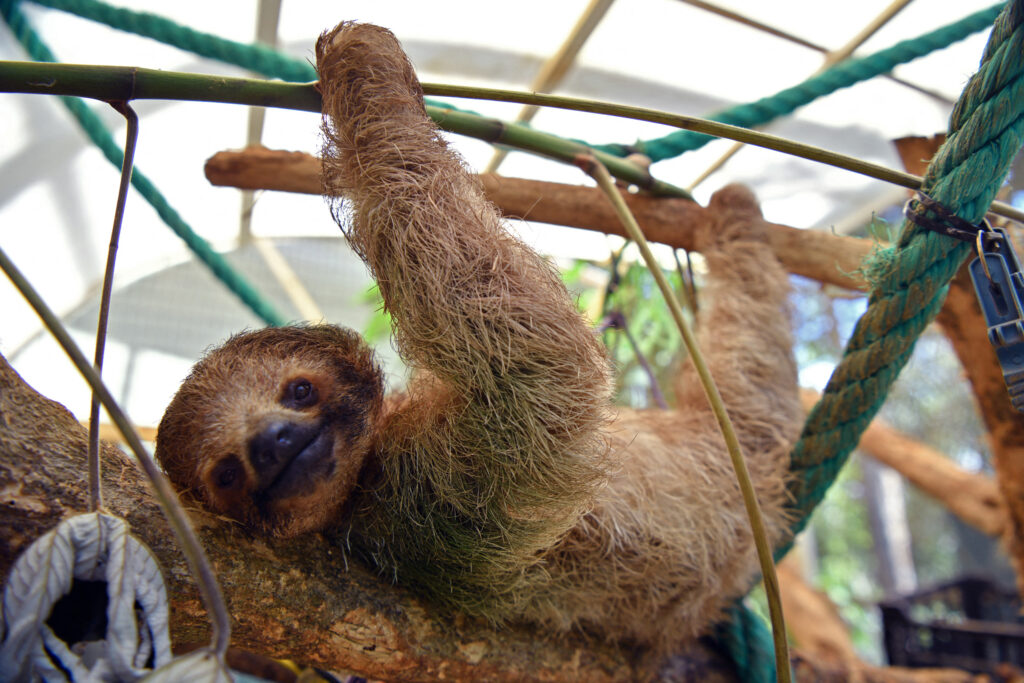
An exotic animal exhibitor whose sloth-encounter business was shut down by New York courts is trying to relaunch in Florida, a state currently dealing with its own sloth-related existential crisis after dozens of the animals died at a different attraction.
Government inspectors repeatedly found problems at Larry Wallach’s earlier businesses, including unsafe and unsanitary conditions for his sloths, kangaroos, tigers and capybaras, according to federal and state records obtained by Inside Climate News. He kept his Long Island sloth business running for more than a year after a 2023 court order to close due to zoning violations, and the federal government declined to issue him a new wildlife-exhibition license in 2024.
Now, Wallach has filed paperwork in Florida to open Wildlife Adventures, a pet store and encounter business featuring sloths, kangaroos, reptiles and birds. He told Inside Climate News on Sunday that he expects to open in two weeks. To animal law experts and welfare groups, this attempted comeback highlights broader oversight failures: weak laws and limited enforcement allow repeat offenders to keep acquiring animals, profiting from them, and violating the law.
Wallach - clutching a live sloth - appeared last month before the Margate City Commission, 25 miles north of Miami, to pitch the business. “I’ve been raising animals since I was like 15 - tigers, bears, lions, everything,” he said. “But my real love is for sloths, and I’m looking to open up a store in Margate that would almost be very, very educational.” Scientists, meanwhile, note that sloths - tree-dwelling mammals from South American rainforests - are extremely ill-suited to captivity.
Wallach’s proposal comes as Florida officials scrutinize the commercial sloth trade after an Inside Climate News investigation in April into Sloth World, a separate planned attraction that imported dozens of sloths from Peru and Guyana. More than 50 of those animals died. In May, state officials temporarily halted sloth imports and said they were pursuing a criminal investigation. Wallach was not involved in that business. He said he has owned 11 sloths and conducted between 25,000 and 30,000 public encounters in New York, and would like to acquire more to have about 20 at his new business.
He asserted all his sloths are captive-bred, not imported from the wild, and declined to provide breeder names or origin verification. State import records list Wallach as the recipient of two sloths brought into Florida in August 2025. He said those sloths came from another U.S. state. The Florida Fish and Wildlife Conservation Commission did not respond to multiple requests for clarification but said it approved Wallach’s state license to display wildlife to the public. The agency said it is “aware of Wallach’s history” and “FWC investigators continue to monitor the situation actively,” adding that any violations will be investigated immediately.
Exotic animal exhibitors must also get federal approval and are routinely inspected by the USDA. The USDA told Inside Climate News that Wallach no longer has a federal license after denying his 2024 application based on an Animal Welfare Act regulation that requires denial to applicants who have made false statements, violated the law, entered a no-contest plea, or “is otherwise unfit to be licensed.” Harold Somer, one of Wallach’s attorneys, said the denial was based on “unverified and incorrect information fed to it by others.” Wallach said he is now applying for another federal license and expects to get it.
Wallach has been in the exotic animal business for decades, from a traveling menagerie to an Ohio mall storefront featuring tigers and big cats. He opened his Long Island “Sloth Encounters” store in 2022. Throughout, he has accrued dozens of infractions in USDA inspection reports, some considered serious. Somer said his client appealed some reports but was denied, adding that “at no time while I have known Larry was he ever charged with animal cruelty by any government agency.”
In interviews, Wallach described himself as a hands-on educator contending that USDA reports have been misrepresented and enforcement standards vary. “I can look at a sloth by its coat and tell you what it’s lacking,” he said. He pointed to past licenses as evidence of compliance and blamed animal welfare groups for his regulatory issues. “They can make me look like this piece of shit,” he said. “They think they’re going to just run me down. They’re very mistaken, they don’t know how deep our pockets are. … I happen to be a really good animal person.”
Under U.S. law, animals are generally treated as property, leaving their welfare dependent on a patchwork of laws. The Animal Welfare Act sets minimum standards, but animal welfare experts say the USDA has a multi-decade history of failing to enforce it adequately. The USDA’s own watchdog has repeatedly underscored those concerns, most recently finding that limited staffing and resources hinder enforcement. As of March last year, the USDA had just 115 inspectors and supervisors overseeing more than 12,000 regulated entities. Between March 2025 and April 2026, its Animal and Plant Health Inspection Service lost about 21 percent of its staff. A USDA spokesperson said the agency is “actively hiring.”
Delcianna Winders, director of the Animal Law and Policy Institute at Vermont Law and Graduate School, said Wallach’s history mirrors the agency’s shortcomings. “He is someone who has openly defied the law, who has thumbed his nose at the USDA, and they’ve never taken meaningful action,” she said. Winders argued the USDA should treat Wallach’s ongoing exhibiting without a federal license as a clear violation, refuse to relicense him, and refer his case to prosecutors. The USDA is legally required to refer serious cases to the Department of Justice, but Winders said that mandate is disregarded and the Justice Department’s capacity for animal welfare cases has dwindled. A USDA spokesperson said the agency uses enforcement actions such as warnings, monetary penalties, suspensions, and revocations. Wallach described prosecution as outlandish and said “animal rights people just create havoc.” He contended he can exhibit under other people’s licenses; the USDA declined to clarify.
USDA inspection reports flagging problems accumulated for years before regulators temporarily suspended his license in 2013. Problems continued after reinstatement, leading to an “official warning” in 2024 for mishandling animals. As far back as 2003, inspectors reported animals stored in unsafe conditions at Wallach’s then-home in East Rockaway, New York, where tigers, lions, bears, and other exotics were kept in his garage and back porch, with no documentation tracking acquisitions or sales. Wallach said fencing at his former home complied with USDA requirements until the agency changed regulations, and he typically addressed issues the same day.
Federal officials detailed public safety hazards such as displaying a juvenile tiger in an open-top, unlocked enclosure during a 2008 public exhibition in South Carolina, where the public could lean in and handle the tethered animal’s head and neck. In 2010, one of Wallach’s tigers “was observed to be visibly upset and exhibited stress and discomfort by crying, and rubbing its body against the cage’s sides, and the tiger was observed to continue to have lesions on its nose from abrading against the enclosure wire,” according to court records. Asked about this, Wallach said a tiger rubbing against fencing is not upset: “That’s a tiger that’s happy and just like scratching his own body.”
Denise Flores worked for Wallach at his Ohio mall storefront in the early 2000s, where shoppers could have photos taken with tigers and other animals. She described a high-volume business model with animals on display throughout mall operating hours with little or no breaks.